01. Historical Context
2030 is long enough for backlog to matter, but not long enough to ignore execution
Airbus has already compounded at about 14.0% a year over the last decade on an adjusted basis, rising from roughly EUR 45.16 to EUR 167.68. That history matters because it shows Airbus can create substantial shareholder value over full cycles, but it also shows that the stock tends to move in steps around major delivery, supply-chain, and cash-flow inflection points.
| Horizon | What matters most | What would strengthen the thesis | What would weaken the thesis |
|---|---|---|---|
| 1-3 months | Guidance credibility and delivery pace | 2026 results stay consistent with the 870-delivery target | Fresh supply-chain setbacks |
| 6-18 months | Ramp execution and margin protection | A320 progress and better free-cash-flow conversion | More backlog without enough profit conversion |
| To 2030 | Structural monetization of demand | Higher output, stable margins, and stronger services mix | Persistent execution friction and multiple compression |
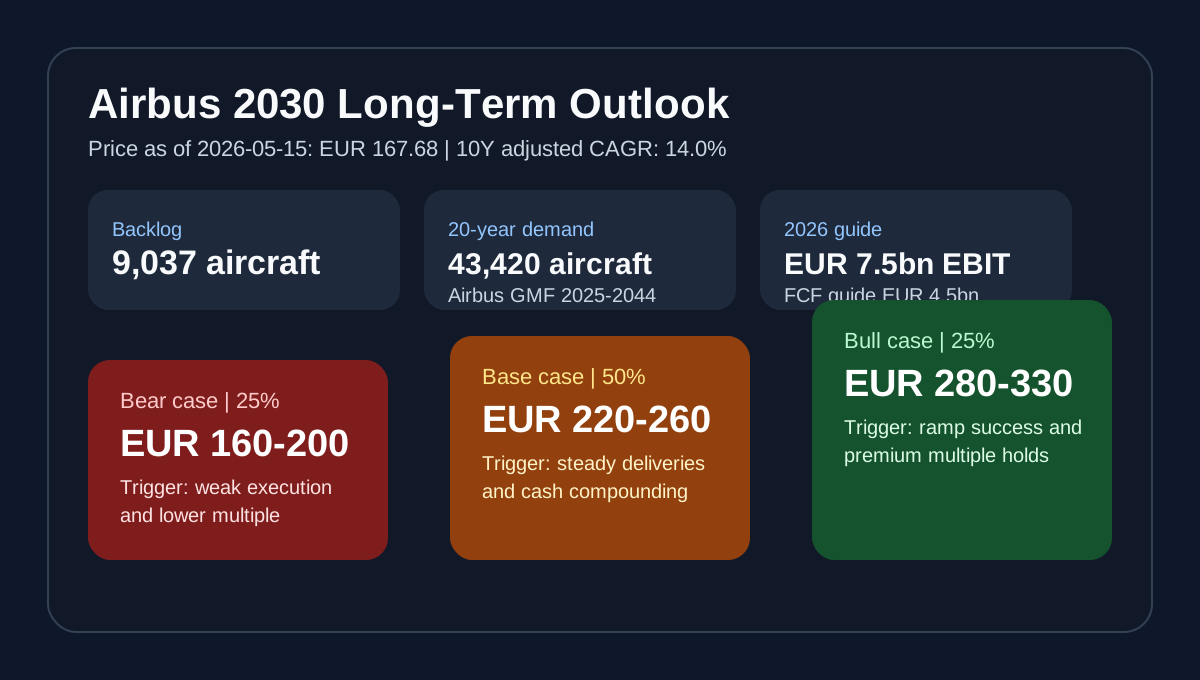
Two official data points define the setup. First, Airbus ended March 2026 with a commercial aircraft backlog of 9,037 aircraft. Second, Airbus's 2025 Global Market Forecast projected demand for 43,420 new aircraft over 2025-2044. The 2030 thesis therefore starts from unusually strong demand visibility.
The harder question is valuation discipline. At around 28.4x trailing earnings and 25.0x forward earnings in May 2026, Airbus is not a cheap cyclical. By 2030, the stock can still outperform if earnings expand faster than the multiple contracts, but that requires several years of reliable execution.
02. Key Forces
The 2030 case rests on volume, margins, and cash flow compounding together
The strongest argument for Airbus is demand visibility. Airlines still need fuel-efficient fleet replacement, air traffic remains on a long-term expansion path, and Airbus continues to hold a very large order book. The structural case is real.
The second argument is operational leverage. If Airbus can convert the A320-family ramp into higher annual deliveries while keeping pricing, supplier discipline, and working-capital intensity under control, 2030 earnings power can expand materially from today's EUR 6.32 trailing EPS base. Even a disciplined market could then support meaningfully higher price levels.
| Factor | Latest evidence | Why it matters | Current assessment | Bias |
|---|---|---|---|---|
| Demand visibility | 9,037-aircraft backlog; 43,420-aircraft market forecast to 2044 | Supports multi-year revenue visibility | Demand backdrop is unusually strong for an industrial | Bullish |
| Production ramp | A320-family target of 70-75 per month by end-2027 | Creates the bridge from backlog to earnings growth | Achievable, but still exposed to suppliers and engines | Neutral |
| Profit quality | FY2025 EBIT Adjusted EUR 7.1 billion; FY2026 guide EUR 7.5 billion | Determines whether growth is genuinely accretive | Positive, but not yet at a level that eliminates execution risk | Neutral to Bullish |
| Cash conversion | FY2025 free cash flow before customer financing EUR 4.6 billion; Q1 2026 negative EUR 2.5 billion | Separates accounting progress from actual value creation | Healthy on a full-year basis, but lumpy | Neutral |
| Valuation | About 25.0x forward earnings in May 2026 | 2030 returns depend partly on how much of today's optimism is already priced | Premium valuation, but not extreme if execution improves | Neutral |
The central 2030 debate is whether Airbus becomes a higher-quality compounder or remains a good business that periodically trades like a constrained industrial. The answer depends less on demand and more on execution consistency.
03. Countercase
The long-term thesis can still disappoint if the ramp stays messy
The cleanest bearish argument is not about demand destruction. It is about operational drag. If the company spends several more years fighting engines, suppliers, and working-capital swings, the market may keep treating Airbus as a good franchise with unreliable short-cycle conversion, which would cap the valuation.
The second risk is that inflation and rates do not settle as smoothly as bulls expect. Euro area inflation moved back up to 3.0% in April 2026, and Q1 2026 GDP growth was only 0.1% quarter on quarter. If that mix persists, equity markets may keep rewarding near-certainty more than long-duration industrial execution stories.
The third risk is simple math. If Airbus reaches higher deliveries by 2030 but does so with weaker margin progression or heavier working-capital demands, earnings growth may underwhelm the size of the backlog headline.
| Risk | Current data | What would confirm it | Current read |
|---|---|---|---|
| Ramp slippage | End-2027 A320 target still depends on constrained suppliers | Another delay to planned output milestones | Moderate risk |
| Cash-flow disappointment | Q1 2026 free cash flow was negative EUR 2.5 billion | Repeated full-year misses versus cash guidance | Watch closely |
| Macro squeeze | 3.0% euro area inflation in April 2026 | Rates stay restrictive while growth remains soft | Manageable but relevant |
| De-rating | Forward P/E near 25x | Multiple falls without offsetting EPS growth | Real long-term risk |
The long-term bull case survives ordinary volatility. It does not survive years of missed operating conversion.
04. Institutional Lens
Official forecasts support the demand story, but not an automatic re-rating
Airbus's own data remain the most relevant institutional input. On April 28, 2026 the company reaffirmed 2026 guidance and said the backlog stood at 9,037 aircraft. That supports the idea that the medium-term revenue base is already spoken for to a large extent.
The longer-range structural signal comes from Airbus's Global Market Forecast, published June 11, 2025, which projected 43,420 new aircraft demand between 2025 and 2044. That scale of demand gives Airbus room to grow beyond 2027 if execution improves.
The macro backdrop is supportive but not euphoric. Eurostat's Q1 2026 GDP estimate showed only 0.1% quarter-on-quarter growth for the euro area, while its April 2026 flash estimate put inflation at 3.0%. The IMF's April 2026 Europe outlook projected euro area growth of 1.1% for 2026. That is enough to keep fleet demand intact, but not enough to justify assuming a wide margin of safety in valuation.
| Source | Update date | What it said | Why it matters here |
|---|---|---|---|
| Airbus Q1 2026 results | April 28, 2026 | Guidance unchanged; backlog at 9,037 aircraft | Demand is visible, so execution becomes the core issue |
| Airbus Global Market Forecast 2025-2044 | June 11, 2025 | 43,420 new aircraft demand forecast | Provides the structural foundation for the 2030 thesis |
| Eurostat | April 30 and May 2, 2026 | Q1 GDP up 0.1% qoq; April inflation 3.0% | Supports demand, but not a carefree valuation regime |
| IMF Europe REO | April 17, 2026 | Euro area growth forecast of 1.1% for 2026 | Suggests a positive but modest macro corridor |
The official data therefore support staying constructive on Airbus as a business. They do not support treating the stock as risk-free compounding at today's multiple.
05. Scenarios
A workable 2030 framework is range-based, not slogan-based
These 2030 ranges are analytical scenarios built from current valuation, trailing EPS, implied forward EPS, and what Airbus would need to do operationally to expand earnings through the end of the decade. They are not company targets.
| Scenario | Probability | Target range | Measured trigger | Review point |
|---|---|---|---|---|
| Bull | 25% | EUR 280-330 | The A320 ramp is achieved on time, cash flow expands with deliveries, and the market still awards Airbus a premium industrial multiple | Re-check after FY2027 and FY2028 results |
| Base | 50% | EUR 220-260 | Deliveries rise steadily, EBIT and cash flow compound, but valuation compresses moderately from today's level | Re-check annually, with the first major reset after FY2026 and FY2027 |
| Bear | 25% | EUR 160-200 | Operational friction persists, free-cash-flow conversion stays uneven, and the forward multiple normalizes toward lower-20s | Re-check if annual guidance is missed in two consecutive years |
The 2030 thesis is therefore still positive, but it is positive because backlog and replacement demand create a runway for earnings growth, not because the current valuation leaves obvious upside on its own.
For long-term investors, the highest-value checkpoints are FY2026 delivery conversion, FY2027 ramp credibility, and whether cash flow continues to scale with output rather than trail it.
References
Sources
- Yahoo Finance quote page for Airbus (AIR.PA)
- Yahoo Finance 10-year chart data for Airbus (AIR.PA)
- Airbus Q1 2026 results, published April 28, 2026
- Airbus full-year 2025 results, published February 19, 2026
- Airbus Global Market Forecast 2025-2044, published June 11, 2025
- Eurostat flash GDP estimate for Q1 2026, published April 30, 2026
- Eurostat flash inflation estimate for April 2026, published May 2, 2026
- IMF Regional Economic Outlook: Europe, April 2026