01. Historical Context
A 2035 forecast for Airbus should start with what the backlog and market forecast allow
By 2035, short-term quarterly noise matters less than the long replacement cycle in commercial aerospace. Airbus's June 2025 Global Market Forecast projected demand for 43,420 new aircraft between 2025 and 2044, which is why the long-duration thesis is credible in the first place.
| Horizon | What matters most | What would strengthen the thesis | What would weaken the thesis |
|---|---|---|---|
| 1-3 months | Guidance and delivery execution | Airbus continues to validate near-term milestones | Visible slippage in 2026-2027 targets |
| 6-18 months | Production scaling and cash generation | Ramp execution improves and cash conversion follows | Backlog grows faster than monetization quality |
| To 2035 | Durable competitive position across the fleet cycle | Higher output, disciplined margins, and stronger services contribution | Repeated execution setbacks or chronic multiple compression |
The reason 2035 still needs discipline is valuation. Airbus traded at about 28.4x trailing earnings and 25.0x forward earnings in May 2026. Long-term returns can still be attractive from that starting point, but they will likely come from earnings growth doing most of the work.
That is why the 2035 range should be based on scenario math rather than a heroic single-number target. Airbus has enough structural demand support to keep compounding, but it still needs several years of proof to earn the upper end of any long-term range.
02. Key Forces
The 2035 thesis improves if Airbus becomes a higher-quality cash compounder
The long-term bull case depends on three things compounding together: higher deliveries, resilient margins, and better cash conversion. If only deliveries rise while working capital and supply friction remain problematic, the share-price outcome will be materially lower than the demand backdrop alone suggests.
By contrast, if Airbus can move through the late-2020s ramp without repeated resets, the company has a clear path to grow into its valuation. A decade-long replacement cycle plus services and aftermarket support can sustain earnings growth much longer than a typical industrial up-cycle.
| Factor | Latest evidence | Why it matters | Current assessment | Bias |
|---|---|---|---|---|
| Structural demand | 43,420-aircraft market forecast over 2025-2044 | Provides the long-run revenue runway | One of the strongest structural demand setups in Europe | Bullish |
| Order book | 9,037-aircraft backlog at March 2026 | Locks in multi-year visibility | Very supportive, assuming execution holds | Bullish |
| Execution quality | Q1 2026 deliveries of 114 and unchanged 2026 guidance | The market still needs proof that higher demand converts cleanly | Improving, but not fully de-risked | Neutral |
| Cash compounding | FY2025 free cash flow before customer financing EUR 4.6 billion | Determines whether 2035 value creation is real | Positive base, but quarterly lumpiness remains | Neutral to Bullish |
| Valuation discipline | Forward P/E near 25x in May 2026 | Long-term investors must assume some multiple normalization | Still premium, so future returns cannot rely on valuation alone | Neutral |
The positive long-term read is therefore justified. The important nuance is that Airbus needs to evolve from a backlog story into a consistently monetized backlog story.
03. Countercase
The bear case is a quality discount that never fully disappears
The most credible bearish outcome by 2035 is not a collapse in aircraft demand. It is a prolonged period in which Airbus remains strategically important and commercially busy, yet still unable to convert that strength into the kind of smooth earnings and free-cash-flow profile that wins a durable premium multiple.
That risk is real because the current macro corridor is only moderately supportive. Euro area GDP growth was 0.1% quarter on quarter in Q1 2026, while April inflation ran at 3.0%. If the next decade includes more periods of sticky inflation, higher discount rates could keep limiting valuation expansion even if Airbus continues to grow.
The second long-term risk is that the stock's present valuation already embeds a good portion of operational improvement. If execution merely improves instead of becoming excellent, total returns could lag the size of the industry demand opportunity.
| Risk | Current evidence | What would confirm it | Current read |
|---|---|---|---|
| Persistent execution discount | Supplier and engine pacing still matter in 2026 | Repeated ramp delays through the late 2020s | Main long-term bear risk |
| Cash-flow gap | Quarterly free cash flow remains lumpy | Earnings growth without matching cash generation | Meaningful risk |
| Macro friction | 3.0% euro area inflation in April 2026 | Higher-for-longer rates over multiple years | Moderate risk |
| Valuation reset | Forward earnings multiple still premium | Multiple drops faster than EPS rises | Always relevant |
The practical implication is that investors should model respectable, not perfect, operating execution as the default.
04. Institutional Lens
The official long-range data help, but the stock still must earn the upper range
Airbus's April 28, 2026 Q1 results reaffirmed the company's near-term guidance and reported a 9,037-aircraft backlog. That is the bridge between the present and the long-term story.
The long-duration support comes from Airbus's June 2025 market forecast, which projected 43,420 new passenger and freighter aircraft deliveries over 2025-2044. That is the strongest single data point backing the structural bull case.
Macro institutions are supportive but not exuberant. Eurostat's Q1 2026 GDP estimate and April 2026 inflation release point to slow-but-positive growth with inflation still above comfort levels, while the IMF's April 2026 Europe outlook projected 1.1% euro area growth in 2026. Those data support fleet replacement and travel demand, but they do not justify assuming that discount rates will stay benign forever.
| Source | Update date | What it said | Why it matters here |
|---|---|---|---|
| Airbus Q1 2026 results | April 28, 2026 | Backlog at 9,037 aircraft; 2026 guidance unchanged | Confirms the medium-term order book remains strong |
| Airbus Global Market Forecast 2025-2044 | June 11, 2025 | 43,420-aircraft long-term demand forecast | Anchors the 2035 structural demand thesis |
| Eurostat | April 30 and May 2, 2026 | Q1 GDP up 0.1% qoq; April inflation at 3.0% | Shows a positive but not easy macro regime |
| IMF Europe REO | April 17, 2026 | Euro area growth forecast of 1.1% for 2026 | Supports demand continuity, not a boom-cycle assumption |
That institutional mix argues for optimism on the business and discipline on the stock.
05. Scenarios
By 2035, returns should be modeled as operating compounding plus some valuation normalization
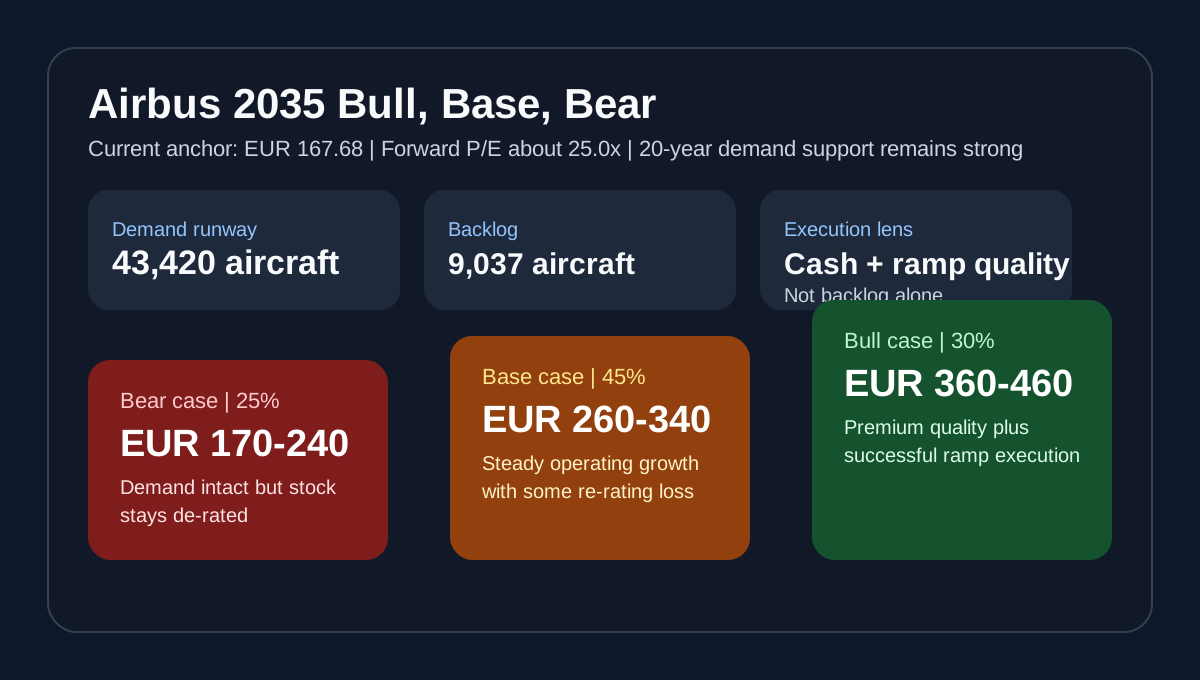
These scenarios assume that by 2035 Airbus has moved well beyond today's immediate delivery questions, but that the market still prices the company according to the quality of its earnings and free-cash-flow profile. The ranges are analytical, not official forecasts.
| Scenario | Probability | Target range | Measured trigger | Review point |
|---|---|---|---|---|
| Bull | 30% | EUR 360-460 | Airbus executes the ramp, turns backlog into durable cash compounding, and keeps a premium quality multiple through the next replacement cycle | Re-check annually; the first decisive checkpoints are FY2027 and FY2028 |
| Base | 45% | EUR 260-340 | Earnings and cash flow grow steadily, but valuation normalizes from today's premium starting point | Re-check each year against deliveries, margins, and free cash flow |
| Bear | 25% | EUR 170-240 | Demand remains healthy but operational quality never becomes consistently premium, leading to a structurally lower multiple | Re-check if ramp targets are reset multiple times through the late 2020s |
The 2035 base case is still favorable because Airbus has more structural demand visibility than most industrials. The constraint is that today's investors are already paying a premium for that visibility.
Long-term upside is therefore most likely to come from years of steady execution rather than from a single dramatic rerating event.
References
Sources
- Yahoo Finance quote page for Airbus (AIR.PA)
- Yahoo Finance 10-year chart data for Airbus (AIR.PA)
- Airbus Q1 2026 results, published April 28, 2026
- Airbus full-year 2025 results, published February 19, 2026
- Airbus Global Market Forecast 2025-2044, published June 11, 2025
- Eurostat flash GDP estimate for Q1 2026, published April 30, 2026
- Eurostat flash inflation estimate for April 2026, published May 2, 2026
- IMF Regional Economic Outlook: Europe, April 2026