01. Historical Context
Airbus has strong demand support, but 2027 still hinges on execution
Airbus shares have climbed from roughly EUR 45.16 to EUR 167.68 on an adjusted basis over the last 10 years, a gain equivalent to about 14.0% annualized, but that long-term compounding has not been linear. The stock also traded between EUR 154.08 and EUR 221.30 over the last 52 weeks, which shows how sensitive the name remains to delivery cadence and production confidence.
| Horizon | What matters most | What would strengthen the thesis | What would weaken the thesis |
|---|---|---|---|
| 1-3 months | Delivery cadence and 2026 guidance credibility | Evidence that 870 deliveries remains achievable | Another supply-chain or engine-related slowdown |
| 6-18 months | A320 ramp and free-cash-flow conversion | Clear progress toward 70-75 A320-family aircraft per month by end-2027 | Cash conversion stays weak and ramp milestones slip |
| To 2027 | Backlog monetization at acceptable margins | Higher deliveries without margin dilution | Execution issues force multiple compression |
Airbus reported FY2025 revenue of EUR 73.4 billion, EBIT Adjusted of EUR 7.1 billion, and free cash flow before customer financing of EUR 4.6 billion. In Q1 2026, it delivered 114 commercial aircraft, generated EUR 12.7 billion of revenue, posted EUR 0.3 billion of EBIT Adjusted, and reported free cash flow before customer financing of negative EUR 2.5 billion. The company kept full-year guidance unchanged at about 870 commercial aircraft deliveries, EBIT Adjusted of about EUR 7.5 billion, and free cash flow before customer financing of about EUR 4.5 billion.
The key takeaway is straightforward: demand is not the binding constraint. Airbus said its commercial aircraft backlog stood at 9,037 aircraft at the end of March 2026. The binding constraint is whether that backlog can be converted into deliveries on time and at the margin profile the market is assuming.
02. Key Forces
The stock is supported by backlog, but valuation leaves less room for mistakes
Yahoo Finance data for May 2026 showed Airbus at about 28.4x trailing earnings and 25.0x forward earnings, with trailing EPS of EUR 6.32. That forward multiple implies roughly EUR 6.7 of forward EPS, only modestly above trailing earnings, which means the stock still needs cleaner evidence that deliveries and free cash flow can accelerate into 2027.
Operationally, the most important disclosed milestone remains the A320-family ramp. Airbus still targets a production rate of 70 to 75 aircraft per month by the end of 2027, but management also said Pratt & Whitney remains the key pacer for the A320 family. That combination is why the setup is constructive but not carefree.
| Factor | Latest evidence | Why it matters | Current assessment | Bias |
|---|---|---|---|---|
| Demand | 9,037-aircraft backlog at March 2026 | Protects revenue visibility well beyond 2027 | Demand remains strong and is not the bottleneck | Bullish |
| Production ramp | 114 Q1 2026 deliveries; 70-75 A320-family target by end-2027 | 2027 upside requires higher output, not just backlog | Feasible, but still constrained by engines and suppliers | Neutral |
| Cash flow | Q1 2026 free cash flow before customer financing of negative EUR 2.5 billion; FY2026 guide EUR 4.5 billion | Confirms whether earnings quality is translating into cash | Seasonally weak quarter, but full-year target still requires a strong catch-up | Neutral |
| Valuation | 28.4x trailing P/E; 25.0x forward P/E | High enough that even modest misses can compress the multiple | Fair for a premium industrial, not cheap for a company with ramp risk | Neutral to Bearish |
| Macro | Euro area GDP up 0.1% qoq in Q1 2026; April 2026 flash inflation 3.0% | Affects airline demand, financing costs, and market discount rates | Growth is positive but soft; inflation is moving in the wrong direction again | Neutral |
The table matters because Airbus is no longer a pure recovery trade. The stock has already re-rated a long way from pandemic lows, so the next move depends more on incremental proof than on the broad story that aircraft demand is healthy.
03. Countercase
What would break the 2027 bull case
The first risk is simple execution. Airbus kept its 2026 delivery target unchanged, but Q1 deliveries were only 114 aircraft and management explicitly identified Pratt & Whitney as the key pacer for the A320 family. If delivery timing slips again, the market can quickly decide that the 2027 ramp deserves a lower multiple.
The second risk is valuation. At around 25x forward earnings, Airbus is not priced like a distressed industrial. It is priced like a quality name with credible medium-term visibility. That makes the stock vulnerable if the market starts to doubt whether the implied forward EPS of roughly EUR 6.7 can expand toward the EUR 7.5-8.0 range needed for the higher-end 2027 outcomes.
The third risk is macro. Eurostat's April 2026 flash estimate put euro area inflation at 3.0%, up from 2.6% in March, while Q1 2026 GDP growth was only 0.1% quarter on quarter. That combination is not a recession signal, but it is also not the clean disinflation-plus-growth backdrop that normally supports industrial multiple expansion.
| Risk | Latest data point | Why it matters | Current read |
|---|---|---|---|
| Delivery miss | 114 aircraft delivered in Q1 2026 | A weak first quarter raises sensitivity to any later-year slip | Watch closely |
| Cash conversion miss | Q1 2026 free cash flow before customer financing was negative EUR 2.5 billion | Backlog only creates value if it converts into cash | Needs recovery |
| Macro re-tightening | Euro area inflation re-accelerated to 3.0% in April 2026 | Higher-for-longer rates can cap the multiple | Moderate risk |
| Valuation compression | About 28.4x trailing P/E and 25.0x forward P/E | Little room for a narrative miss | Real risk |
The practical message is that Airbus does not need a macro shock to disappoint. A slower production ramp plus a still-demanding valuation would be enough to push the stock into a lower trading band.
04. Institutional Lens
What the latest institutional and official data actually say
Airbus said on April 28, 2026 that its 2026 guidance was unchanged: about 870 commercial aircraft deliveries, EBIT Adjusted of about EUR 7.5 billion, and free cash flow before customer financing of about EUR 4.5 billion. The same release said the commercial aircraft backlog stood at 9,037 aircraft and reiterated the target to reach 70-75 A320-family aircraft per month by the end of 2027.
Airbus's 2025 Global Market Forecast, published in June 2025, projected demand for 43,420 new passenger and freighter aircraft over 2025-2044. That is the structural demand argument behind the stock. It supports a constructive long-term stance, but it does not remove the near-term execution bottleneck.
On the macro side, Eurostat reported on April 30, 2026 that euro area GDP grew 0.1% quarter on quarter in Q1 2026, and its April 2026 flash inflation estimate put headline inflation at 3.0%. The IMF's April 2026 Regional Economic Outlook for Europe projected euro area growth of 1.1% in 2026. Put together, the macro data still support aircraft demand, but they do not justify assuming a large valuation re-rating on macro alone.
| Source | Update date | What it said | Why it matters here |
|---|---|---|---|
| Airbus Q1 2026 results | April 28, 2026 | 870 deliveries, EUR 7.5 billion EBIT Adjusted, and EUR 4.5 billion free cash flow guidance unchanged | Confirms management still sees 2026 as a delivery and cash step-up year |
| Airbus Global Market Forecast 2025-2044 | June 11, 2025 | 43,420 new aircraft demand forecast over 20 years | Supports the long-order-book thesis behind Airbus |
| Eurostat | April 30 and May 2, 2026 | Q1 2026 euro area GDP up 0.1% qoq; April inflation at 3.0% | Constructive growth, but inflation remains a valuation headwind |
| IMF Europe REO | April 17, 2026 | Euro area growth forecast of 1.1% for 2026 | Suggests demand should hold, but not in a boom-like macro regime |
The institutional read-through is that the demand side of the thesis is intact. What still has to be earned is operational trust.
05. Scenarios
Probability-weighted scenarios investors can actually monitor
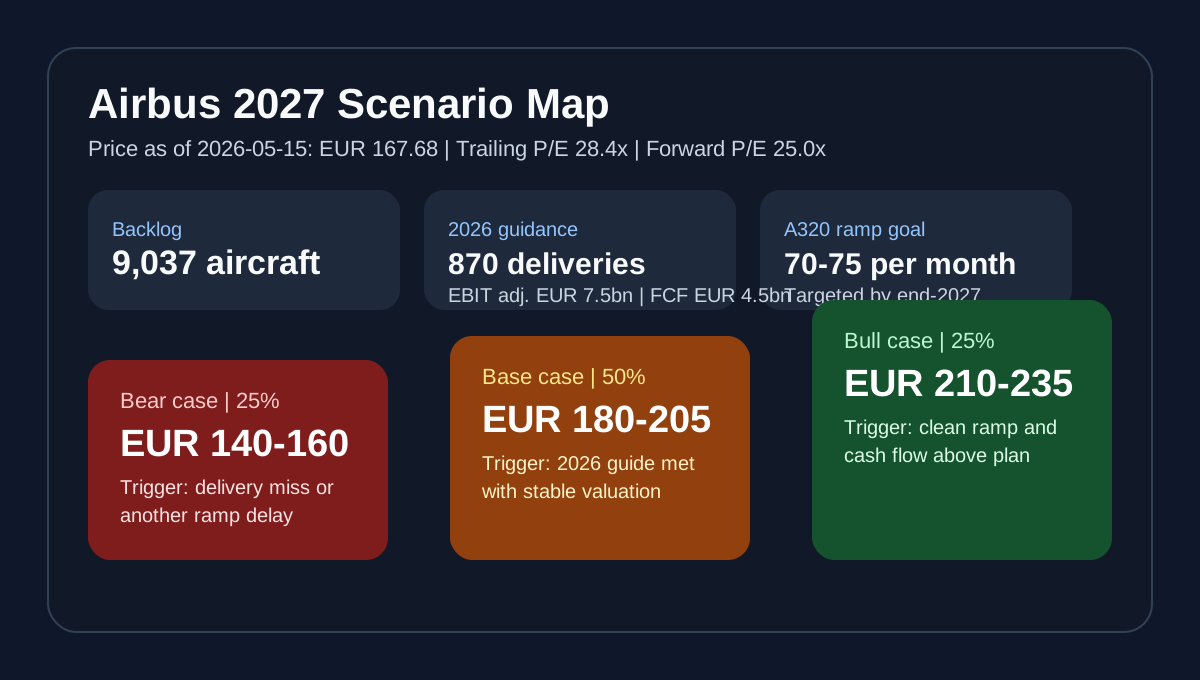
The ranges below are valuation scenarios, not official targets. They combine the current price, the present multiple, the implied forward EPS, and what Airbus would likely need to deliver operationally for the market to accept a higher or lower earnings multiple by the end of 2027.
| Scenario | Probability | Target range | Measured trigger | Review point |
|---|---|---|---|---|
| Bull | 25% | EUR 210-235 | Airbus stays on track for about 870 deliveries in 2026, keeps the end-2027 A320 ramp target intact, and cash flow lands at or above the EUR 4.5 billion guidance | Re-check after FY2026 results in February 2027 |
| Base | 50% | EUR 180-205 | 2026 guidance is broadly met, but the production ramp remains uneven and the stock holds roughly a 24-26x forward multiple | Re-check after H1 2027 deliveries and guidance |
| Bear | 25% | EUR 140-160 | Deliveries miss plan, Pratt & Whitney or supply-chain friction persists, or inflation and rates stay high enough to compress the multiple toward the low 20s | Re-check immediately if 2026 guidance is cut |
For investors already long, the most actionable test is whether Airbus exits 2026 with stronger delivery confidence than it entered the year. For investors without a position, the base case stays constructive, but the cleanest entries likely come from execution proof rather than from paying an even richer multiple in advance of that proof.
The conclusion is not that Airbus is expensive enough to avoid. It is that the stock now requires evidence, quarter by quarter, to justify further upside.
References
Sources
- Yahoo Finance quote page for Airbus (AIR.PA)
- Yahoo Finance 10-year chart data for Airbus (AIR.PA)
- Airbus Q1 2026 results, published April 28, 2026
- Airbus full-year 2025 results, published February 19, 2026
- Airbus Global Market Forecast 2025-2044, published June 11, 2025
- Eurostat flash GDP estimate for Q1 2026, published April 30, 2026
- Eurostat flash inflation estimate for April 2026, published May 2, 2026
- IMF Regional Economic Outlook: Europe, April 2026