01. Historical Context
Current market snapshot before the forecast
The base case for Alibaba is improving strategically but still valuation-sensitive: cloud and AI are finally growing fast enough to offset a slower domestic commerce backdrop, yet the market still needs proof that monetization can outrun capital intensity. Alibaba Group Announces March Quarter 2026 and Fiscal Year 2026 Results showed FY2026 revenue of RMB1.024 trillion, while Alibaba says cloud revenue growth accelerated and AI strategy delivered showed the part that matters most for multiple expansion: cloud revenue up 38% and external cloud revenue up 40%.
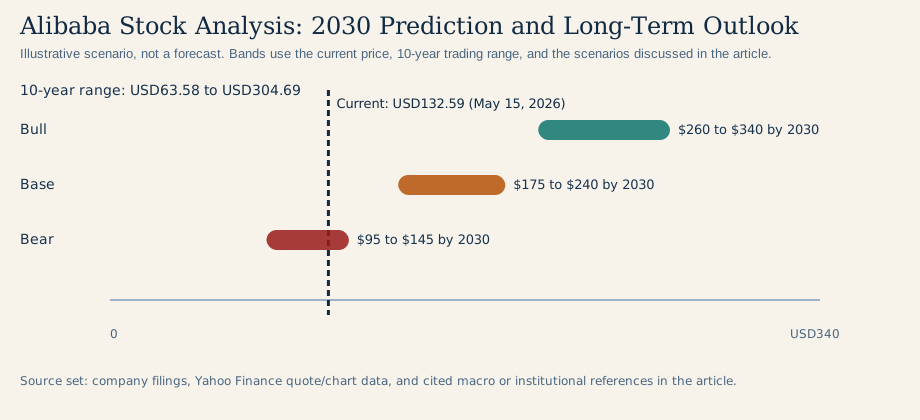
That combination matters because the stock's recent close of USD132.59 still sits far below its 10-year high of USD304.69, yet well above its 10-year low of USD63.58. The market is no longer pricing Alibaba like a broken platform, but it is also not giving it a clean AI winner multiple yet. Yahoo Finance quote page for BABA
| Metric | Current reading | Why it matters |
|---|---|---|
| Recent close | $132.59 on May 15, 2026 | Yahoo Finance 1-month daily chart |
| 10-year range | $63.58 to $304.69 | Yahoo Finance 10-year monthly chart |
| Forward valuation | About 21.0x forward P/E; 1-year target estimate $189.75 | Yahoo Finance quote page |
| Latest annual revenue | RMB1.024 trillion in FY2026, up 3% reported and 11% like-for-like | Alibaba FY2026 results |
| Cloud/AI proof point | Cloud revenue RMB41.6 billion in the March quarter, up 38%; AI-related product revenue RMB8.97 billion | Alibaba FY2026 results |
Yahoo Finance's May 2026 snapshot still shows a forward multiple below many global mega-cap internet peers, but free cash flow turned negative as Alibaba accelerated AI and quick-commerce spending.
02. Key Forces
Main drivers shaping the next move
The first driver is macro quality, not macro euphoria. IMF Executive Board concludes 2025 Article IV consultation with China and World Bank China Economic Update, December 2025 both argue for slower but still positive Chinese growth, while SCIO press conference on China's consumer goods trade-in program suggests policy support is still being used to cushion consumption. That is enough to support a base case, but it does not guarantee the kind of consumer boom that would make all of Alibaba's commerce businesses look easy again.
The second driver is AI monetization. Cloud Intelligence revenue of RMB41.6 billion and AI-related product revenue of RMB8.97 billion are meaningful because they show the new story is not theoretical anymore. The problem is that the same quarter also showed how expensive the transition remains.
The third driver is valuation discipline. Yahoo Finance analyst estimates page for BABA and Yahoo Finance quote page for BABA show that analysts still see upside from here, but the market will only pay that upside if cloud growth remains strong and free cash flow stops deteriorating.
| Factor | Latest evidence | Current assessment | Bias |
|---|---|---|---|
| China commerce demand | Like-for-like customer management revenue grew 8% in the March quarter while the trade-in program remained in place. | Demand has improved, but not enough to fully erase macro skepticism. | Neutral to Bullish |
| Cloud and AI monetization | Cloud Intelligence revenue rose 38% and external cloud revenue accelerated to 40%. | This is the strongest part of the thesis today. | Bullish |
| Cash generation | FY2026 free cash flow was an outflow of RMB46.6 billion because of quick-commerce and cloud infrastructure spending. | Near-term cash conversion is under pressure. | Bearish |
| Balance-sheet flexibility | Cash and other liquid investments were RMB520.8 billion as of March 31, 2026. | Alibaba still has the balance sheet to fund the build-out. | Bullish |
| Valuation and consensus | Average 1-year target on Yahoo Finance was $189.75 in May 2026. | The stock still trades below many bullish sell-side targets, but that premium depends on execution. | Neutral |
03. Countercase
What could invalidate the thesis
The immediate countercase is cash conversion. FY2026 free cash flow was an outflow of RMB46.6 billion, and management said AI investment is likely to exceed the prior three-year plan. That is not fatal, but it means even a good revenue story can translate into a weak equity story if the market loses patience.
The second risk is macro dilution. IMF Executive Board concludes 2025 Article IV consultation with China still expects growth to slow into 2026, so if trade-in support fades or consumer confidence rolls over, Alibaba's domestic commerce engines may not produce the operating leverage bulls need.
The third risk is revision pressure. Earlier-2026 analyst pages captured by Yahoo Finance analyst estimates page for BABA showed estimate cuts for both the current and following fiscal year. If that pattern reappears after fresh results, the valuation can look cheap and still keep compressing.
| Risk | Latest data or context | Why it matters now | When to review |
|---|---|---|---|
| AI capex overshoots monetization | Management said AI investment will exceed the previously announced RMB380 billion three-year plan. | Watch cloud gross margin, free cash flow, and any further step-down in non-GAAP earnings. | May 2026 earnings call and next two quarterly updates |
| Chinese consumer recovery disappoints | IMF still projects China growth to slow from 5.0% in 2025 to 4.5% in 2026. | Watch retail sales, trade-in subsidy follow-through, and Taobao/Tmall customer management revenue. | Monthly China data and each earnings season |
| Estimate revisions stay negative | Earlier-2026 Yahoo Finance analyst pages showed meaningful 30-day EPS estimate cuts for FY2026 and FY2027. | If revisions keep falling, valuation support can disappear quickly. | Consensus changes ahead of each quarter |
| Policy or tariff shock | Reuters reported that U.S. approval for some AI chip sales to Chinese groups still left execution dependent on Chinese sign-off. | A tighter hardware or cross-border policy regime would delay AI monetization. | Any export-control or domestic policy announcement |
04. Institutional Lens
What the latest institutional and primary-source evidence says
Institutional work is only useful when it changes the evidence set. For this group of articles, the most relevant inputs are the latest company filings, current quote and consensus pages, and official macro publications rather than generic market commentary. Alibaba Group Announces March Quarter 2026 and Fiscal Year 2026 Results and Yahoo Finance quote page for BABA are doing most of the heavy lifting.
That matters because each scenario range below is anchored to a recent trading price, the last 10 years of monthly price history, present valuation, and the direction of earnings or revenue revision signals. The methodology is intentionally simple: use the current price as the anchor, then widen or narrow the band depending on whether operating proof and macro conditions are improving or deteriorating.
In other words, these are probability-weighted ranges, not promises. The article becomes more bullish only if the measurable triggers continue to improve after the next review date.
| Source | Updated | What it says | Why investors should care |
|---|---|---|---|
| Alibaba FY2026 results | May 13, 2026 | Revenue grew 3% reported; cloud revenue rose 38%; AI-related product revenue reached RMB8.97 billion; liquid investments were RMB520.8 billion. | This is the most important company-specific evidence set because it shows AI demand is real but cash conversion is weaker. |
| Yahoo Finance consensus | May 2026 quote snapshot | 1-year target estimate stood at $189.75, with forward P/E around 21.0x. | The market is not paying an extreme multiple, but it is already discounting a meaningful rebound. |
| IMF China Article IV | February 18, 2026 | The IMF Executive Board concluded the 2025 consultation and backed growth forecasts of 5.0% for 2025 and 4.5% for 2026. | Alibaba still needs a decent macro floor because domestic commerce is too large to ignore. |
| World Bank China Economic Update | December 2025 | The World Bank estimated 4.9% growth in 2025 and 4.4% in 2026. | That reinforces the view that Alibaba's upside has to come from mix improvement, not a clean macro boom. |
| Reuters on AI spending | May 14, 2026 | Reuters reported Alibaba expects to exceed its prior AI spending plan as commercial returns become clearer. | That supports the strategic upside case while also explaining why near-term margins remain messy. |
05. Scenarios
Scenario analysis and investor positioning
The probability table below reflects the current setup, not a permanent view. Rising odds represent the chance that the stock finishes the next review window above today's level by enough to validate the thesis; sideways odds cover consolidation or only modest change; falling odds cover a material de-rating or drawdown.
Current framework: probability of rising 40%, probability of moving sideways 30%, and probability of falling 30%. Investors should review the thesis when either consensus revisions, free cash flow, or the specific company catalyst path changes meaningfully.
| Scenario | Probability | Illustrative target range | Trigger conditions | When to revisit |
|---|---|---|---|---|
| Bull | 30% | $260 to $340 by 2030 | Cloud growth stays elevated, free cash flow recovers, and China consumption does not relapse. | Reassess after each FY result and any major AI capex update |
| Base | 45% | $175 to $240 by 2030 | Cloud and AI revenue grow faster than the core commerce segment, but margins rebuild only gradually. | Reassess after FY2027 and FY2028 margin trends |
| Bear | 25% | $95 to $145 by 2030 | AI capex overshoots returns, consumer demand remains uneven, or geopolitics hurts hardware access. | Reassess immediately if free cash flow remains negative through another annual cycle |
| Investor group | Suggested posture | Practical action | What to monitor next |
|---|---|---|---|
| Investor already in profit | Hold a core position but rebalance if the scenario table moves away from your original thesis. | Protect gains when probability skews worsen. | Revision breadth, valuation, and next catalyst |
| Investor currently at a loss | Separate a delayed thesis from a broken thesis. | Add only when measurable triggers improve. | Guidance, margin trend, and cash flow |
| Investor with no position | Waiting for a cleaner setup is valid. | Use scenario triggers rather than headlines as entry rules. | Price relative to current range and catalyst calendar |
| Trader | Focus on review dates and trigger conditions, not the long-range target. | Use stop-losses because scenario bands are wide. | Earnings reactions and macro data |
| Long-term investor | Use gradual position building or rebalancing rather than all-in decisions. | A wide base case is normal in long-horizon work. | Structural competitiveness and capital allocation |
| Investor seeking a hedge | Hedging is sensible when portfolio concentration is high. | Match hedge size to risk exposure rather than fear. | Volatility, correlation, and event timing |
The forecast ranges in this article are built from four anchors: the recent market price, the 10-year trading range, the current valuation regime, and the direction of revisions or cash-flow evidence. That framework is intentionally conservative because it tries to separate what is plausible from what is merely possible.
Disclaimer: This is a scenario-based research article, not personalized investment advice. Markets can move sharply on earnings, regulation, macro data, and liquidity. Use position sizing, stop-loss discipline where appropriate, and independent due diligence.
References
Sources
- Alibaba Group Announces March Quarter 2026 and Fiscal Year 2026 Results
- Alibaba says cloud revenue growth accelerated and AI strategy delivered
- Alibaba filing notice for FY2025 annual report on Form 20-F
- Yahoo Finance quote page for BABA
- Yahoo Finance analyst estimates page for BABA
- IMF Executive Board concludes 2025 Article IV consultation with China
- IMF staff completes 2025 Article IV mission to China
- World Bank China Economic Update, December 2025
- SCIO press conference on China's consumer goods trade-in program
- Reuters-syndicated report on Alibaba AI spending exceeding its prior plan