01. Historical Context
Allianz into 2027: short enough for catalysts to matter
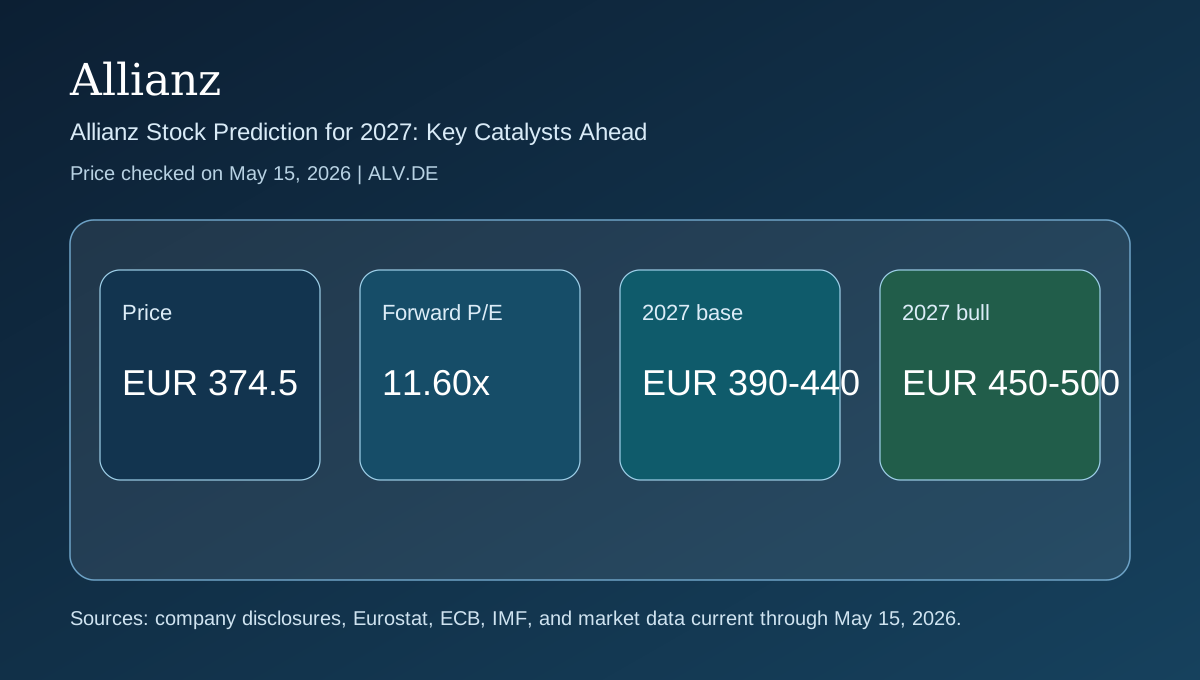
The 2027 window is short enough that current conditions still matter. Allianz is trading at EUR 374.5 with a 52-week range of EUR 333.2 to EUR 397.0, so the market is already pricing in some degree of operating resilience.
That means the stock will likely react more to whether management keeps delivering against visible targets than to broad thematic storytelling.
For a two-year forecast, scenario discipline matters more than a single target number. Investors need measurable checkpoints and clear invalidation levels.
| Horizon | Latest anchor | Current assessment |
|---|---|---|
| Current setup | EUR 374.5 share price and EUR 333.2 to EUR 397.0 52-week range | Trading near the upper half of the range |
| Next results window | Company guidance and solvency updates through FY26 and FY27 matter more than macro headlines | Catalyst-heavy |
| 2027 call | The 2027 range mainly reflects EPS delivery plus the multiple the market is willing to pay | Actionable |
02. Key Forces
Five catalysts that can move the 2027 call
Allianz's first support is operating momentum. Allianz reported 1Q 2026 operating profit of EUR 4.517 billion and a P&C combined ratio of 91.0%.
The second support is capital return. Allianz still carries a strong solvency buffer at 221% and couples that with EUR 2.5 billion buyback. That matters because, at the current multiple, buybacks and dividends remain an important part of total return.
The third support is valuation discipline. A stock trading at 12.02x trailing earnings and 11.60x forward earnings does not look like a momentum bubble, but it also no longer offers the margin of safety of a deeply unloved insurer.
The fourth force is macro transmission. Higher bond yields can support investment income, but sticky inflation can also feed claims costs and keep equity multiples contained. The latest IMF, Eurostat, and ECB data point to slower but still positive growth rather than a clean reacceleration.
The fifth force is strategic execution. For insurers, the stock usually follows the combination of pricing discipline, claims control, capital management, and distribution reach. The market eventually looks through slogans and asks whether those four levers are still working.
| Factor | Latest data | Current Assessment | Bias |
|---|---|---|---|
| Valuation | Trailing P/E 12.02x; forward P/E 11.60x | Reasonable for a large European insurer, not distressed | Neutral to Bullish |
| Operating momentum | 2025 operating profit EUR 17.4 billion; 1Q 2026 operating profit EUR 4.517 billion | Running ahead of a flat macro backdrop | Bullish |
| Underwriting quality | 1Q 2026 P&C combined ratio 91.0% | Still disciplined, but must hold through the next catastrophe cycle | Bullish |
| Capital strength | Solvency II 221%; EUR 2.5 billion buyback | A strong capital base still supports dividends and buybacks | Bullish |
| Macro drag | Euro area CPI 3.0% in April 2026; GDP +0.1% q/q in 1Q 2026 | Higher claims inflation is the main external risk | Neutral |
03. Countercase
What would invalidate the 2027 setup
The countercase is not that the franchise is weak. It is that the next stage of upside may be capped if inflation, claims pressure, and multiple discipline all tighten at the same time.
That is why the current macro backdrop matters. The IMF now sees euro area growth at 1.1% in 2026, while the ECB still describes the outlook as highly uncertain after a 0.1% first-quarter GDP print.
If operating trends weaken while macro conditions stay noisy, the stock could deliver a much flatter path than a straight-line forecast assumes.
| Risk | Latest data | Break level | Current assessment |
|---|---|---|---|
| Claims inflation | Euro area CPI 3.0% in April 2026; energy 10.9% | If combined ratio moves above 93% | Manageable, but rising |
| Capital buffer | Solvency II at 221% | Below 210% | Comfortable |
| Valuation reset | Shares trade at 12.02x trailing P/E | A de-rating to 10-11x | Real risk if growth softens |
| Asset management cycle | 1Q 2026 third-party net inflows were EUR 45.2 billion | If flows turn negative for several quarters | Healthy today |
04. Institutional Lens
Institutional lens: which updates deserve the most attention
Allianz's own disclosures set the nearest institutional anchor. The May 13, 2026 release showed 1Q 2026 operating profit of EUR 4.517 billion, core EPS of EUR 9.96, and Solvency II of 221%.
The macro anchor is less comfortable. The IMF cut its 2026 euro area growth view to 1.1% in April 2026, while Eurostat and the ECB both showed inflation pressure picking up again into April.
That leaves current market data as the valuation anchor. At EUR 374.5 and 12.02x trailing P/E, investors are paying for resilience, but not yet for an extreme growth story.
| Source | Updated | What it says | Why it matters |
|---|---|---|---|
| Allianz | May 2026 | Allianz reported EUR 4.517 billion of 1Q 2026 operating profit and kept 2026 guidance intact | Company execution still drives the thesis |
| IMF Europe | April 17, 2026 | The IMF cut its 2026 euro area growth view to 1.1% as energy shock risk rose | Supports a cautious growth backdrop |
| Eurostat | April 30, 2026 | Euro area inflation was 3.0% in April 2026; energy inflation was 10.9% | Claims costs and discount rates remain live issues |
| ECB | Issue 3, 2026 | The ECB noted euro area GDP growth of 0.1% in 1Q 2026 and kept the deposit rate at 2.00% | No hard landing yet, but no easy macro tailwind either |
| Market data | May 15, 2026 | EUR 374.5 share price with 12.02x trailing P/E and 11.60x forward P/E | Valuation is no longer a deep-value story |
05. Scenarios
2027 scenarios with triggers and review dates
The 2027 scenario map is shorter-dated and more measurable. Upcoming half-year and full-year releases should tell investors whether current guidance remains intact or needs to be cut.
That makes 2027 one of the easier horizons to monitor: the stock will likely follow a small set of reported KPIs and not a broad macro narrative alone.
| Scenario | Probability | Trigger | Target range | Review point | Action bias |
|---|---|---|---|---|---|
| Bull | 25% | Core EPS keeps tracking the top end of the 7-9% 2024-2027 target, combined ratio stays near 91-92%, and solvency remains above 215% | EUR 450-500 | Review after FY26 and FY27 results | Add only if the trigger is visible |
| Base | 50% | Operating profit stays around guidance, P&C remains disciplined, and valuation stays around 11.5-13x | EUR 390-440 | Review at each half-year report | Core holding or watchlist |
| Bear | 25% | Combined ratio drifts above 93%, solvency weakens below 210%, or the market de-rates the stock toward 10-11x earnings | EUR 320-360 | Reassess immediately if the trigger appears | Reduce or stay patient |
References
Sources
- Allianz 1Q 2026 earnings release
- Allianz 4Q and 12M 2025 earnings release PDF
- Allianz Capital Markets Day 2024 targets
- Yahoo Finance 10-year chart data for ALV.DE
- Stock Analysis overview for Allianz SE
- Stock Analysis statistics for Allianz SE
- IMF Regional Economic Outlook for Europe, April 2026
- Eurostat flash estimate for euro area inflation, April 2026
- ECB Economic Bulletin Issue 3, 2026