Alphabet Inc. Class A shares (Nasdaq: GOOGL) entered October 2026 with a volatile but improving short-term pattern. The stock fell sharply on October 1, recovered on October 2, and closed October 5 at $346.47. That recovery is constructive, but it has not yet produced the kind of price-and-volume confirmation that would make the trend unambiguously bullish.
The most useful way to analyze GOOGL now is to separate price behavior from the business story. Alphabet's operating results are strong, especially in Search and Google Cloud, while its AI buildout is requiring unusually large capital commitments. A good trend analysis should therefore answer three questions: Is price holding above recent support? Are operating fundamentals strong enough to justify the current valuation? And what evidence would force a change in the current view?
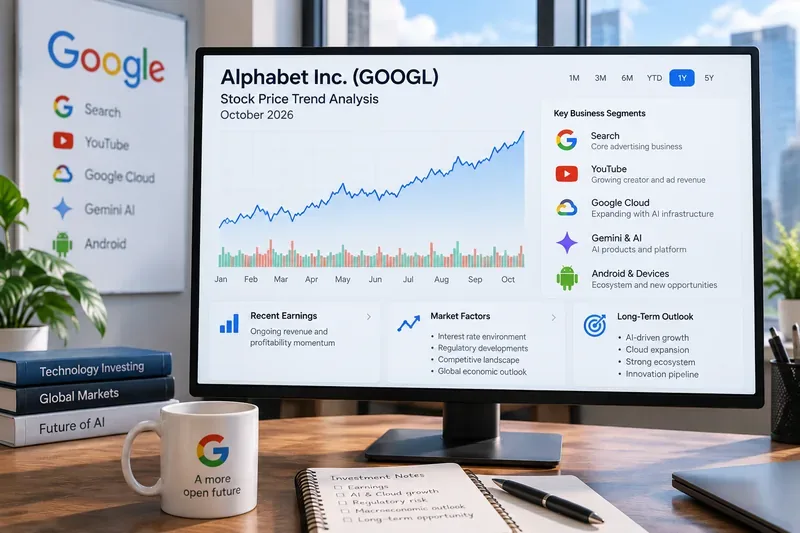
Where GOOGL stood at the start of October 2026
Google Finance showed GOOGL closing at $346.47 on October 5, 2026, up 0.86% for that session. The stock opened at $342.59, traded as high as $348.09, and as low as $342.40. Reported volume was about 22.6 million shares versus an average volume of roughly 26.2 million. The same page listed a 52-week high of $408.61 and a 52-week low of $235.84. See the Google Finance GOOGL quote.
On October 2, GOOGL closed at $343.50 after trading between $341.16 and $345.77, according to the same Google Finance market feed. The October 1 session had been much weaker, with the stock closing around $338 after an intraday low near $335.50. By October 5, the stock had recovered roughly 2.4% from the October 1 close.
That rebound matters because it shows buyers responded after the early-month selloff. However, a two-session recovery is not enough by itself to establish a durable uptrend. The October 5 close was still below the $350-$353 area that capped the stock around the beginning of the month, and trading volume was below its reported average.
What would make the October recovery higher quality?
A high-quality bullish trend is not simply a sequence of green days. It combines price progress with evidence that buyers are willing to support higher levels. For GOOGL, several signs would improve the quality of the October move:
- Daily closes above roughly $350-$353 rather than brief intraday moves into that area.
- Follow-through for several sessions instead of an immediate reversal.
- Trading volume at or above the recent average as the stock pushes through resistance.
- Pullbacks that hold the low-$340s rather than falling back through the October 1 low.
- Continued evidence that Search, Cloud, and AI monetization are growing fast enough to absorb rising infrastructure costs.
The October 5 session did not satisfy all of those conditions. It was positive, but volume was roughly 14% below the reported average. That does not make the rebound weak by definition; it simply means the price move had less participation than investors would normally prefer to see during a breakout attempt.
Short-term support and resistance to watch
The first support zone is approximately $341-$343. That area includes the October 2 trading range and the October 5 opening region. A pullback that stabilizes there would keep the short-term recovery intact.
The more important downside level is near $335-$338, around the October 1 low and close. A decisive close below that zone would suggest that the early-October rebound failed and that sellers had regained control.
On the upside, the first practical resistance zone is around $350-$353. A sustained close above that range would be more meaningful than an intraday touch. Investors should also remember that the stock remained about 15% below its reported 52-week high of $408.61 as of October 5, so clearing the low-$350s would improve the short-term picture without automatically restoring the prior long-term high.
Alphabet's operating results are stronger than the price pattern suggests
Alphabet's latest filed quarterly results were unusually strong. For the quarter ended June 30, 2026, consolidated revenue reached $119.8 billion, up 24% year over year. Operating income increased 30% to $40.8 billion, and operating margin expanded to 34%. The figures are available in Alphabet's official Q2 2026 earnings release filed with the SEC.
Google Services revenue rose 15% to $94.5 billion. Within that segment, Google Search & other revenue increased 17% to $63.3 billion, while YouTube advertising revenue increased 13% to $11.1 billion. Those figures matter because they show that AI products have not, at least in the latest reported quarter, displaced the core advertising engine.
For trend analysis, the quality check is straightforward: future quarters should continue showing healthy Search monetization while new AI experiences expand usage. If Search growth slows materially while AI infrastructure costs keep rising, the market may become less willing to pay for the growth story.
Google Cloud is the most important acceleration signal
Google Cloud was the standout segment in Q2 2026. Revenue increased 82% year over year to $24.8 billion, while Cloud operating income rose from $2.8 billion a year earlier to $8.8 billion. Alphabet also reported $519.5 billion of company-wide remaining performance obligations, or contracted revenue backlog, with $513.9 billion related to Google Cloud. These figures come from Alphabet's Q2 2026 Form 10-Q.
This is a stronger fundamental signal than revenue growth alone because Cloud profitability improved at the same time. If that combination persists—rapid revenue growth plus expanding operating income—it gives Alphabet more capacity to fund AI investment without relying entirely on the advertising business.
The warning sign would be a reversal in that relationship: Cloud revenue slowing sharply while depreciation, energy, infrastructure, or model-serving costs continue rising. That would reduce the quality of the growth even if headline revenue remained positive.
The biggest limitation: AI growth requires extraordinary capital spending
Alphabet is investing at a scale that changes how investors should evaluate the company. In its 2025 annual filing, Alphabet said it expected to significantly increase technical-infrastructure investment in 2026. In April 2026, the company told shareholders it planned around $180 billion of total capital expenditures for 2026, roughly double the prior year's level. The shareholder communication is available through Alphabet's SEC-filed 2026 annual meeting materials.
By June 30, 2026, Alphabet had already spent $80.6 billion on capital expenditures during the first six months of the year, compared with $39.6 billion in the first half of 2025. The Q2 Form 10-Q also disclosed substantial future data-center lease commitments.
This spending is not automatically negative. Strong Cloud growth and demand for Gemini-related infrastructure can justify large investment. The quality test is whether revenue, operating income, and cash generation scale fast enough to earn attractive returns on that capital. If spending continues rising while Cloud growth or margins weaken, the stock's risk profile changes.
Do not overread Alphabet's Q2 net income
Alphabet reported $112.1 billion of net income available to common shareholders in Q2 2026, but that figure was heavily affected by approximately $98.0 billion of other income, primarily unrealized gains on equity securities. That makes operating income a cleaner measure for evaluating the underlying quarter.
This distinction is important in stock-trend work. A large one-time or market-driven gain can make earnings per share look dramatically stronger without producing the same improvement in recurring operations. For October, operating revenue, segment margins, Cloud profitability, and cash investment are more informative than simply extrapolating Q2 net income.
Interest rates remain a valuation risk
The Federal Reserve raised its target range for the federal funds rate by 25 basis points on September 16, 2026, to 3.75%-4.00%, saying inflation remained elevated. The decision is documented in the official September 2026 FOMC statement.
Higher interest rates can pressure growth-stock valuations even when company fundamentals remain strong. Alphabet has substantial cash generation, but its valuation still reflects expectations about future profits. If Treasury yields or policy rates rise further, investors may demand a lower multiple for those future earnings. That creates a scenario where Alphabet can report strong Cloud growth while GOOGL shares remain range-bound or decline.
Dividend and capital return are supportive, but secondary
Alphabet declared a quarterly cash dividend of $0.22 per Class A, Class B, and Class C share in July 2026, payable in September. The same Q2 earnings filing documents the dividend program. For a company whose investment case is dominated by Search, Cloud, AI, and capital spending, the dividend is a useful signal of financial capacity but not the main reason the stock's October trend will strengthen or weaken.
A practical October 2026 framework
| Observed signal | Interpretation | What to verify next |
|---|---|---|
| Closes above $350-$353 with stronger volume | Recovery is becoming a more credible breakout | Look for several sessions of follow-through |
| Pullbacks hold around $341-$343 | Short-term buyers remain active | Watch whether rebounds occur without unusually heavy selling volume |
| Close below roughly $335-$338 | Early-October recovery thesis is weakening | Reassess support rather than assuming an automatic rebound |
| Cloud remains high-growth and highly profitable | AI infrastructure spending has stronger economic support | Compare revenue growth, operating income, backlog, and depreciation |
| Capex rises faster than monetization | Return-on-investment risk increases | Watch operating cash flow, free cash flow, margins, and infrastructure utilization |
| Rates move higher | Valuation pressure can offset strong company results | Separate business performance from market multiple compression |
When should the trend thesis change?
The current view is best described as constructive recovery, not confirmed breakout. That assessment should become more bullish if GOOGL holds above the low-$340s, closes decisively above the $350-$353 area, and does so with stronger participation. It should become more cautious if the stock loses the October 1 low, if Cloud growth decelerates materially, or if rising AI costs begin to weaken consolidated operating margins.
The fundamental thesis should also change if evidence shows that AI Search experiences are reducing monetization instead of extending it. Alphabet's current filings show strong Search growth, so that risk is not yet visible in the latest reported numbers. It remains something investors should test quarter by quarter rather than assume away.
Bottom line
GOOGL's first few October 2026 sessions show a rebound from a sharp October 1 selloff. The October 5 close of $346.47 put the stock back above its October 2 close and above the low-$340s support area, but it remained below nearby resistance in the low-$350s and rose on below-average volume.
Fundamentally, Alphabet's latest quarter was strong: revenue grew 24%, Search grew 17%, and Google Cloud revenue grew 82% while Cloud operating income more than tripled year over year. The counterweight is the enormous cost of building AI infrastructure, with 2026 capital spending planned at a scale far above prior years.
The best October approach is therefore conditional rather than predictive. Watch whether price can hold the low-$340s and break above the low-$350s, while checking whether Cloud profitability and Search monetization continue to justify the infrastructure buildout. This analysis uses market information available through October 6, 2026, and should not be treated as a live quote, a price target, or investment advice.