01. Current Data
The current operating and valuation picture
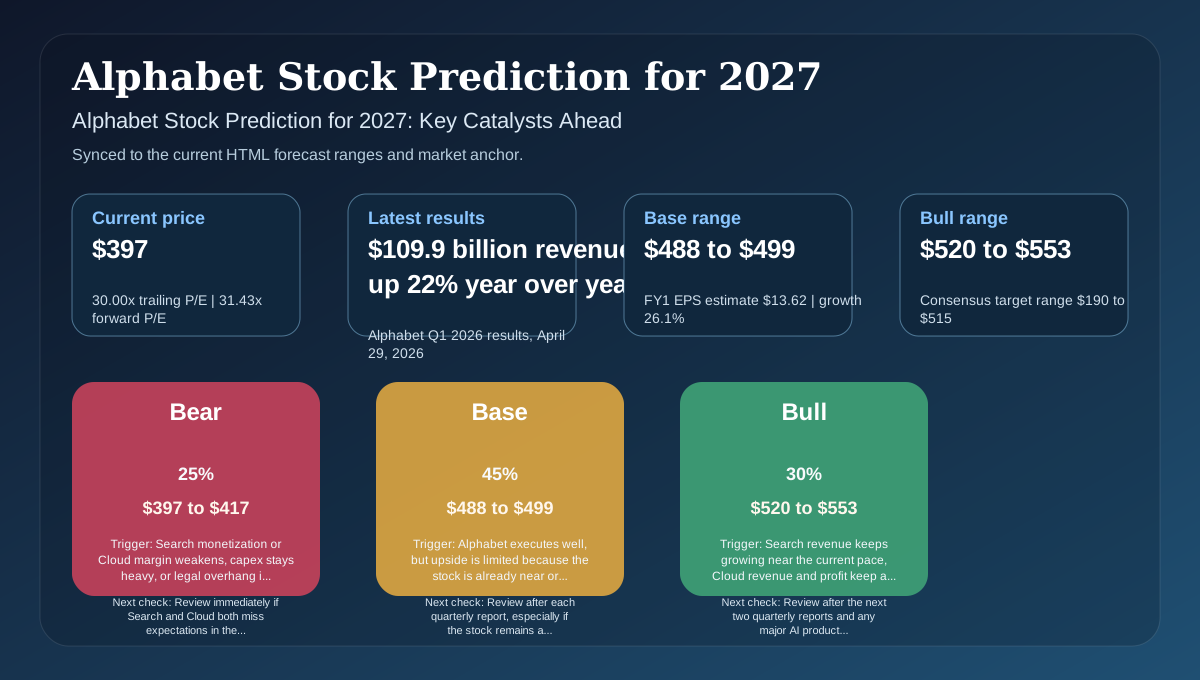
| Metric | Latest figure | Why it matters |
|---|---|---|
| Share price | $397 | Sets the market starting point for every scenario |
| Market cap | $4.81 trillion | Shows how much scale is already reflected in the equity value |
| Valuation | 30.00x trailing P/E; 31.43x forward P/E | Defines whether the stock still has room for multiple expansion |
| Latest results | $109.9 billion revenue, up 22% year over year | Alphabet Q1 2026 results, April 29, 2026 |
| EPS setup | TTM EPS $13.11; next-year consensus EPS $13.62 | Shows the bridge between current earnings and forward expectations |
| Consensus range | $391.60 average target; $190 low; $515 high | Frames how much upside the Street still sees from here |
| Capital allocation / guide | Google Cloud revenue rose to $20.0 billion, Cloud operating income hit $6.6 billion, and the quarterly dividend was raised 5% to $0.22 | Creates the next measurable checkpoints for the thesis |
Base case: Alphabet remains fundamentally strong into 2030 because Search is still expanding, Google Cloud is accelerating, and AI is lifting usage, but the current setup is less one-sided than the income statement first appears because reported earnings were boosted by large investment gains.
The official first-quarter release was strong. Alphabet posted revenue of $109.896 billion, up 22% year over year, operating income of $39.696 billion, operating margin of 36%, and diluted EPS of $5.11. Search and other revenue rose 19% to $60.399 billion, Google Cloud revenue rose 63% to $20.028 billion, and Google Cloud operating income climbed to $6.598 billion from $2.177 billion a year earlier. Sundar Pichai also said Cloud backlog nearly doubled quarter on quarter to over $460 billion, paid subscriptions reached 350 million, and Gemini Enterprise paid monthly active users grew 40% quarter on quarter.
There is, however, an important accounting nuance. Alphabet disclosed that gains on equity securities increased net income by $28.7 billion and diluted EPS by $2.35 in Q1 2026. That is why the stock can show a trailing P/E around 30x while the forward P/E is still above 31x. The operating business is strong, but investors should judge it on Search, Cloud, and capex economics more than on one quarter of investment gains.
Macro still matters. U.S. real GDP rose 2.0% annualized in Q1 2026, while real final sales to private domestic purchasers increased 2.5% and the gross domestic purchases price index rose 3.6%. April 2026 CPI rose 3.8% year over year and core CPI rose 2.8%; March 2026 PCE inflation was 3.5% year over year. On April 1, 2026, the IMF said U.S. GDP growth should rise to 2.4% in 2026 on a Q4/Q4 basis and core PCE inflation should move back to 2% in the first half of 2027. For Alphabet, the macro question is less about survival and more about whether ad demand and AI spending stay supportive enough to justify a premium multiple when the stock already trades near the Street's average target.
02. Key Factors
Five factors shaping the next move
The first force is Search durability. A 19% increase in Search and other revenue is a stronger outcome than many skeptics expected, especially with AI Overviews and other answer-engine formats changing the user experience. The second force is Cloud monetization. Google Cloud is no longer just a promising segment; at $20.028 billion of revenue and $6.598 billion of operating income, it is now carrying meaningful weight in the thesis.
The third force is valuation quality. Because Q1 earnings were flattered by investment gains, investors should focus on forward estimates and segment economics rather than simply citing the trailing multiple. The fourth and fifth forces are capital intensity and regulation. Property and equipment purchases reached $35.674 billion in the quarter, and Alphabet still faces antitrust and platform oversight risk even as the business executes well.
| Factor | Why it matters | Current Assessment | Bias | Current evidence |
|---|---|---|---|---|
| Valuation quality | Separates operating strength from one-off earnings effects | Mixed | 0 | Trailing P/E near 30x is helped by a $2.35 EPS boost from equity-security gains, while forward P/E remains above 31x |
| Recent earnings | Tests whether AI is supporting the core business | Strong | + | $109.9 billion revenue, 36% operating margin, and $5.11 diluted EPS all exceeded the prior year by wide margins |
| Search durability | Shows whether AI is helping or hurting the core cash engine | Strong | + | Google Search & other revenue rose 19% to $60.399 billion with queries at an all-time high |
| Cloud monetization | Measures whether AI capex is becoming operating income | Very strong | + | Google Cloud revenue rose 63% to $20.028 billion and operating income reached $6.598 billion |
| Near-term consensus | Shows whether the stock already discounts the good news | Selective | - | Average price target is $391.60, slightly below the current price, even though FY2026 EPS consensus is $13.62 |
03. Countercase
What could weaken the stock from here
The first risk is valuation optics. Alphabet's reported Q1 diluted EPS of $5.11 included a $2.35 benefit from gains on equity securities. That means investors who anchor only on the trailing multiple may be underestimating the valuation investors are actually paying for the operating business.
The second risk is AI monetization friction. Search revenue growth was strong in Q1, but the market still needs proof that AI answers and newer formats expand engagement and monetization faster than they displace traditional ad economics.
The third risk is capital intensity. Purchases of property and equipment reached $35.674 billion in the first quarter alone, which underlines how expensive this AI cycle is becoming. If Cloud growth slows before returns on that spend are fully visible, the multiple can compress.
The final risk is macro and regulation. April CPI at 3.8% and March PCE inflation at 3.5% keep rate sensitivity alive, while antitrust and platform remedies remain a live overhang even when quarterly numbers are strong.
| Risk | Latest data point | Why it matters now | What would confirm it |
|---|---|---|---|
| Quality of earnings | Q1 diluted EPS was $5.11, but equity-security gains added $2.35 | The reported earnings beat overstates core operating leverage | Forward estimates stop rising even after a headline beat |
| Search monetization risk | Search & other revenue was $60.399 billion, up 19% | The core ad engine still matters more than any AI narrative | Search growth slows sharply as AI answer formats scale |
| Capex pressure | Property and equipment purchases were $35.674 billion in Q1 | AI infrastructure spending is only bullish if returns stay visible | Cloud growth cools while capex remains elevated |
| Macro and regulatory risk | April CPI 3.8%; March PCE inflation 3.5% | Higher rates and policy action can both compress multiples | Inflation stays high or legal remedies become economically meaningful |
04. Institutional Lens
How current source material changes the thesis
Alphabet's own filing supplies the key evidence. On April 29, 2026, the company reported $109.896 billion of revenue, 36% operating margin, $20.028 billion of Google Cloud revenue, and $6.598 billion of Cloud operating income. Pichai also said Search queries hit an all-time high, subscriptions reached 350 million, and Cloud backlog exceeded $460 billion after nearly doubling quarter on quarter.
The macro and market backdrop still matters, but it should not be overstated. FactSet said on April 2, 2026 that total estimated S&P 500 Q1 earnings had increased 0.4% since December 31, and that Information Technology had the second-largest increase in expected dollar earnings at +8.0% while posting the highest count of positive EPS guidance at 33 companies. That note is useful mainly as context for technology earnings breadth, not as a substitute for Alphabet's own segment data. The more important institutional nuance came from Alphabet's own disclosure that gains on equity securities added $28.7 billion to net income and $2.35 to diluted EPS in Q1.
Consensus makes the near-term setup more selective than the long-term setup. As of May 14, 2026, StockAnalysis showed 45 analysts with a Strong Buy consensus, but an average target of $391.60 versus a current price around $397, with FY2026 EPS consensus of $13.62. On April 1, 2026, the IMF said U.S. GDP growth should rise to 2.4% in 2026 on a Q4/Q4 basis and core PCE inflation should move back to 2% in the first half of 2027. The practical read is that Alphabet still looks strategically strong, but the next leg higher probably requires another step-up in operating estimates rather than a simple rerating.
| Source type | Concrete datapoint | Why it matters for the stock |
|---|---|---|
| Alphabet SEC filing, April 29, 2026 | $109.896 billion revenue, 36% operating margin, $5.11 diluted EPS, Search +19%, Google Cloud $20.028 billion and $6.598 billion operating income | Anchors the thesis in reported segment economics |
| Alphabet management commentary, April 29, 2026 | Cloud backlog above $460 billion, 350 million paid subscriptions, Gemini Enterprise paid MAUs +40% QoQ | Shows where AI is affecting usage and enterprise demand |
| Alphabet SEC filing footnote, April 29, 2026 | $28.7 billion boost to net income and $2.35 to diluted EPS from equity-security gains | Explains why trailing valuation can look cheaper than operating reality |
| StockAnalysis snapshot, May 14, 2026 | Approx. 30.00x trailing P/E, 31.43x forward P/E, FY2026 EPS estimate of $13.62, average target of $391.60 | Shows the current valuation and consensus hurdle |
| IMF, BLS, and BEA | GDP remains positive while inflation stays above target | Defines the macro corridor for risk assets and digital advertising |
05. Scenarios
Scenario analysis with probabilities and review points
For 2027, the most useful review points are Search growth, Cloud operating income, capex intensity, and whether forward EPS can keep outrunning the optical distortion in trailing EPS.
Each scenario below is designed to be monitored with current valuation, earnings, and macro data rather than a vague long-term story. When the trigger changes, the range should change with it.
| Scenario | Probability | Range / implication | Trigger | When to review |
|---|---|---|---|---|
| Bull | 30% | $520 to $553 | Search revenue keeps growing near the current pace, Cloud revenue and profit keep accelerating, and FY2026 EPS moves above the $13.62 consensus | Review after the next two quarterly reports and any major AI product monetization update |
| Base | 45% | $488 to $499 | Alphabet executes well, but upside is limited because the stock is already near or above consensus target levels | Review after each quarterly report, especially if the stock remains above average target |
| Bear | 25% | $397 to $417 | Search monetization or Cloud margin weakens, capex stays heavy, or legal overhang intensifies | Review immediately if Search and Cloud both miss expectations in the same quarter |
References
Sources
- Alphabet Q1 2026 earnings release filed with the SEC
- StockAnalysis Alphabet statistics and valuation snapshot
- StockAnalysis Alphabet analyst target and EPS forecast snapshot
- StockAnalysis Alphabet Class A revenue and EPS forecast snapshot
- U.S. CPI April 2026 release
- BEA PCE price index page
- U.S. GDP advance estimate for Q1 2026
- IMF 2026 U.S. Article IV consultation
- FactSet S&P 500 earnings season preview for Q1 2026