01. Current Data
The current operating and valuation picture
| Metric | Latest figure | Why it matters |
|---|---|---|
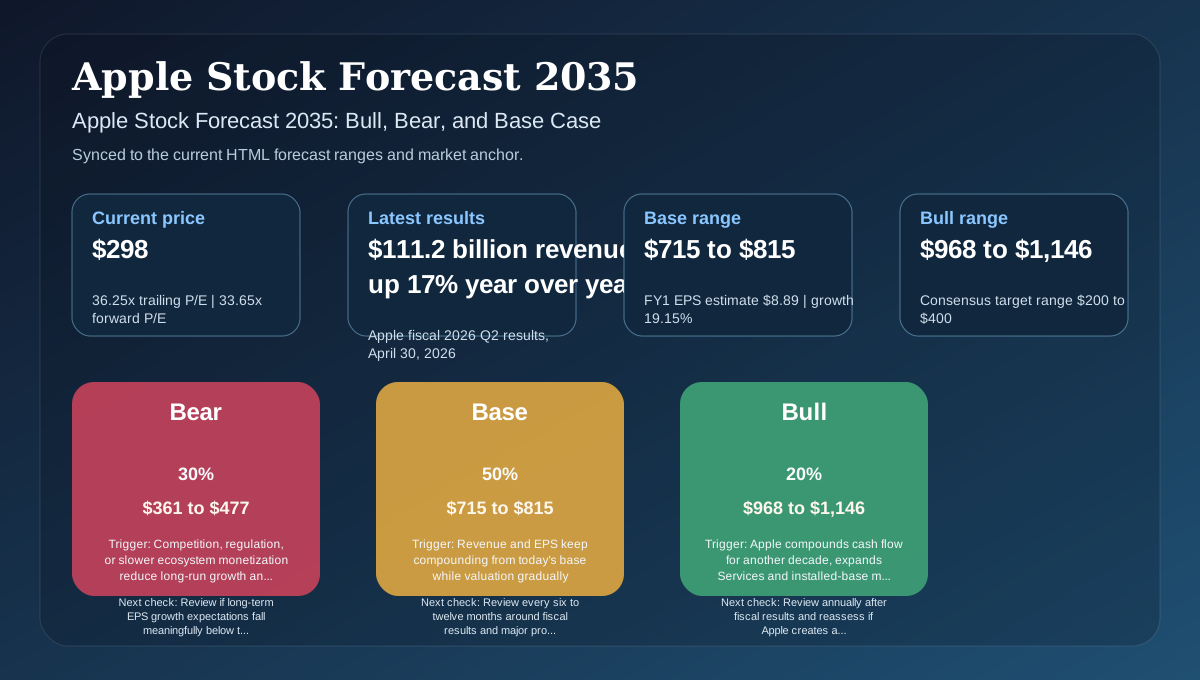
| Share price | $298 | Sets the market starting point for every scenario |
| Valuation | 36.25x trailing P/E; 33.65x forward P/E | Defines whether the stock still has room for multiple expansion |
| Latest results | $111.2 billion revenue, up 17% year over year | Apple fiscal 2026 Q2 results, April 30, 2026 |
| EPS setup | TTM EPS $8.25; next-year consensus EPS $8.89 | Shows the bridge between current earnings and forward expectations |
| Consensus range | $304.69 average target; $200 low; $400 high | Frames how much upside the Street still sees from here |
| Capital allocation / guide | $100 billion buyback authorization, $0.27 dividend, and over $28 billion operating cash flow | Creates the next measurable checkpoints for the thesis |
Apple's base case still leans constructive, but the easy re-rating phase looks largely complete. At $299.09, 36.25x trailing earnings and 33.65x forward earnings, the stock is priced as both a quality compounder and a renewed growth story. That leaves room for upside, but much less room for operational slippage than investors had a year ago.
The operating evidence is solid. Apple reported fiscal 2026 second-quarter revenue of $111.2 billion, up 17% year over year, and diluted EPS of $2.01, up 22%. Management also said the March quarter set records for total company revenue, iPhone revenue, and EPS, while Services reached a new all-time high. Apple generated more than $28 billion of operating cash flow in the quarter, raised the dividend 4% to $0.27 per share, and authorized another $100 billion of repurchases.
The macro backdrop is supportive but not frictionless. U.S. real GDP rose 2.0% annualized in Q1 2026, while real final sales to private domestic purchasers increased 2.5% and the gross domestic purchases price index rose 3.6%. April 2026 CPI rose 3.8% year over year and core CPI rose 2.8%; March 2026 PCE inflation was 3.5% year over year and core PCE was 3.2%. On April 1, 2026, the IMF projected U.S. GDP growth of 2.4% on a Q4/Q4 basis for 2026 and said core PCE inflation should move back to 2% in the first half of 2027. For Apple, that matters because a premium multiple is easier to defend when the economy keeps expanding and disinflation resumes; it becomes harder to defend if rates stay high while iPhone and Services growth normalize.
02. Key Factors
Five factors shaping the next move
The first issue is valuation discipline. Apple's premium is understandable, but it is no longer cheap enough for investors to ignore quarter-to-quarter execution. The second issue is earnings support. Consensus still expects EPS growth this year, yet that expectation now requires continued product-cycle strength and steady Services monetization rather than buybacks alone.
The third issue is the quality of the growth mix. Apple's latest official numbers emphasize iPhone momentum, Services strength, and cash generation, which is a better foundation than narrative-driven AI enthusiasm. The fourth and fifth issues are balance-sheet resilience and macro sensitivity. Apple still has net cash and substantial free cash flow, but a stock above 33x forward earnings is exposed if growth moderates while the inflation backdrop stays sticky.
| Factor | Why it matters | Current Assessment | Bias | Current evidence |
|---|---|---|---|---|
| Valuation | Sets the hurdle for upside | Demanding | - | 36.25x trailing P/E and 33.65x forward P/E leave less margin for error |
| Recent earnings | Shows whether the premium is being earned | Strong | + | $111.2 billion revenue and $2.01 EPS both grew at double-digit rates year over year |
| Estimate backdrop | Tells you what the market expects next | Moderately positive | + | 29 analysts imply FY2026 EPS of $8.89 and an average target of $304.69 |
| Cash return engine | Supports downside and per-share growth | Strong | + | Over $28 billion operating cash flow in the quarter plus a new $100 billion buyback |
| Macro/rates | Drives multiple durability | Mixed | 0 | GDP is growing, but April CPI at 3.8% and March core PCE at 3.2% keep duration risk alive |
03. Countercase
What could weaken the stock from here
The first live risk is simple: Apple's valuation has moved ahead of its medium-term growth rate. A 36.25x trailing multiple and 33.65x forward multiple can hold, but only if the market keeps seeing evidence that iPhone demand, Services monetization, and margin quality are all staying better than normal.
The second risk is a tougher comparison base. Apple just printed a March-quarter revenue record, a record iPhone quarter, and a Services all-time high. If upcoming quarters fall back to mid-single-digit growth, investors may not punish the business, but they could compress the multiple.
The third risk is macro. April CPI at 3.8% and March core PCE at 3.2% are not recessionary numbers, but they are also not low enough to guarantee a friendlier discount-rate regime. For a stock already trading close to the Street's average target, valuation support is less forgiving if rates move higher again.
| Risk | Latest data point | Why it matters now | What would confirm it |
|---|---|---|---|
| Multiple compression | 36.25x trailing P/E; 33.65x forward P/E | A stock priced for quality and growth can de-rate on only modest disappointment | Forward P/E falls below 30x after a slower revenue print or softer guidance |
| Product-cycle cooling | $111.2 billion revenue; record iPhone quarter | The latest quarter set a high bar for the next two product cycles | Revenue growth drops back toward mid-single digits across hardware |
| Services normalization | Services reached a new all-time high | Services growth is one of the cleanest reasons investors pay a premium | Services growth slows while gross margin expansion stalls |
| Macro/rates shock | April CPI 3.8%; March core PCE 3.2% | High-quality megacaps still react to real-rate repricing | Inflation stays sticky into summer 2026 and yields move higher |
04. Institutional Lens
How current source material changes the thesis
The most useful institutional read on Apple starts with the issuer, not a name-drop. Apple's April 30, 2026 release gave investors hard evidence: $111.2 billion of revenue, $2.01 of diluted EPS, over $28 billion of operating cash flow, a 4% dividend increase, and another $100 billion of buyback authorization.
The broader setting is constructive but selective. FactSet said on April 2, 2026 that total estimated S&P 500 Q1 earnings had increased 0.4% since December 31, with Information Technology showing the second-largest increase in expected dollar earnings at +8.0% and the highest count of positive EPS guidance at 33 companies. That matters because Apple benefits when megacap technology still sits inside a healthy revision cycle, but the company-specific hurdle remains high because consensus upside is limited: as of May 14, 2026, StockAnalysis showed 29 analysts with an average target of $304.69, versus a low of $200 and a high of $400, plus FY2026 EPS consensus of $8.89.
Macro still closes the loop. On April 1, 2026, the IMF projected U.S. GDP growth of 2.4% on a Q4/Q4 basis for 2026 and said core PCE inflation should move back to 2% in the first half of 2027. In practical terms, Apple's bull case does not need macro perfection, but it does benefit if inflation cools enough to stop the market from attacking premium multiples.
| Source type | Concrete datapoint | Why it matters for the stock |
|---|---|---|
| Apple release, April 30, 2026 | $111.2 billion revenue, $2.01 diluted EPS, over $28 billion operating cash flow, $100 billion buyback, 4% dividend hike | Defines the current operating base case |
| StockAnalysis snapshot, May 14, 2026 | 36.25x trailing P/E, 33.65x forward P/E, FY2026 EPS estimate of $8.89, average target of $304.69 | Shows what valuation and consensus already assume |
| BLS and BEA, April-May 2026 | April CPI 3.8% and March core PCE 3.2% | Sets the discount-rate backdrop for a premium megacap |
| IMF, April 1, 2026 | U.S. GDP growth forecast of 2.4% for 2026 and core PCE back to 2% in H1 2027 | Frames the base macro corridor |
| FactSet, April 2, 2026 | Tech sector estimate revision breadth remained positive | Supports the idea that the valuation backdrop is not only company-specific |
05. Scenarios
Scenario analysis with probabilities and review points
For a 2035 horizon, the most important question is not the next quarter alone; it is whether Apple can keep converting ecosystem depth into per-share earnings growth without relying on valuation expansion.
Each scenario below is designed to be monitored with current valuation, earnings, and macro data rather than a vague long-term story. When the trigger changes, the range should change with it.
| Scenario | Probability | Range / implication | Trigger | When to review |
|---|---|---|---|---|
| Bull | 20% | $968 to $1,146 | Apple compounds cash flow for another decade, expands Services and installed-base monetization, and preserves a premium multiple despite a much larger earnings base | Review annually after fiscal results and reassess if Apple creates a new durable platform beyond current devices and services |
| Base | 50% | $715 to $815 | Revenue and EPS keep compounding from today's base while valuation gradually moderates into a still-premium range | Review every six to twelve months around fiscal results and major product cycles |
| Bear | 30% | $361 to $477 | Competition, regulation, or slower ecosystem monetization reduce long-run growth and pull the multiple closer to mature large-cap norms | Review if long-term EPS growth expectations fall meaningfully below the current 5-year consensus path |
References
Sources
- Apple reports second quarter results, April 30 2026
- StockAnalysis Apple statistics and valuation snapshot
- StockAnalysis Apple analyst target and EPS forecast snapshot
- U.S. CPI April 2026 release
- U.S. Personal Income and Outlays March 2026
- U.S. GDP advance estimate for Q1 2026
- IMF 2026 U.S. Article IV consultation
- FactSet S&P 500 earnings season preview for Q1 2026