01. Historical Context
The 2030 case is anchored by ASML's own long-term operating targets
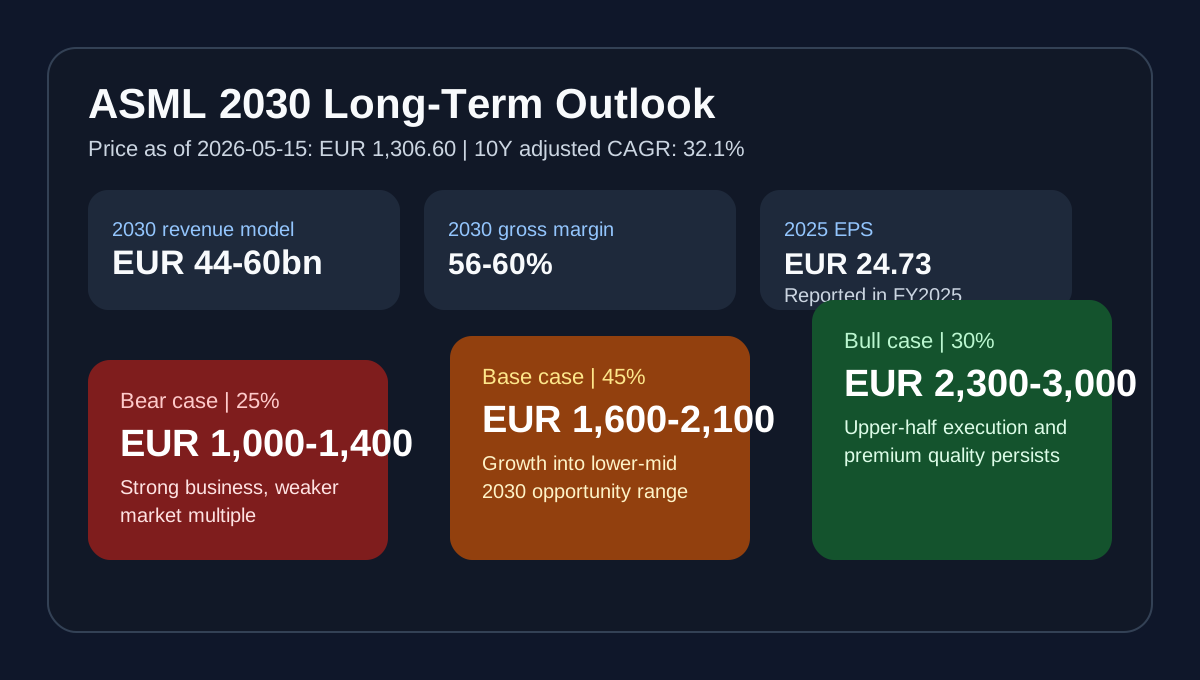
ASML is unusual because the company has already outlined a quantified long-term opportunity. At Investor Day 2024, management reiterated a 2030 revenue opportunity of EUR 44-60 billion and gross margin of 56-60%. That gives analysts a much firmer starting point than is typical for technology hardware names.
| Horizon | What matters most | What would strengthen the thesis | What would weaken the thesis |
|---|---|---|---|
| 1-3 months | 2026 guidance delivery | Revenue and margins trend toward the upper half of the range | Book-to-bill or commentary softens |
| 6-18 months | Demand durability and policy stability | Logic, AI, and services all stay firm | Export-control risk or order pushouts rise |
| To 2030 | Whether ASML grows into its premium valuation | Revenue approaches the long-term opportunity range with resilient margins | Growth underdelivers versus valuation expectations |
That long-term opportunity starts from a strong current base. ASML reported EUR 32.7 billion of sales and EUR 9.6 billion of net income in 2025, then guided to EUR 36-40 billion of sales for 2026. The business therefore does not need a speculative leap to justify higher long-term earnings; it needs sustained execution.
The stock, however, already reflects scarcity and quality. At around 47x trailing earnings in May 2026, future 2030 returns should be modeled with some multiple moderation unless earnings growth remains exceptional.
02. Key Forces
The 2030 debate is about how much premium quality is worth
ASML's strategic position is the clearest part of the story. EUV and High NA lithography remain indispensable to advanced semiconductor manufacturing, which is why the company can discuss 2030 in terms of quantified opportunity rather than generic optimism.
The harder part is valuation math. If the company moves into even the lower half of its EUR 44-60 billion 2030 revenue opportunity while protecting gross margin in the mid-to-high 50s, today's valuation can still be justified. If revenue growth comes in lighter or policy shocks disrupt shipments, the stock has enough multiple risk to offset a chunk of the operating progress.
| Factor | Latest evidence | Why it matters | Current assessment | Bias |
|---|---|---|---|---|
| Strategic demand | 2030 revenue opportunity of EUR 44-60 billion | Supports a long runway for earnings growth | One of the strongest secular setups in semicap | Bullish |
| Current growth base | 2026 sales guide of EUR 36-40 billion after EUR 32.7 billion in 2025 | Shows the long-term opportunity starts from real momentum | Strong | Bullish |
| Margin structure | 2026 gross margin guide of 51-53%; 2030 opportunity 56-60% | Margins determine how much revenue turns into equity value | Healthy and potentially improving | Neutral to Bullish |
| Valuation | About 47x trailing P/E in May 2026 | Requires sustained execution to avoid de-rating | Premium, with limited room for error | Neutral to Bearish |
| Policy risk | Export-control uncertainty remains embedded in guidance commentary | Can alter shipment timing and sentiment even with intact demand | Manageable, but never trivial | Neutral |
The 2030 case is therefore strong because the company has scarce technology and quantifiable long-term demand. The caution comes from the stock price, not the franchise quality.
03. Countercase
The bear case is a valuation problem more than a business-collapse case
The clearest long-term risk is not that ASML loses strategic importance. It is that the stock's premium multiple compresses faster than earnings grow. That can happen if shipments get delayed, export controls intensify, or customers stretch their capex cadence after a strong AI buildout phase.
The second risk is cyclicality hiding inside a secular story. ASML can still be structurally essential while going through one or two periods of order digestion that make the medium-term path much choppier than the long-term narrative suggests.
The third risk is discount-rate pressure. Euro area inflation came in at 3.0% in April 2026, and GDP growth was only 0.1% quarter on quarter in Q1 2026. For a premium-duration equity, the macro backdrop still matters even if it is not the core demand driver.
| Risk | Current data | What would confirm it | Current read |
|---|---|---|---|
| De-rating | Trailing P/E around 47x | High growth slows before margins expand enough | Main stock risk |
| Capex digestion | 2026 still expected to be a growth year | Customers start delaying rather than accelerating tools | Moderate risk |
| Policy disruption | Guidance still incorporates export-control uncertainty | Restrictions widen materially | Meaningful risk |
| Macro pressure | Euro area inflation at 3.0% in April 2026 | Rates stay restrictive for longer | Secondary but relevant |
The point is not that ASML is fragile. The point is that a premium stock can underperform without the underlying business thesis being broken.
04. Institutional Lens
Management's long-term targets justify optimism, but not complacency
ASML's April 15, 2026 results kept the near-term story constructive: EUR 8.8 billion of Q1 sales, EUR 2.8 billion of net income, and a full-year 2026 sales guide of EUR 36-40 billion with 51-53% gross margin. That supports another year of real operating growth.
The more important long-term signal remains Investor Day 2024. Management reiterated a 2030 revenue opportunity of EUR 44-60 billion and gross margin of 56-60%. Those are not vague aspirations; they are the company's stated medium-term operating framework.
Macro institutions are useful mainly as boundary conditions. Eurostat's 2026 growth and inflation releases, together with the IMF's 1.1% euro area growth forecast, suggest a decent but not euphoric macro corridor. That means ASML's 2030 upside still needs to come mostly from company execution and customer demand, not from a lower discount-rate miracle.
| Source | Update date | What it said | Why it matters here |
|---|---|---|---|
| ASML Q1 2026 results | April 15, 2026 | 2026 sales guide of EUR 36-40 billion and gross margin guide of 51-53% | Keeps the medium-term growth path intact |
| ASML FY2025 results | January 28, 2026 | EUR 32.7 billion sales, EUR 9.6 billion net income, EUR 38.8 billion backlog | Shows the present cycle already has scale |
| ASML Investor Day 2024 | November 14, 2024 | 2030 opportunity of EUR 44-60 billion revenue and 56-60% gross margin | Provides the backbone for long-term scenario work |
| Eurostat and IMF | April and May 2026 | Slow growth and still-elevated inflation | Defines discount-rate risk, not the main demand thesis |
The institutional evidence therefore argues for staying constructive on ASML as a company while remaining selective on the multiple investors are willing to underwrite.
05. Scenarios
A practical 2030 range should combine growth with some multiple normalization
These 2030 scenarios assume ASML continues to expand earnings materially from the 2025 EPS base of EUR 24.73, but that investors should not rely on the current valuation staying unchanged forever. The ranges are analytical outcomes, not management price targets.
| Scenario | Probability | Target range | Measured trigger | Review point |
|---|---|---|---|---|
| Bull | 30% | EUR 2,300-3,000 | ASML moves into the upper half of its EUR 44-60 billion 2030 opportunity and keeps margins close to the upper end of the 56-60% range | Re-check after each annual result; key milestone is whether 2027-2028 growth stays on track |
| Base | 45% | EUR 1,600-2,100 | Revenue reaches the lower-to-middle part of the 2030 opportunity range and the stock trades on somewhat lower but still premium valuation multiples | Re-check annually against sales growth, margin trend, and export-control developments |
| Bear | 25% | EUR 1,000-1,400 | Growth remains positive but too uneven to sustain a premium multiple, especially if policy risk or capex digestion intensifies | Re-check after any major downward revision to medium-term demand assumptions |
The base case remains attractive because ASML has few direct substitutes at the leading edge of lithography. The caution is that the stock already knows that.
Investors should therefore monitor not just revenue growth, but whether ASML keeps converting its strategic scarcity into enough profit growth to justify staying expensive.
References
Sources
- Yahoo Finance quote page for ASML (ASML.AS)
- Yahoo Finance 10-year chart data for ASML (ASML.AS)
- ASML Q1 2026 financial results, published April 15, 2026
- ASML fourth-quarter and annual results 2025, published January 28, 2026
- ASML Investor Day 2024
- Eurostat flash GDP estimate for Q1 2026, published April 30, 2026
- Eurostat flash inflation estimate for April 2026, published May 2, 2026
- IMF Regional Economic Outlook: Europe, April 2026