01. Historical Context
A 2035 view on ASML starts with strategic scarcity, not with near-term hype
ASML's last decade already proved what strategic scarcity can do: the stock compounded at about 32.1% annualized on an adjusted basis, from roughly EUR 80.61 to EUR 1,306.60. That is a reminder that truly dominant infrastructure franchises can support very large long-run returns.
| Horizon | What matters most | What would strengthen the thesis | What would weaken the thesis |
|---|---|---|---|
| 1-3 months | Whether the current growth year holds | 2026 guidance remains intact or improves | Export-control or order commentary deteriorates |
| 6-18 months | Cycle quality | Revenue, margins, and services all remain firm | Capex digestion becomes more visible |
| To 2035 | Whether ASML keeps monetizing its technological moat | Sustained growth into and beyond the 2030 opportunity window | Long-term growth becomes more cyclical than the market expects |
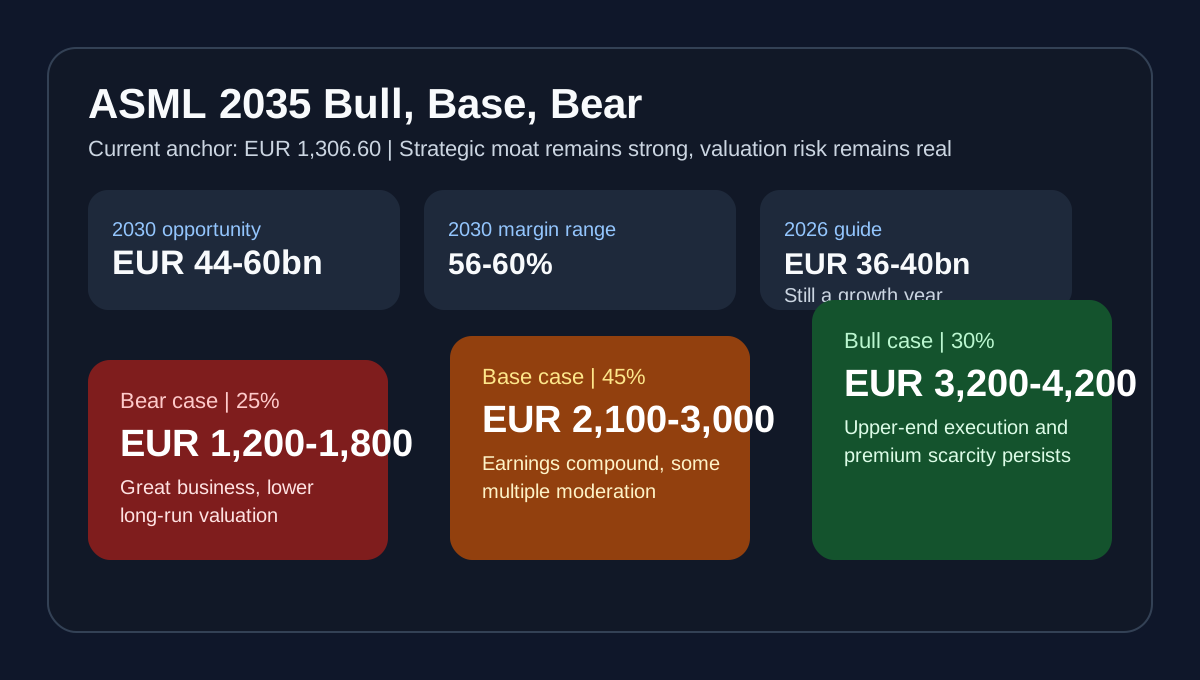
The long-term opportunity is unusually explicit. Investor Day 2024 laid out a 2030 revenue opportunity of EUR 44-60 billion with 56-60% gross margin. That makes the 2035 conversation much more concrete than the usual technology stock debate.
The valuation caveat remains critical. A stock that already trades on a premium multiple can still compound strongly over another decade, but the contribution from valuation should probably be smaller than it was in the last 10 years.
02. Key Forces
The 2035 bull case depends on durability, not just leadership
ASML's competitive moat is the easiest part of the thesis. The harder part is estimating how much of that moat the market is already capitalizing. By 2035, the company can still justify very attractive returns if it keeps extending its role in advanced logic and memory capacity build-outs while growing services and preserving high gross margins.
The key long-term positive is that ASML does not need every year to be perfect. It needs the multi-year arc of revenue, margins, and capital intensity to remain consistent with the company's strategic importance. The key long-term negative is that investors may eventually pay less for that same quality than they do today.
| Factor | Latest evidence | Why it matters | Current assessment | Bias |
|---|---|---|---|---|
| Technological moat | ASML remains central to advanced lithography | Supports long-duration pricing power and relevance | The moat remains exceptional | Bullish |
| Long-term operating model | 2030 opportunity of EUR 44-60 billion revenue and 56-60% gross margin | Provides a quantified bridge to higher long-term earnings | Very supportive | Bullish |
| Current growth base | 2026 sales guide of EUR 36-40 billion | Reduces the need for speculative assumptions | Strong | Bullish |
| Valuation risk | Premium earnings multiple in May 2026 | Long-term stock returns may trail business quality if the multiple compresses | Persistent risk | Neutral to Bearish |
| Policy and cycle risk | Export controls and capex timing still matter | Can interrupt the path even if the endpoint remains attractive | Manageable but recurring | Neutral |
The conclusion is that ASML still deserves a premium strategic valuation. The question is how much premium should be paid from a starting point that is already rich.
03. Countercase
The long-term bear case is not technological obsolescence; it is valuation drag
The most credible bearish path to 2035 is that ASML remains a very good business, but the stock spends large stretches of time repricing around cycle resets, export restrictions, or capex pauses. In that version of the future, business quality stays high but investor returns depend much more on entry price.
The second risk is that the market may eventually demand more proof and less promise. As companies mature, investors often assign lower multiples even when revenue keeps growing. That effect can matter a great deal over a nine-year horizon.
The third risk is macro and policy regime shift. Sticky inflation, tighter real rates, or broader restrictions on tool shipments could all lower the multiple investors are willing to pay, even if long-term semiconductor demand remains positive.
| Risk | Current evidence | What would confirm it | Current read |
|---|---|---|---|
| Multiple compression | Stock already trades at premium earnings multiples | Growth slows toward a more normal hardware cadence | Main 2035 risk |
| Policy drag | Export-control uncertainty remains part of official commentary | Restrictions expand in scope or duration | Material risk |
| Cycle volatility | Semicap demand is strong but still cyclical | Customers pause after major AI-related buildouts | Recurring risk |
| Discount-rate pressure | Euro area inflation ran at 3.0% in April 2026 | Premium growth equities stay structurally less favored | Secondary but relevant |
The key discipline is to separate a great company from a stock that may not compound at the same rate forever.
04. Institutional Lens
Official long-term signals remain unusually strong for ASML
ASML's April 15, 2026 quarter showed another growth year is still the official base case: EUR 8.8 billion of Q1 sales, EUR 2.8 billion of net income, and full-year 2026 sales guidance of EUR 36-40 billion. That is the near-term bridge.
The long-term anchor remains Investor Day 2024, where management reiterated EUR 44-60 billion of 2030 revenue opportunity and 56-60% gross margin. Few companies of ASML's size publish such a clear long-range framework, and it is why the 2035 conversation can stay rooted in disclosed numbers.
Macro institutions provide the valuation backdrop rather than the operating thesis. Eurostat and IMF data still describe a moderate European growth environment with inflation not fully solved. For ASML, that matters because premium-growth stocks are sensitive to discount rates even when their business fundamentals are stronger than the macro cycle.
| Source | Update date | What it said | Why it matters here |
|---|---|---|---|
| ASML Q1 2026 results | April 15, 2026 | 2026 remains a growth year with EUR 36-40 billion sales guidance | Confirms the current cycle still supports the long-term bridge |
| ASML FY2025 results | January 28, 2026 | EUR 32.7 billion sales, 52.8% gross margin, EUR 9.6 billion net income | Shows the long-term thesis already has a strong earnings base |
| ASML Investor Day 2024 | November 14, 2024 | 2030 opportunity of EUR 44-60 billion revenue and 56-60% gross margin | Anchors long-term scenario construction |
| Eurostat and IMF | April and May 2026 | Slow growth and still-elevated inflation backdrop | Explains why long-term valuation discipline still matters |
The official data therefore support staying constructive on ASML through 2035, but with explicit respect for starting valuation.
05. Scenarios
The 2035 setup is attractive, but the range should stay wide
These scenario ranges assume ASML remains a strategically central semicap company through the next decade, but that stock-market outcomes will depend on both operating performance and how investors price that performance. They are analytical ranges, not official company targets.
| Scenario | Probability | Target range | Measured trigger | Review point |
|---|---|---|---|---|
| Bull | 30% | EUR 3,200-4,200 | ASML delivers near the top of its long-term opportunity range, sustains very high margins, and preserves premium strategic scarcity across the cycle | Re-check annually; key medium-term tests are 2027-2030 execution versus the Investor Day framework |
| Base | 45% | EUR 2,100-3,000 | Revenue and earnings compound strongly, but valuation is somewhat lower than today's premium starting point | Re-check annually against sales growth, gross margin, and policy risk |
| Bear | 25% | EUR 1,200-1,800 | The business stays important but the stock is re-rated as a more cyclical semicap name over time | Re-check if medium-term growth assumptions are revised lower or policy risk intensifies |
The long-term thesis remains compelling because ASML occupies a scarce and durable position in the semiconductor stack. The main limitation is that investors already know this and price the stock accordingly.
For long-horizon investors, the stock can still work very well from here, but the path is most likely to be driven by earnings compounding and less by multiple expansion than in the last decade.
References
Sources
- Yahoo Finance quote page for ASML (ASML.AS)
- Yahoo Finance 10-year chart data for ASML (ASML.AS)
- ASML Q1 2026 financial results, published April 15, 2026
- ASML fourth-quarter and annual results 2025, published January 28, 2026
- ASML Investor Day 2024
- Eurostat flash GDP estimate for Q1 2026, published April 30, 2026
- Eurostat flash inflation estimate for April 2026, published May 2, 2026
- IMF Regional Economic Outlook: Europe, April 2026