01. Historical Context
ASML enters 2027 with both structural strength and valuation risk
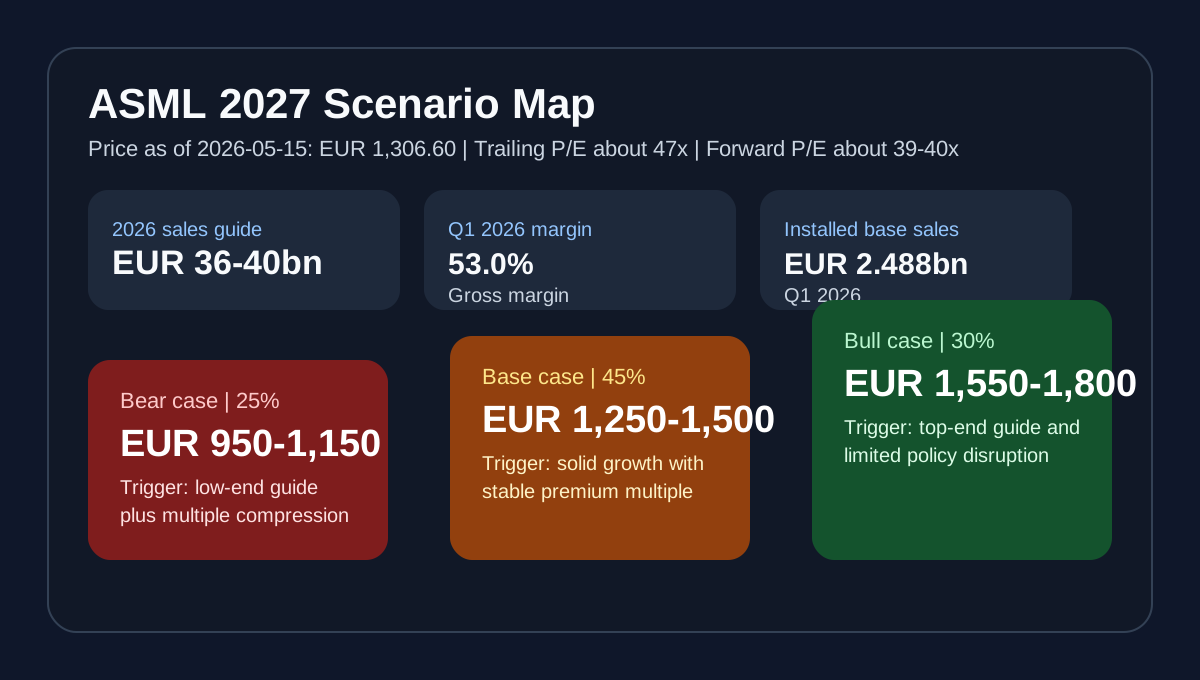
ASML's adjusted share price has risen from about EUR 80.61 to EUR 1,306.60 over the last 10 years, equivalent to roughly 32.1% annualized compounding. That is exceptional performance, and it explains why the stock now trades much more on expectations around future lithography demand and AI infrastructure spending than on near-term cyclical bargain hunting.
| Horizon | What matters most | What would strengthen the thesis | What would weaken the thesis |
|---|---|---|---|
| 1-3 months | 2026 revenue guidance credibility | Sales trend stays consistent with the upper half of guidance | Export-control or order-timing noise worsens |
| 6-18 months | Bookings, gross margin, and services stability | Customer demand remains elevated and margins stay above 53% | Book-to-bill weakens and valuation compresses |
| To 2027 | Whether AI and logic demand keeps absorbing a premium multiple | Growth remains strong enough to justify high-30s forward P/E | Growth slows into a lower-quality capex cycle |
ASML reported 2025 net sales of EUR 32.7 billion, gross margin of 52.8%, net income of EUR 9.6 billion, EPS of EUR 24.73, and a year-end backlog of EUR 38.8 billion. On April 15, 2026, the company reported Q1 2026 net sales of EUR 8.8 billion, gross margin of 53.0%, net income of EUR 2.8 billion, and said it expected 2026 total net sales of EUR 36-40 billion with gross margin of 51-53%.
The stock is therefore supported by real earnings power, not only by a thematic story. But because ASML is already near its 10-year high, future returns depend on whether that earnings power arrives cleanly enough to prevent a large multiple reset.
02. Key Forces
ASML has better fundamentals than most semicap peers, but a richer price too
Yahoo Finance data in May 2026 put ASML around 47x trailing earnings. Using the current price and the market's roughly 39-40x forward P/E, the stock implies forward EPS of about EUR 33, or about one-third above the EUR 24.73 EPS reported for 2025. That is a powerful growth assumption, but not an impossible one if EUV, High NA, and installed-base services continue to scale.
The operational backdrop remains supportive. In the April 15, 2026 release, ASML said customer demand expectations had increased for both the short and medium term, installed base management sales reached EUR 2.488 billion in Q1, and management still expected 2026 to be a growth year. The risk is not that demand disappears; it is that order timing and export controls inject enough uncertainty to compress the multiple.
| Factor | Latest evidence | Why it matters | Current assessment | Bias |
|---|---|---|---|---|
| Demand | 2026 sales guidance of EUR 36-40 billion; management says demand expectations increased | Supports another growth year and sustains investor confidence | Demand is strong and broad enough to support growth | Bullish |
| Recurring revenue | Q1 2026 installed base management sales of EUR 2.488 billion | Adds resilience versus purely shipment-driven models | Recurring mix remains a quality support | Bullish |
| Margins | 53.0% Q1 2026 gross margin; 51-53% full-year guide | High margins justify part of the premium multiple | Still healthy, but the range leaves room for volatility | Neutral to Bullish |
| Valuation | About 47x trailing earnings and roughly 39-40x forward earnings | Magnifies the stock's sensitivity to any guidance wobble | Premium valuation remains the main tactical risk | Neutral to Bearish |
| Policy risk | Guidance explicitly includes uncertainty around export controls | Can affect shipments, customer timing, and market sentiment | Manageable for now, but still a real headline risk | Neutral |
That mix explains why ASML is still a high-quality long story but not an easy stock. The business is excellent; the margin for error in the valuation is thinner.
03. Countercase
What would break the 2027 upside case
The first risk is valuation. A stock trading around 47x trailing EPS and about 39-40x forward EPS can still rise, but it cannot absorb many disappointments. If revenue ends up nearer the low end of the EUR 36-40 billion range, the market may start to question whether a high-30s forward multiple is still appropriate.
The second risk is policy. ASML's own April 2026 guidance range acknowledges uncertainty tied to export controls. That matters because even when long-term demand is intact, shipment timing and customer behavior can still move enough to unsettle a richly valued stock.
The third risk is cyclicality within semiconductor capex. Logic and AI spending are supportive now, but order timing in semicap is rarely smooth. If customers pause, delay, or rebalance capex after a strong wave of AI infrastructure commitments, the stock can re-rate lower before the long-term thesis changes.
| Risk | Latest data point | Why it matters | Current read |
|---|---|---|---|
| Growth disappointment | 2026 sales guide is EUR 36-40 billion | The low end would likely be too soft for the present multiple | Watch closely |
| Margin pressure | Full-year gross margin guide is 51-53% | Margins anchor quality perception and justify premium valuation | Still strong |
| Export-control shock | Guidance explicitly references uncertainty around controls | Could disrupt order timing and sentiment | Meaningful risk |
| Valuation reset | About 47x trailing EPS | Any miss can trigger faster de-rating than in lower-multiple peers | Main stock-specific risk |
The key distinction is that ASML's business can stay excellent while the stock still underperforms for a period. At this valuation, good is not always enough; the company often needs to be better than expected.
04. Institutional Lens
The latest official data still support the growth thesis
ASML's April 15, 2026 Q1 release said the company generated EUR 8.8 billion of total net sales and EUR 2.8 billion of net income in the quarter, and now expected 2026 total net sales of EUR 36-40 billion with gross margin of 51-53%. Management also said customer demand expectations had increased for both the short and medium term and that 2026 should be another growth year.
For longer-duration context, ASML's 2024 Investor Day reiterated a 2030 revenue opportunity of EUR 44-60 billion with gross margin of 56-60%. That is one of the strongest official long-term operating targets in European technology and explains why the market keeps awarding the company a premium multiple.
Macro data matter less here than for Airbus, but they still set the discount-rate backdrop. Eurostat reported euro area GDP growth of 0.1% quarter on quarter in Q1 2026 and April 2026 inflation of 3.0%, while the IMF's April 2026 Europe outlook projected 1.1% euro area growth for 2026. In other words, the macro regime is not strong enough to carry ASML by itself; the company still has to do most of the work through fundamentals.
| Source | Update date | What it said | Why it matters here |
|---|---|---|---|
| ASML Q1 2026 results | April 15, 2026 | EUR 8.8 billion sales, EUR 2.8 billion net income, 2026 sales guide of EUR 36-40 billion | Confirms another growth year remains the base case |
| ASML FY2025 results | January 28, 2026 | EUR 32.7 billion sales, 52.8% gross margin, EUR 9.6 billion net income, EUR 38.8 billion backlog | Shows the current cycle already has strong operating support |
| ASML Investor Day | November 14, 2024 | 2030 revenue opportunity of EUR 44-60 billion and gross margin of 56-60% | Anchors the long-term premium case |
| Eurostat and IMF | April and May 2026 | Slow euro area growth and still-elevated inflation | Sets the discount-rate backdrop, not the core demand thesis |
The official read-through stays constructive: ASML still has both near-term growth and long-term strategic scarcity. The caveat is that those strengths are already reflected in the stock to a significant degree.
05. Scenarios
A 2027 framework for ASML must balance operating strength and multiple risk
The ranges below combine the current price, current valuation, reported 2025 EPS, implied forward EPS, and the execution conditions required for the market to keep paying a premium multiple through the end of 2027.
| Scenario | Probability | Target range | Measured trigger | Review point |
|---|---|---|---|---|
| Bull | 30% | EUR 1,550-1,800 | 2026 sales land near the top of the EUR 36-40 billion range, gross margin stays around or above 53%, and customer demand keeps improving without a major export-control setback | Re-check after FY2026 results in January 2027 |
| Base | 45% | EUR 1,250-1,500 | 2026 growth remains solid, services stay resilient, and the stock holds a high-30s forward multiple rather than re-rating higher | Re-check after H1 2027 results |
| Bear | 25% | EUR 950-1,150 | 2026 lands nearer the low end of guidance, export-control uncertainty worsens, or order timing weakens enough to compress the multiple toward the low-30s | Re-check immediately if guidance is cut or order commentary weakens materially |
Investors already long should treat the highest-risk part of the thesis as multiple compression, not business collapse. Investors without a position need to decide whether they are paying for structural quality or for near-perfect execution; right now, the market still asks for both.
The base case remains positive, but it is positive with a narrower margin of safety than the quality of the business alone might suggest.
References
Sources
- Yahoo Finance quote page for ASML (ASML.AS)
- Yahoo Finance 10-year chart data for ASML (ASML.AS)
- ASML Q1 2026 financial results, published April 15, 2026
- ASML fourth-quarter and annual results 2025, published January 28, 2026
- ASML Investor Day 2024
- Eurostat flash GDP estimate for Q1 2026, published April 30, 2026
- Eurostat flash inflation estimate for April 2026, published May 2, 2026
- IMF Regional Economic Outlook: Europe, April 2026