01. Historical Context
AstraZeneca in context: what the current valuation is actually asking investors to believe
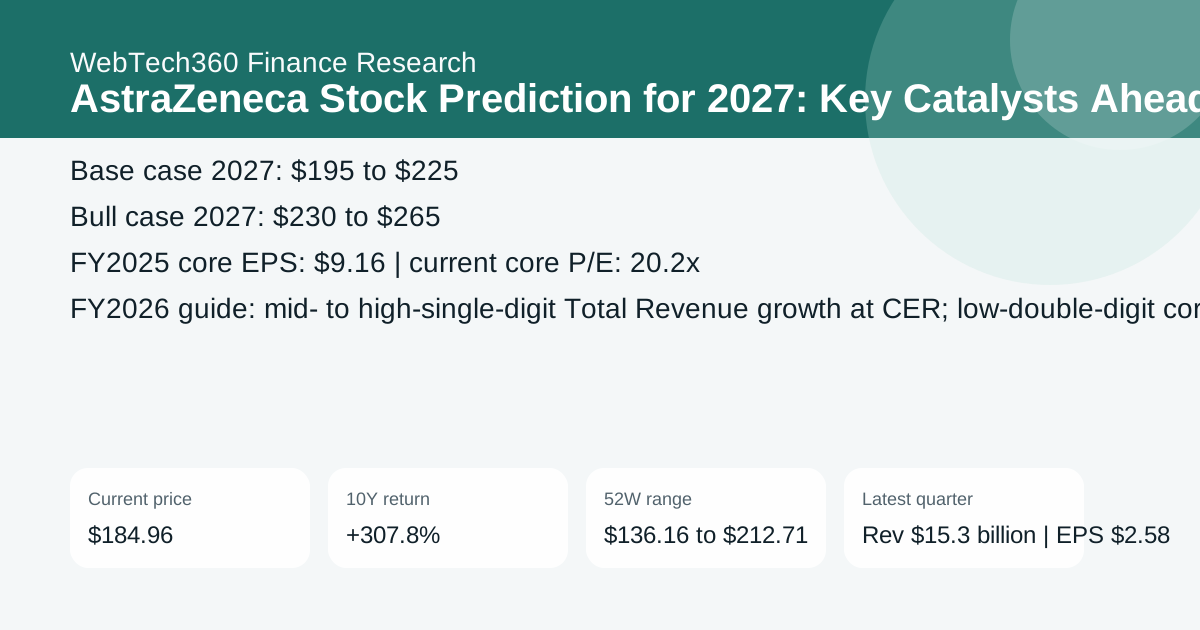
At $184.96 on May 14, 2026, the ADR already discounts a lot of success. The stock is up +307.8% from $45.36 on June 1, 2016 and has compounded at roughly 15.2% a year over the past decade.
The hard data still supports a quality story. AstraZeneca reported FY2025 revenue of $58.7 billion with +18% at constant exchange rates and core EPS of $9.16. In Q1 2026, revenue reached $15.3 billion (+13% reported, +8% at CER) and core EPS reached $2.58 (+4% reported, +5% at CER).
That is why the current debate is not whether the company is good. It is whether future launches, line extensions and indication expansions are strong enough to justify valuation that still sits near 20.2x on FY2025 core EPS and roughly 18x forward.
| Horizon | What matters now | What would strengthen the thesis | What would weaken the thesis |
|---|---|---|---|
| Next 6 months | Guidance credibility, key events, and FX | Quarterly results keep beating the implied pace | Guidance slips or a major event turns negative |
| 12-24 months | Launch quality, cash conversion, and balance-sheet pressure | New products outgrow legacy drag | Cash flow or divisional execution weakens |
| To 2027 | Sustainable EPS compounding and the multiple investors will still pay | Execution proves durable enough to hold the valuation | Execution weakens and the market stops paying a premium |
02. Key Forces
Five forces that matter most from here
The first force is guidance credibility. Management reaffirmed on April 29, 2026 that FY2026 should deliver mid- to high-single-digit Total Revenue growth at CER with low-double-digit core EPS growth at CER. If the next two quarters keep that pace, the 2027 discussion can stay constructive even without a bigger multiple.
Second, investors should separate reported and underlying valuation. On FY2025 reported EPS of $6.60, the ADR is near 28.0x trailing earnings. On core EPS of $9.16, it is closer to 20.2x.
Third, the 10-year chart matters for behavioral reasons. AZN has returned +307.8% over a decade and traded between $39.80 to $206.30 on a monthly adjusted basis.
Fourth, the 2030 growth bridge still matters. Reuters said on April 29, 2026 that LSEG consensus still points to roughly $80 billion of 2030 sales.
Fifth, macro is a discount-rate input, not the thesis. Positive global growth is supportive, but it does not guarantee further P/E expansion for an already-expensive healthcare leader.
| Factor | Current assessment | Bias | What would improve it | What would weaken it |
|---|---|---|---|---|
| Operating momentum | Latest quarter revenue was $15.3 billion after FY2025 revenue of $58.7 billion. | Constructive | Another quarter of volume and mix-driven growth | A guidance cut or weaker divisional mix |
| Earnings quality | Latest quarter core EPS was $2.58. | Constructive | Cash conversion and margin stability | One-off items start masking softer underlying demand |
| Balance sheet / cash flow | The market wants proof that earnings translate into clean cash. | Neutral | Lower leverage or better free cash flow | More cash drain, debt pressure, or legal outflows |
| Valuation | The stock trades around 20.2x on the latest core earnings base and 18x forward by current assumptions. | Neutral to rich | EPS upgrades without another multiple jump | Any sign the market already paid for perfection |
| Catalyst path | Management said in Q1 2026 that it was preparing for multiple launches and further readouts this year while remaining on track for its 2030 ambition. | Event-driven | Clear approvals, launches, or legal de-risking | A regulatory setback or delayed decision |
03. Countercase
What would break the thesis
The cleanest risk is valuation compression. Using FY2025 reported EPS of $6.60, the ADR is near 28.0x trailing earnings. Even on core EPS, the multiple is about 20.2x.
Pipeline risk is no longer theoretical. On April 30, 2026, the FDA Oncologic Drugs Advisory Committee voted 6-3 against camizestrant in the SERENA-6 setting. That does not break the long-term thesis on its own, but it shows how quickly market confidence can wobble when one of the next-wave assets disappoints.
There is also a replacement risk from loss of exclusivity and pricing pressure. If launches fail to offset those headwinds, the stock can de-rate even if headline revenue still rises.
Macro is a second-order risk rather than the main driver, but a higher discount rate still matters for a stock already priced as a premium compounder.
| Risk | Current data point | Why it matters now | Review trigger |
|---|---|---|---|
| Valuation fatigue | 28.0x trailing reported P/E and 20.2x trailing core P/E. | The stock is expensive enough that merely meeting expectations may not be enough. | A lower multiple without business deterioration would improve the setup. |
| Regulatory friction | Camizestrant received a 6-3 negative ODAC vote on April 30, 2026. | The pipeline is valuable, but not every late-stage asset will convert cleanly. | Watch the final FDA decision and any change to label scope. |
| Patent / pricing pressure | Management still frames 2026 as a year of multiple launches and offsetting LOE pressure. | If replacement assets slip, the market will likely punish the stock before reported revenue fully shows it. | Re-check after each quarterly launch update and the FY2026 report. |
| Macro / FX | IMF projects 3.1% global growth in 2026 and 4.4% headline inflation. | Higher rates and FX swings can hit reported pharma numbers even when CER trends hold. | Review after major central-bank shifts or if USD strength changes reported growth. |
04. Institutional Lens
What current institutional work adds to the analysis
AstraZeneca's own April 29, 2026 release showed revenue above $15 billion and core EPS of $2.58, while Reuters said LSEG still models 2026 sales growth of 7.2% and profit growth of 11.2%.
That combination says the market still believes in the franchise, but it also says much of the easy 2027 upside already requires continued beats.
IMF's April 2026 macro baseline matters because AstraZeneca's premium multiple is easier to defend in a world of 3%-ish global growth than in a world of renewed inflation shocks.
| Source | Latest update | What it said | Why it matters |
|---|---|---|---|
| Company results | April 29, 2026 | Latest quarter delivered revenue of $15.3 billion and core EPS of $2.58. | This is the cleanest read on whether the base case is intact. |
| Annual results | February 10, 2026 | FY2025 revenue was $58.7 billion and the full-year earnings base was $9.16 core EPS with reported EPS of $6.60. | It anchors valuation work and avoids projecting from a single quarter. |
| Reuters / consensus | April-May 2026 | Reuters reported on April 29, 2026 that LSEG consensus still implies 2026 sales growth of 7.2% and profit growth of 11.2%, while analysts continue to model roughly $80 billion of sales by 2030. | This is the best public cross-check on how much good news the market already prices in. |
| IMF | April 14, 2026 | IMF said on April 14, 2026 that global growth is projected at 3.1% in 2026 and 3.2% in 2027, with headline inflation rising to 4.4% in 2026 before easing again in 2027. That matters mainly through discount rates and FX. | Macro does not drive product cycles directly, but it changes discount-rate tolerance and FX noise. |
05. Scenarios
Scenario analysis investors can actually use
Base case, probability 50%: the ADR ends 2027 in the $195 to $225 range. That assumes FY2026 guidance is met, FY2027 still shows mid- to high-single-digit revenue growth, and the market values the business at about 18x to 20x forward core earnings.
Bull case, probability 25%: the stock reaches $230 to $265. That needs a cleaner regulatory slate after the camizestrant setback, a visible launch contribution from the 2026-2027 pipeline, and enough confidence for the market to hold a 20x to 22x core multiple.
Bear case, probability 25%: the stock falls into $145 to $175. That would likely come from a combination of launch delays, more regulatory friction, and a de-rating toward the mid-teens on earnings.
| Scenario | Probability | Price range | Measurable trigger | Review date | Suggested posture |
|---|---|---|---|---|---|
| Bull | 25% | $230 to $265 | FY2026 growth stays on track, major launches convert, and regulatory news turns positive again | Q3 2026 and FY2026 results | Let winners run, but size around regulatory dates |
| Base | 50% | $195 to $225 | Revenue and core EPS track guidance, with valuation stable around the current band | Every quarter through February 2027 | Hold core exposure; add only on pullbacks that keep the thesis intact |
| Bear | 25% | $145 to $175 | Two weak quarters, another material pipeline setback, or a move to a mid-teens core multiple | Immediately after any guidance cut | Protect capital first; wait for evidence before averaging down |
References
Sources
- Yahoo Finance chart data for AstraZeneca ADR (AZN), including latest price and 10-year monthly history
- AstraZeneca FY and Q4 2025 results, February 10, 2026
- AstraZeneca Q1 2026 results announcement, April 29, 2026
- Reuters on AstraZeneca Q1 2026 results and LSEG growth expectations, April 29, 2026
- Reuters on the negative camizestrant advisory-panel vote, May 1, 2026
- IMF World Economic Outlook, April 2026
- AstraZeneca on AI-enabled drug discovery and development