01. Historical Context
Bayer in context: what the current discount is actually pricing
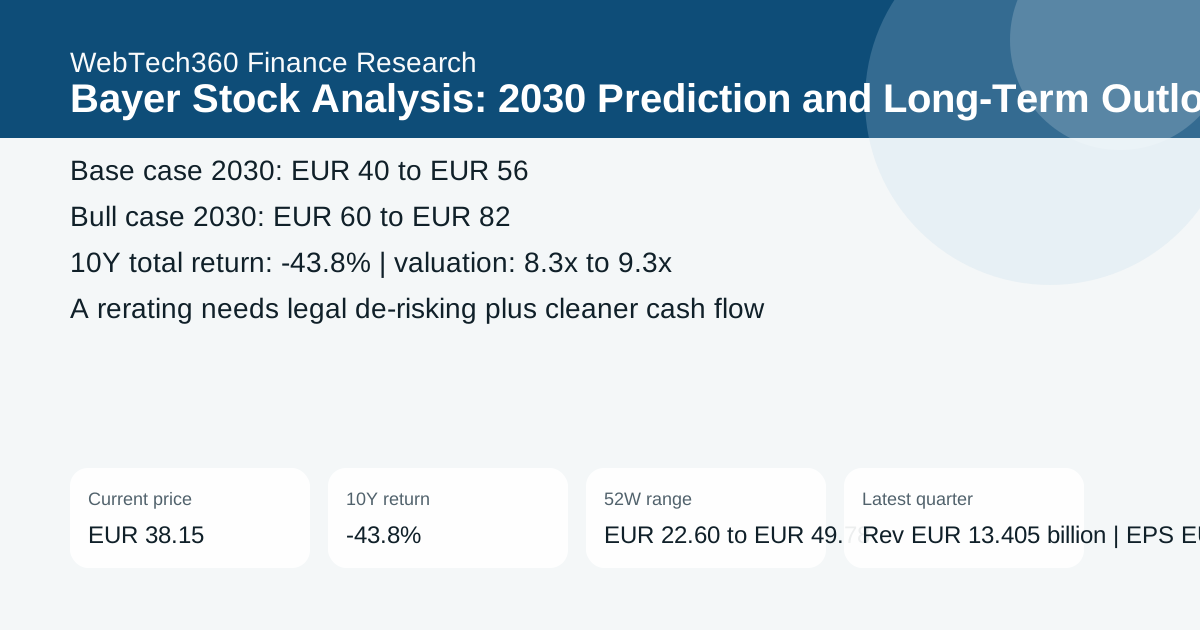
At EUR 38.15 on May 15, 2026, Bayer is still a turnaround and litigation story, not a finished quality compounder. The share is down -43.8% from EUR 67.87 on May 31, 2016 and its monthly adjusted range over the last decade spans EUR 19.17 to EUR 89.06.
The latest operating data is better than the long chart suggests. Bayer reported FY2025 sales of EUR 46.6 billion, and in Q1 2026 sales rose to EUR 13.405 billion (+4.1% currency- and portfolio-adjusted), EBITDA before special items rose to EUR 4.453 billion (+9.0%), and core EPS improved to EUR 2.71 (+12.9%).
Even so, the stock is still being valued through the legal overhang. Reported FY2025 EPS was negative EUR 3.68, so a normal trailing P/E is not useful. Investors instead fall back on core EPS, where the stock trades around 8.3x on the latest full-year base and 8.3x to 9.3x forward.
| Horizon | What matters now | What would strengthen the thesis | What would weaken the thesis |
|---|---|---|---|
| Next 6 months | Guidance credibility, key events, and FX | Quarterly results keep beating the implied pace | Guidance slips or a major event turns negative |
| 12-24 months | Launch quality, cash conversion, and balance-sheet pressure | New products outgrow legacy drag | Cash flow or divisional execution weakens |
| To 2030 | Sustainable EPS compounding and the multiple investors will still pay | Execution proves durable enough to hold the valuation | Execution weakens and the market stops paying a premium |
02. Key Forces
Five forces that matter most from here
Bayer's 2030 case starts with valuation asymmetry. At EUR 38.15 and about 8.3x to 9.3x on current 2026 core EPS guidance, the stock does not need heroic assumptions to produce acceptable upside.
Second, the operational base is better than the share history suggests. Q1 2026 sales were EUR 13.405 billion and core EPS was EUR 2.71, while Crop Science EBITDA before special items rose 17.9% to EUR 3.014 billion.
Third, 2030 depends on whether Pharmaceuticals can become a positive offset rather than a drag.
Fourth, the legal profile still dominates the discount rate. As long as investors see more than 100,000 claims and EUR 5 billion of expected 2026 litigation payouts, they will be reluctant to pay a premium multiple.
Fifth, macro remains relevant through farmer economics, FX and borrowing costs.
| Factor | Current assessment | Bias | What would improve it | What would weaken it |
|---|---|---|---|---|
| Operating momentum | Latest quarter revenue was EUR 13.405 billion after FY2025 revenue of EUR 46.6 billion. | Mixed to constructive | Another quarter of volume and mix-driven growth | A guidance cut or weaker divisional mix |
| Earnings quality | Latest quarter core EPS was EUR 2.71. | Mixed | Cash conversion and margin stability | One-off items start masking softer underlying demand |
| Balance sheet / cash flow | The market wants proof that earnings translate into clean cash. | Bearish on legal overhang | Lower leverage or better free cash flow | More cash drain, debt pressure, or legal outflows |
| Valuation | The stock trades around 8.3x on the latest core earnings base and 8.3x to 9.3x forward by current assumptions. | Cheap | EPS upgrades without another multiple jump | Any sign the market already paid for perfection |
| Catalyst path | The operating case improved in Q1 2026 because Crop Science EBITDA before special items rose 17.9% to EUR 3.014 billion, but Pharmaceuticals still has to prove that launch assets can offset loss-of-exclusivity pressure. | Event-driven | Clear approvals, launches, or legal de-risking | A regulatory setback or delayed decision |
03. Countercase
What would break the thesis
Bayer's Annual Report 2025 says glyphosate provisions and liabilities totaled US$11.3 billion (EUR 9.6 billion) as of December 31, 2025, and management expects about EUR 5 billion of litigation payouts in 2026.
The second risk is that Q1 2026 may overstate operating momentum. Crop Science benefited from a soy licensing resolution and better seed performance, but Pharmaceuticals still has to deal with loss-of-exclusivity pressure. Q1 2026 free cash flow was minus EUR 2.320 billion.
Third, the share is cheap for a reason. A core multiple of only 8.3x looks attractive, but it is only cheap if the legal bill stops growing and if 2026 guidance actually translates into cleaner cash generation in 2027 and beyond.
Finally, macro matters through agriculture and rates. Bayer is more exposed than premium pharma peers to lower farmer sentiment, FX swings and a higher cost of capital.
| Risk | Current data point | Why it matters now | Review trigger |
|---|---|---|---|
| Glyphosate litigation | Provision and liabilities were US$11.3 billion (EUR 9.6 billion) at December 31, 2025. | That overhang still dominates free cash flow and investor confidence. | Supreme Court ruling expected by end-June 2026 and any settlement updates. |
| Cash flow strain | Q1 2026 free cash flow was minus EUR 2.320 billion. | Strong EBITDA does not help equity holders much if cash leaves through litigation and restructuring. | Watch Q2 and full-year free cash flow versus guidance. |
| Pharma execution | Q1 Pharma sales were roughly in line year on year while segment earnings fell. | A rerating needs proof that new launches can offset older-product pressure. | Re-check after each quarterly divisional update. |
| Valuation trap risk | The stock looks cheap at 8.3x to 9.3x forward core EPS, but reported FY2025 EPS was negative EUR 3.68. | Cheap valuation does not help if legal and cash-flow risk remain unresolved. | The setup improves only if cash generation normalizes after legal payments. |
04. Institutional Lens
What current institutional work adds to the analysis
Company guidance says 2026 should still deliver EUR 45 billion to EUR 47 billion of sales at constant FX and core EPS of EUR 4.30 to EUR 4.80, while Reuters says the Supreme Court decision should arrive by the end of June 2026.
That means the 2030 thesis can improve quickly if one binary risk is reduced. It also means investors should resist the temptation to assume that one strong quarter alone fixes Bayer's cost of capital.
IMF's April 2026 macro baseline is a helpful external check because Bayer's agricultural and consumer exposure is more economically sensitive than AstraZeneca's.
| Source | Latest update | What it said | Why it matters |
|---|---|---|---|
| Company results | May 12, 2026 | Latest quarter delivered revenue of EUR 13.405 billion and core EPS of EUR 2.71. | This is the cleanest read on whether the base case is intact. |
| Annual results | March 4, 2026 | FY2025 revenue was EUR 46.6 billion and the full-year earnings base was EUR 4.57 under the new 2026 methodology and EUR 4.91 under the old presentation core EPS with reported EPS of negative EUR 3.68. | It anchors valuation work and avoids projecting from a single quarter. |
| Company outlook | May 12, 2026 | Bayer confirmed on May 12, 2026 that currency-adjusted 2026 guidance still calls for EUR 45 billion to EUR 47 billion of sales and EUR 4.30 to EUR 4.80 of core EPS, while the FX-refreshed range is EUR 44.5 billion to EUR 46.5 billion of sales and EUR 4.10 to EUR 4.60 of core EPS. | This is the clearest public bridge from current operations to 2026 earnings power. |
| Reuters legal | April 27, 2026 | Reuters reported on April 27, 2026 that the U.S. Supreme Court appeared divided in Bayer's Roundup case and that a ruling is expected by the end of June 2026. Reuters also noted the outcome could influence the fate of more than 100,000 glyphosate-related claims. | This is the main public marker for the discount-rate shock that still dominates the stock. |
05. Scenarios
Scenario analysis investors can actually use
Base case, probability 40%: Bayer reaches EUR 40 to EUR 56 by 2030. That assumes the legal overhang shrinks over time, free cash flow normalizes after the heavy 2026 payouts, and core EPS grows enough for the market to keep valuing the stock near 8x to 10x earnings.
Bull case, probability 35%: the share reaches EUR 60 to EUR 82. That path needs meaningful legal de-risking, better Pharma execution, and a genuine re-rating toward 10x to 12x on higher normalized core EPS.
Bear case, probability 25%: the share lands in EUR 22 to EUR 36. That would likely mean the litigation shadow remains stubborn, cash generation disappoints, and the market continues treating Bayer as a value trap rather than a recovery story.
| Scenario | Probability | Price range | Measurable trigger | Review date | Suggested posture |
|---|---|---|---|---|---|
| Bull | 35% | EUR 60 to EUR 82 | Legal visibility improves and core EPS rises clearly above the current guidance architecture | After the Supreme Court ruling and each annual report | Own upside, but keep legal-event discipline |
| Base | 40% | EUR 40 to EUR 56 | Moderate EPS recovery and limited multiple expansion from a cheap base | Annual review through 2030 | Prefer staged accumulation over aggressive averaging |
| Bear | 25% | EUR 22 to EUR 36 | Cash drain and litigation keep rerating blocked | Any large adverse legal or cash-flow surprise | Treat the stock as speculative until evidence changes |
References
Sources
- Yahoo Finance chart data for Bayer (BAYN.DE), including latest price and 10-year monthly history
- Bayer Annual Report 2025
- Bayer Corporate Outlook in the Q1 2026 quarterly statement, published May 12, 2026
- Bayer Q1 2026 media update and guidance confirmation, May 12, 2026
- Reuters on Bayer's U.S. Supreme Court Roundup case, April 27, 2026
- Reuters on Bayer Q1 2026 operating profit, May 12, 2026
- IMF World Economic Outlook, April 2026
- Bayer-Cradle AI antibody discovery collaboration, January 7, 2026