Home
» Today
»
Beaver Moon Peaks Today: Viewing Guide for Nov. 24, 2026
Beaver Moon Peaks Today: Viewing Guide for Nov. 24, 2026
Updated Nov. 24, 2026, 8:55 a.m. UTC (3:55 a.m. EST).
The November Beaver Moon reaches its exact full phase today, Tuesday, Nov. 24, at 14:53 UTC—9:53 a.m. Eastern Standard Time. That means the Moon will look full tonight across the United States, even though the precise astronomical moment happens in daylight for most U.S. time zones. For the best first look, choose a clear eastern horizon around your local moonrise, typically near sunset; check a local moonrise listing for your town because the time varies by location.
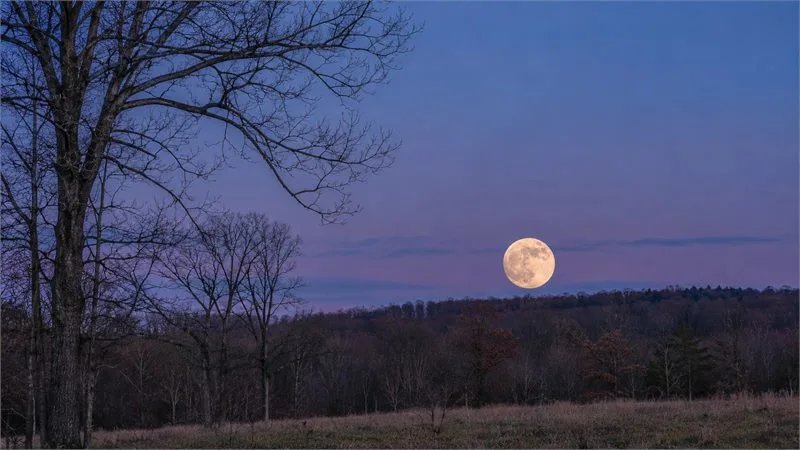
NASA classifies today’s full Moon as a supermoon, when a full Moon occurs near the closest part of its orbit to Earth. The practical effect is a slightly larger and brighter appearing lunar disk, while the added moonlight can make faint stars harder to see. This generated image is illustrative, not a photograph of tonight’s actual sky.
Destaques
Peak: Nov. 24 at 14:53 UTC, or 9:53 a.m. EST; the U.S. date remains Tuesday in all continental time zones.
Best viewing: Look east around local moonrise near sunset, when the Moon is low and foreground scenery can add scale.
What to expect: This is a supermoon, but its apparent size difference from an ordinary full Moon is subtle to the unaided eye.
Stargazing tradeoff: Bright moonlight makes the Moon easy to see but washes out dimmer stars and deep-sky targets.
Illustrative moonrise scene generated for this Beaver Moon viewing guide.
When is the Beaver Moon full in each U.S. time zone?
The U.S. Naval Observatory lists the full phase at 14:53 UTC on Nov. 24. Converted to the standard time zones in effect after the November daylight-saving change, that is 9:53 a.m. EST, 8:53 a.m. CST, 7:53 a.m. MST and 6:53 a.m. PST. In Alaska, it is 5:53 a.m. AKST; in Hawaii, 4:53 a.m. HST. These are the moments of exact fullness—not moonrise times.
For an evening outing, the useful time is your local moonrise, which depends on your location and the horizon. Look up the Nov. 24 moonrise for your city using a trusted astronomy calendar or planetarium app, then arrive a little early. An unobstructed eastern view helps because the Moon rises in the east and climbs through the night. The U.S. Naval Observatory’s phase table provides the exact phase time; local phase and rise tables show how times vary by city.
What makes the November full Moon a supermoon?
A supermoon occurs when a full Moon happens close to perigee, the point in the Moon’s elliptical orbit nearest Earth. NASA lists Nov. 24, 2026, as a supermoon. The term describes orbital geometry, not a separate lunar event, and it does not mean the Moon will appear dramatically oversized. Its apparent diameter changes modestly; the familiar “Moon illusion” can make it seem larger near the horizon because viewers compare it with trees, rooftops or hills.
The November full Moon is commonly called the Beaver Moon. The name is associated with seasonal traditions and the time of year when beavers prepare for winter. It is a cultural name, not an astronomical classification. NASA’s supermoon guide explains the connection between a full phase and the Moon’s closest orbital approach.
How can you get the best view tonight?
Pick a safe public spot with an open eastern horizon, such as a park overlook or shoreline, and check cloud cover before leaving. A low Moon may look warm or orange because its light travels through more of Earth’s atmosphere; color and visibility depend on atmospheric conditions, clouds and local obstructions. As it rises higher, the Moon usually looks brighter and less distorted by haze near the horizon.
No special equipment is needed. Your eyes are enough to see the lunar disk, while binoculars can reveal broad patterns of dark lunar maria. A small telescope shows more detail, though a full Moon’s direct lighting creates fewer long shadows on the surface than a crescent or quarter Moon. If you bring optics, steady them on a support and avoid looking toward the Sun before sunset.
For a phone photo, brace the device or use a tripod, tap to focus on the Moon and lower exposure so the bright disk retains detail. Automatic night mode often turns the Moon into a white blur because the surrounding sky is dark. Include a roofline or tree only if it does not block the Moon, and avoid driving or standing in unsafe places while framing a shot.
Will the full Moon affect stargazing?
Yes. A bright full Moon increases sky brightness, reducing contrast for faint stars, galaxies and nebulae. If the Moon is your target, that is a benefit; if you planned a dark-sky session, use the early evening before moonrise if timing allows, face away from the Moon, and focus on brighter stars or planets. This is a practical expectation based on the full Moon’s brightness, not a forecast of tonight’s clouds or local sky quality.
Weather is the main uncertainty for any specific viewing spot. Forecasts differ across the country, so check a local hourly forecast and cloud cover close to departure. A cloudy or hazy horizon can hide moonrise even when the Moon is technically above the horizon. If skies are blocked tonight, the Moon will remain nearly full in appearance on the nights just before and after the exact phase, so another evening may still offer a satisfying view.
Frequently asked questions
Is tonight a full Moon?
Yes. Tuesday, Nov. 24, 2026, is the full Beaver Moon date. The exact phase is 9:53 a.m. EST, and the Moon will appear full tonight.
What time should I watch the Beaver Moon rise?
Plan for your local moonrise near sunset on Nov. 24. The exact time depends on your city, so check a location-specific moonrise calendar rather than using the 9:53 a.m. EST phase time.
Can I see the supermoon without a telescope?
Yes. The Moon is easy to see with the unaided eye when skies are clear. Binoculars or a telescope are optional for closer surface detail.