If you like using the Moon as a planning ritual, October 2026 gives you one clear waxing-moon window for hair coloring: roughly October 11 through October 25. For a simple calendar, the strongest “lunar tradition” picks are October 12–17 and October 19–24, while October 11, 18, and 25 are transition-adjacent dates that are still commonly treated as favorable. This is a cultural or personal scheduling framework, not a medical rule. Current hair-dye safety guidance from the U.S. Food and Drug Administration (FDA) and the American Academy of Dermatology (AAD) does not use lunar phases as a factor in dye performance, hair growth, or allergy risk.
The astronomical dates below are verified against the U.S. Naval Observatory table of 2026 Moon phases. The USNO lists the October 2026 last quarter at 13:25 UTC on October 3, new moon at 15:50 UTC on October 10, first quarter at 16:12 UTC on October 18, and full moon at 04:12 UTC on October 26. Local civil dates can differ near midnight depending on your time zone, so use the UTC times if you want exact phase timing.
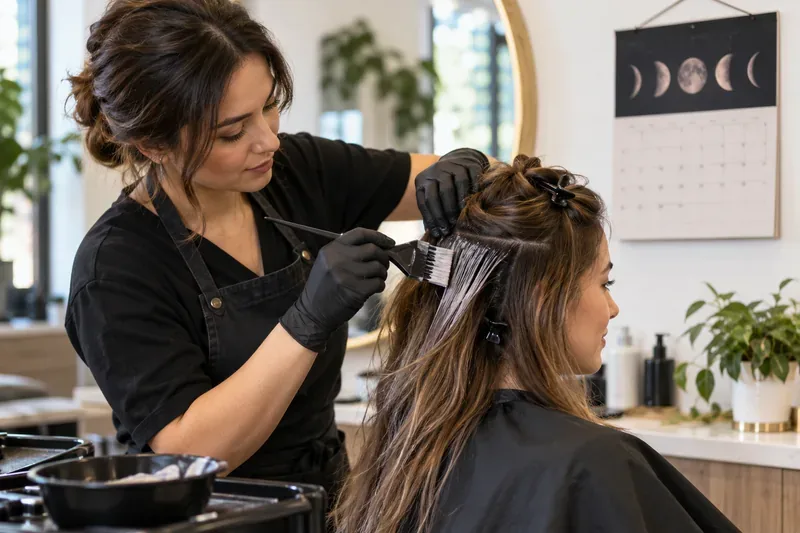
October 2026 lunar calendar for hair coloring
People who follow lunar beauty traditions often associate the waxing Moon—the period from new moon toward full moon—with growth, renewal, visibility, and “building” intentions. By that logic, a color refresh, warmer tone, brighter result, or noticeable transformation is often scheduled during the waxing phase. The waning Moon, from full moon toward new moon, is more commonly associated with reducing, releasing, or maintaining rather than amplifying.
That symbolism can be useful if it helps you choose a date and stick to a care plan, but it should not be confused with a demonstrated chemical effect on hair dye. Hair color develops through the formulation, developer strength, processing time, hair porosity, prior chemical services, and application technique. Moon phase is not included in FDA or AAD hair-color safety recommendations.
| Date or range | Moon phase | Lunar-calendar interpretation | Practical recommendation |
|---|---|---|---|
| October 1–3 | Waning toward last quarter | Traditionally less favored for “growth” or bold-change intentions | Choose only if the date is convenient and your hair/scalp are ready |
| October 4–9 | Waning crescent | Often treated as a quieter maintenance period | Not a priority window for lunar followers |
| October 10 | New moon at 15:50 UTC | Reset or transition point | Many lunar planners wait until the Moon is clearly waxing |
| October 11–17 | Waxing crescent | Commonly favored for beginning or refreshing | Good lunar-calendar window; October 12–17 are the clearest picks |
| October 18 | First quarter at 16:12 UTC | Momentum and action symbolism | Reasonable favorable date if you like quarter-phase symbolism |
| October 19–24 | Waxing gibbous | Traditionally linked with building toward fullness | Another strong lunar-calendar window |
| October 25 | Very near full moon | Peak-approach symbolism | Still favorable for many lunar traditions, but close to the phase change |
| October 26 | Full moon at 04:12 UTC | Peak or culmination | Optional symbolic date; not proven to improve color results |
| October 27–31 | Waning gibbous | Traditionally less favored for initiating a growth-oriented change | Lower priority if you specifically want a waxing-moon date |
Best days to color hair in October 2026
If your main goal is to follow a lunar calendar without overcomplicating it, use two practical windows: October 12–17 and October 19–24. These dates sit comfortably inside the waxing phase and avoid the exact new-moon and full-moon transition points. October 18, the first-quarter date, can also work well if you specifically like the symbolism of action and forward momentum.
For a small root touch-up or gloss, there is no practical need to wait for a “perfect” Moon date if delaying would be inconvenient. For a major lightening session, corrective color, or first-time use of a new product, safety and hair condition matter much more than the calendar. A good lunar day cannot compensate for an irritated scalp, an allergy risk, or hair that has already been overprocessed.
Quick pick list
- Best simple waxing-moon dates: October 12, 13, 14, 15, 16, 17, 19, 20, 21, 22, 23, and 24.
- Also favorable for many lunar planners: October 11, 18, and 25.
- Lower priority if you only want waxing-moon timing: October 1–10 and October 27–31.
- Do not treat any lunar date as a safety guarantee: follow the product label and your stylist’s professional assessment.
Dates to avoid: lunar preference versus real safety reasons
“Dates to avoid” can mean two very different things. Under a lunar tradition, you might simply skip the waning-moon days because they do not match your intended symbolism. That is a preference, not a warning. Real safety reasons are different: they are based on your scalp condition, recent chemical services, allergy precautions, and product instructions.
If you follow lunar tradition
You may prefer to avoid October 1–10 and October 27–31 because those periods are primarily waning, with October 10 marking the new moon. Some people also avoid the exact full-moon date, October 26, because they prefer to color during the build-up rather than at the peak. There is no established FDA or AAD guidance saying these dates are physically unsafe for hair coloring.
If you follow evidence-based hair-dye safety
The more important “avoid” conditions come from the product and your skin. The FDA hair-dye safety guidance says not to dye or relax hair when the scalp is irritated, sunburned, or damaged. It also says to wait at least 14 days after bleaching, relaxing, or perming before using hair dye. That 14-day interval is far more relevant to safety than whether the Moon is waxing or waning.
The FDA also advises performing the skin test described with the product before every use, even if you have colored your hair before without a problem. Sensitivity can develop after repeated exposure, and formulations can change. The agency’s Cosmetics Safety Q&A on hair dyes tells users to follow package warnings, wear gloves, avoid leaving dye on longer than directed, rinse the scalp thoroughly, and never mix different hair-dye products.
How to choose your date based on the kind of color service
Root touch-up or gray coverage
Convenience and consistent timing are usually more useful than waiting for a narrow lunar window. If you enjoy lunar planning, book during October 12–24, but prioritize enough time for the recommended allergy test and a calm appointment rather than squeezing the service into a supposedly lucky date.
Going darker or changing tone
A waxing-moon date may fit the symbolism of adding richness or depth. From a hair-health standpoint, the AAD notes that staying within about three shades of your natural color is generally less damaging than aggressive lightening. The AAD’s coloring and perming tips explain that lightening more than three shades usually requires stronger peroxide, which can cause more damage.
Highlights, balayage, or major lightening
For these services, hair condition should drive the schedule. A lunar-calendar date can be your tiebreaker between two equally suitable appointments, but it should not override a strand assessment, prior bleach history, breakage, or a stylist’s recommendation to delay. If you recently had another chemical service, check the product instructions and the FDA’s 14-day advice before booking.
Corrective color
Corrective color is the least suitable situation for rigid calendar rules because the service may require staged appointments. If the hair is compromised, spacing sessions safely is more important than trying to finish before the full moon. Use the Moon as a personal planning cue only after the technical plan is settled.
What the Moon can and cannot tell you about hair color
A lunar calendar can tell you the astronomical phase and give you a traditional framework for choosing a day. It cannot tell you how porous your hair is, whether your scalp will react to an ingredient, how much lift your hair can tolerate, or how a particular shade will develop over previous color. Those questions depend on hair history, formulation, application, and individual sensitivity.
For October 2026, the useful distinction is simple: the Moon is waxing after the October 10 new moon and continues toward the October 26 full moon. If you enjoy the tradition, that makes October 11–25 the broad favorable period, with October 12–17 and 19–24 as easy, phase-stable choices. If you do not follow lunar traditions, there is no need to schedule around these dates.
Before you color: a practical checklist
- Confirm that your scalp is not irritated, sunburned, scratched, or damaged.
- Read the complete product directions and warning statements before mixing anything.
- Complete the product’s instructed allergy/skin test each time you dye your hair.
- Check whether you have bleached, relaxed, or permed your hair within the previous 14 days.
- Do not mix different hair-dye products unless the manufacturer explicitly instructs you to do so as part of one system.
- Wear gloves and keep dye away from the eyes.
- Use a timer and do not exceed the stated processing time.
- Rinse the scalp thoroughly after processing.
- If you are making a large color change or your hair is already fragile, consider a professional assessment before proceeding.
Bottom line
For a lunar-calendar approach, the best October 2026 hair-color dates are October 12–17 and October 19–24, with October 11, 18, and 25 as additional favorable options. If you prefer to avoid waning-moon dates, skip October 1–10 and October 27–31 for symbolic reasons. But the Moon should remain a scheduling preference, not a safety rule. FDA and AAD guidance places the real emphasis on product directions, skin testing, scalp condition, spacing around other chemical services, and minimizing unnecessary damage.
Source note: Moon-phase times are from the U.S. Naval Observatory and are given in Universal Time (UTC). Hair-dye safety points are based on current FDA consumer guidance and AAD dermatologist guidance reviewed for this article on September 29, 2026.