For a traditional “faster growth” haircut, choose a waxing-Moon date from October 11 through 25, 2026. For a cut meant to hold its shape longer, lunar-haircut calendars often favor the waning Moon: October 1–9 or October 27–31. These dates are a folklore-based scheduling guide, not a proven way to speed up or slow down hair growth. If the calendar adds meaning to your salon ritual, use it; for actual length retention, focus on preventing breakage and choose a trim schedule that suits your hair.
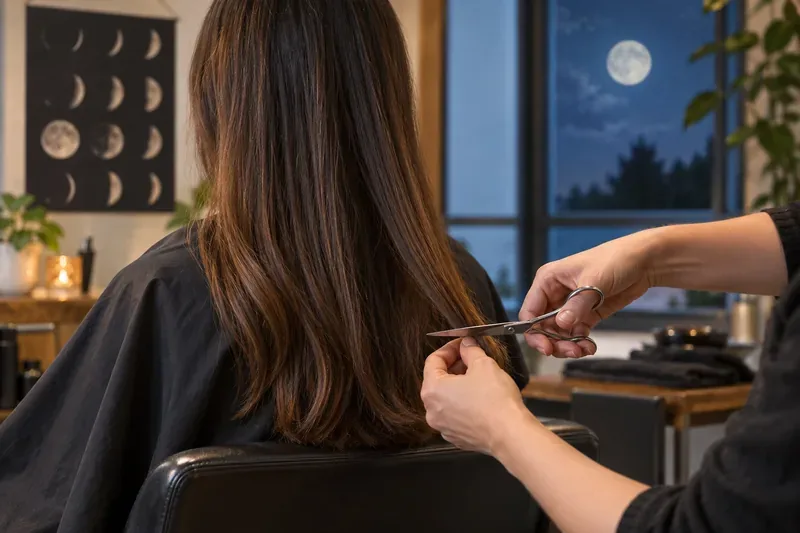
October 2026 haircut calendar
The phase dates below use U.S. Eastern Daylight Time (EDT). They are based on the U.S. Naval Observatory’s primary lunar-phase times, converted from Universal Time. Lunar haircut traditions commonly associate the waxing Moon (new Moon to full Moon) with faster or fuller regrowth, and the waning Moon (full Moon to new Moon) with slower regrowth or a style that lasts longer. That interpretation is traditional, not a dermatological recommendation.
| October dates (EDT) | Moon phase | Traditional haircut timing |
|---|---|---|
| Oct. 1–3 | Waning gibbous, then last quarter on Oct. 3 | Choose for a style you hope to maintain longer |
| Oct. 4–9 | Waning crescent | Traditional “slower regrowth” window |
| Oct. 10 | New Moon at 11:50 a.m. EDT; waxing phase begins after | Transition day; use the afternoon if following the waxing calendar |
| Oct. 11–17 | Waxing crescent | Traditional “faster growth” window |
| Oct. 18–25 | Waxing gibbous; first quarter on Oct. 18 | Another waxing-Moon window for a growth-focused trim |
| Oct. 26 | Full Moon at 12:12 a.m. EDT | Some calendars favor full-Moon trims; traditions vary |
| Oct. 27–31 | Waning gibbous | Traditional “slower regrowth” window |
Time-zone note: the full Moon occurs at 04:12 UTC on October 26, which is October 25 at 9:12 p.m. Pacific Daylight Time. Dates around a phase change can therefore differ by location. If you live outside the United States, check a local astronomical calendar before using a date-specific ritual.
Which October dates should you choose?
If you want the “faster growth” tradition
Book between October 11 and 25, after the October 10 new Moon and before the October 26 full Moon. In lunar folklore, the brightening Moon is treated as a symbol of increase, so this is the conventional choice for someone growing out a short cut or hoping for fuller-looking hair. Some traditions include the new-Moon transition itself; because the phase occurs late morning in the Eastern time zone, October 10 is a split day rather than a simple all-day category.
Useful action: if following this custom matters to you, select an appointment on October 11–25 that also works for your stylist and hair-care plan. Keep the trim modest if you are retaining length. The Moon date does not change how much length the follicle produces.
If you want a cut to keep its shape
Traditional calendars generally point to October 1–9 and October 27–31, when the Moon is waning. The belief is that hair cut as the Moon appears to diminish will regrow more slowly. Treat that as symbolic guidance: it may give you a preferred appointment date, but it cannot guarantee that bangs, a bob, or a fade will need less maintenance.
Useful action: for a style that should look crisp for an event, schedule based on the actual event date and your usual rate of visible regrowth. Ask your stylist how long the shape typically lasts on your hair texture, then use a waning-Moon date only as a tie-breaker.
What about the full Moon on October 26?
Some lunar haircut traditions treat the full Moon as especially favorable for strength, thickness, or a dramatic change; others simply classify it as the end of the waxing period. There is no single standardized lunar haircut calendar, so a “best day” can depend on which tradition a calendar follows. Astronomically, the full Moon is a verified phase and date. A special effect on hair growth is not established.
Useful action: if the full Moon has personal or cultural meaning for you, it is reasonable to use October 26 (or October 25 in Pacific time) as a symbolic appointment date. Decide on the cut for practical reasons—desired shape, condition of the ends, and time between salon visits.
What is verified, and what is not?
Verified: the Moon’s phases occur on calculable dates
The U.S. Naval Observatory lists the October 2026 last quarter on October 3 at 13:25 UTC, new Moon on October 10 at 15:50 UTC, first quarter on October 18 at 16:12 UTC, and full Moon on October 26 at 04:12 UTC. The phase calendar is an astronomical reference. Convert from UTC to your local time zone when a phase falls near midnight.
Useful action: use the U.S. Naval Observatory’s 2026 lunar-phase table to confirm the phase dates, and check local time before booking.
Not established: lunar timing changes the hair-growth rate
Hair grows from follicles in the scalp. A haircut removes the visible hair shaft, so cutting it does not reach or reset the follicle. The American Academy of Dermatology calls the claim that more frequent cuts make hair grow faster a myth. That does not prove every possible lunar influence has been tested; it means there is no sound basis for promising that an October phase will make hair grow faster or slower. Lunar scheduling is best understood as personal tradition, not a growth treatment.
Useful action: if your goal is longer hair, protect the length you already have: limit damaging heat and chemical processing, handle wet hair gently, and trim when split or damaged ends need attention. A trim can make ends look neater and reduce the appearance of fraying, but it does not accelerate growth at the scalp. For sudden shedding or noticeable thinning, consult a dermatologist instead of relying on a lunar calendar.
See the American Academy of Dermatology’s myth-check on haircuts and growth and its guidance on hair-loss care.
A practical way to use the calendar
- Growing it out: if you enjoy lunar traditions, try a small trim during October 11–25. Protecting hair from breakage matters more to visible length than the appointment’s Moon phase.
- Maintaining a short or sharply shaped cut: choose the date based on your preferred upkeep interval. October 1–9 or 27–31 matches the traditional waning-Moon custom, but does not guarantee slower regrowth.
- Keeping the ritual simple: note that October 10 and 26 are transition dates, and account for your time zone. Pick the nearest convenient appointment rather than postponing needed care.
In short, October’s waxing-Moon dates are October 11–25 for the traditional faster-growth choice; the waning-Moon periods are October 1–9 and 27–31 for the traditional slower-growth choice. The phase dates are astronomical facts. The effect on hair growth remains unproven, so let the calendar guide a ritual—not replace realistic expectations or healthy hair care.