Home
» Today
»
Beta Pictoris b Radio Emission: What It Is and How Scientists Study It
Beta Pictoris b Radio Emission: What It Is and How Scientists Study It
The short answer: astronomers have reported radio waves coming directly from Beta Pictoris b, a young giant exoplanet about 63 light-years from Earth. The signal is not a message from an alien civilization. The research team interprets it as natural auroral radio emission produced by energetic electrons moving through the planet’s magnetic field.
The result matters because radio auroras can act like a remote magnetometer. In the September 15, 2026 preprint, the authors report recurring, strongly circularly polarized bursts plus fainter persistent emission between 0.85 and 3.5 gigahertz (GHz). If the interpretation holds, the highest observed frequency implies a magnetic field of at least about 1.25 kilogauss at the region where the radio waves are generated.
There is an important limit to that statement: as of October 3, 2026, the paper is still listed on arXiv as version 1 and has not completed peer review. The finding is therefore best described as a reported first direct localization of auroral radio emission to an exoplanet, not as a fully settled result independently reproduced by another team. The original paper is available at arXiv:2609.16720.
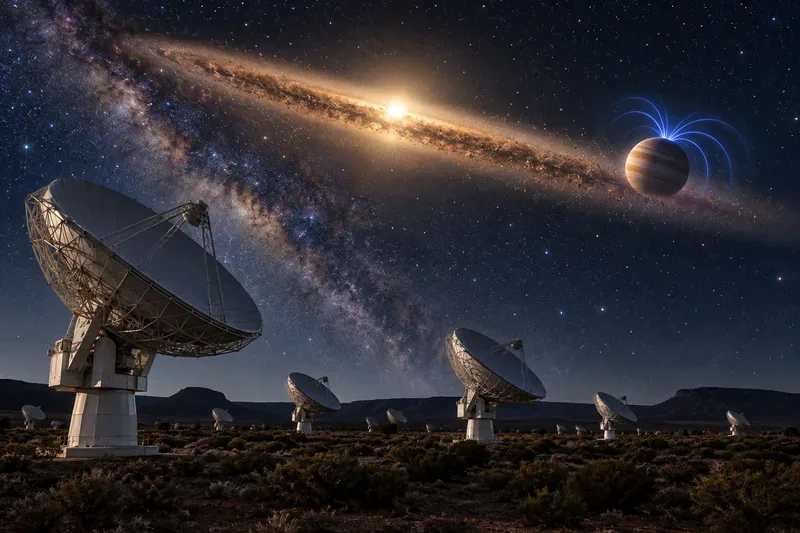
A conceptual view of radio dishes observing a distant giant planet with auroral activity. The scene illustrates the observing idea and is not an image of the actual radio emission from Beta Pictoris b.
What exactly did scientists detect?
The researchers observed the Beta Pictoris system with South Africa’s MeerKAT radio telescope on four occasions in 2025 and 2026. They used L-band observations covering roughly 0.8–1.7 GHz and S-band observations covering roughly 1.7–3.5 GHz. The source appeared in every observing epoch, and the data included both short, rapidly changing bursts and a lower-level component between bursts.
The bursts were especially interesting because they were strongly circularly polarized, at roughly 40% to 70% in the authors’ analysis. Circular polarization means the electric field of the radio wave rotates as the wave travels. In planetary and ultracool-dwarf radio astronomy, strong circular polarization combined with rapid variability is a classic clue for coherent emission, especially electron cyclotron maser instability, usually abbreviated ECMI.
ECMI is the same broad physical mechanism associated with powerful auroral radio emission in magnetized objects. Electrons accelerated along magnetic field lines can produce narrow-beamed, highly polarized radio waves. That makes the signal useful for probing magnetic fields that cannot be measured by sending a spacecraft to the planet.
How did the team know the radio source was the planet?
This is the key question. Detecting radio waves from the direction of a planetary system is not enough, because the host star can also produce radio emission. Previous searches have often faced exactly that ambiguity.
The Beta Pictoris system is unusually favorable because planet b travels far enough from the star on the sky for precise radio astrometry to help separate the two. The team tied the MeerKAT radio image to the Gaia reference frame using compact background radio sources and propagated the known orbital positions of the star and planets. In their analysis, the radio source was consistent with the predicted position of Beta Pictoris b and strongly inconsistent with the host star and Beta Pictoris c.
That positional test is more important than simply saying the source varied like a planet. The authors report that the radio position disagreed with the host star at 4.4 sigma and with planet c at 4.8 sigma after including their estimated systematic uncertainties. Those statistics support the planetary localization within the paper’s model, but they do not remove the need for peer review and independent follow-up.
Why does 3.5 GHz imply a very strong magnetic field?
For electron cyclotron maser emission, the characteristic cyclotron frequency depends directly on magnetic-field strength. A useful approximation is about 2.8 GHz for every kilogauss of magnetic field. The team detected strongly polarized emission up to 3.5 GHz, the upper edge of its observing band.
Dividing 3.5 GHz by about 2.8 GHz per kilogauss gives roughly 1.25 kilogauss. That is why the paper quotes a field strength of at least 1.25 kG at the emission site.
The phrase “at least” is important. MeerKAT did not observe beyond 3.5 GHz in these data, so 3.5 GHz may not be the true cutoff frequency of the emission. If the radio spectrum continues to still higher frequencies, the local magnetic field could be stronger than 1.25 kG.
Why an older search could miss the planet
An earlier study searched for Beta Pictoris b at much lower radio frequencies, 250–500 megahertz, with the upgraded Giant Metrewave Radio Telescope and reported no detection, setting a 3-sigma upper limit of 0.18 millijansky. That paper can be read at arXiv:2312.15176.
The older nondetection does not automatically conflict with the 2026 MeerKAT result. Radio auroral emission can be strongly frequency-dependent and beamed, and a planet with a much stronger magnetic field may emit its most revealing cyclotron radiation at frequencies well above a few hundred megahertz. Different observing bands, observing times, sensitivities, and viewing geometry can therefore produce different outcomes.
What is Beta Pictoris b?
Beta Pictoris b is a directly imaged gas giant orbiting the young A-type star Beta Pictoris. NASA’s exoplanet catalog lists it as a gas giant discovered by imaging in 2008, with an orbital distance of about 10 astronomical units and an orbital period of roughly 24 years. NASA also describes the system as about 63 light-years from Earth. See NASA’s Beta Pictoris b catalog entry.
The planet is a particularly useful radio target because it is young, massive, relatively nearby, and widely separated from its star in angular terms. Its host star is also comparatively quiet at radio wavelengths, reducing one source of confusion.
How MeerKAT studies such a faint source
MeerKAT is not one giant dish. It is an interferometric array of 64 linked 13.5-meter receptors in South Africa’s Northern Cape. By combining signals from many antennas spread over baselines of up to about 8 kilometers, astronomers synthesize a much sharper radio view than a single dish of similar diameter could provide. The South African Radio Astronomy Observatory describes the array at its official MeerKAT overview.
For Beta Pictoris b, the researchers used several complementary tests:
Repeated observing epochs: a real source should reappear when the system is observed again.
Astrometric localization: the radio position is compared with the moving positions of the star and planets.
Total intensity measurements: these show how bright the radio source is over time.
Circular polarization measurements: these help identify coherent auroral emission.
Time-resolved light curves: fast bursts provide clues to emission physics and potentially to rotation and magnetic geometry.
Frequency coverage: the highest detected frequency constrains the minimum magnetic-field strength if ECMI is the correct mechanism.
What conditions make an exoplanet a good radio target?
Beta Pictoris b is not a template that can simply be applied to every exoplanet. A radio search is more promising when several conditions line up.
Condition
Why it helps
Strong planetary magnetic field
Raises the electron cyclotron frequency and can make auroral emission easier to separate from low-frequency noise.
Young, massive giant planet
Such planets may sustain powerful dynamos and energetic magnetospheres.
Large apparent separation from the host star
Makes it easier to localize the radio source to the planet instead of the star.
Radio-quiet host star
Reduces the chance that stellar bursts masquerade as planetary emission.
Repeated observations across several bands
Tests whether the source recurs and whether its spectrum matches the proposed mechanism.
High-precision astrometry
Allows the radio source position to be compared with a predicted planetary orbit.
That means the Beta Pictoris b method is most directly applicable first to nearby, directly imaged giant planets rather than small Earth-like planets close to bright, active stars.
What the result does—and does not—tell us
If confirmed, the detection would open a new way to measure exoplanet magnetic fields directly. Magnetic fields matter because they connect a planet’s interior, rotation, atmosphere, and interaction with its stellar environment. Radio observations could therefore complement infrared imaging and spectroscopy rather than replace them.
But the signal does not show that Beta Pictoris b is habitable, does not indicate life, and does not imply artificial communication. Beta Pictoris b is a hot, massive gas giant. The scientific value lies in remote magnetospheric physics: learning how strong its magnetic field is, how its auroral engine works, and whether similar radio behavior appears in other giant planets.
What scientists will need to check next
The strongest next steps are straightforward in principle but observationally demanding. Independent teams can repeat the detection, observe the system at frequencies above 3.5 GHz to look for the true high-frequency cutoff, and monitor the bursts over longer spans to search for periodicity related to planetary rotation. Better sampling could also test whether changes in polarization track different magnetic hemispheres.
Most importantly, replication will determine whether Beta Pictoris b becomes a one-off curiosity or the first member of a broader class of radio-detected exoplanets. As of October 3, 2026, the evidence is unusually compelling for a planetary radio source, but the normal scientific process—peer review, repeat observations, and independent analysis—is still in progress.
Bottom line
Beta Pictoris b radio emission is best understood as a reported natural auroral signal from a giant exoplanet, detected and spatially localized with MeerKAT. Its rapid variability, strong circular polarization, and frequency range are consistent with electron cyclotron maser emission. Under that interpretation, emission reaching 3.5 GHz requires a local magnetic field of at least about 1.25 kilogauss.
The result is scientifically important because it offers a direct way to probe an exoplanet’s magnetic field from Earth. It is also still preliminary: the September 2026 study remains an arXiv preprint, so careful reporting should distinguish what MeerKAT measured from the physical interpretation and from claims that still await independent confirmation.