Home
» Today
»
Bills vs. Lions: Full Game Breakdown and Key Player Numbers from Buffalo’s 41–31 Win
Bills vs. Lions: Full Game Breakdown and Key Player Numbers from Buffalo’s 41–31 Win
Buffalo’s 41–31 win over Detroit on September 17, 2026 was decided before the Lions’ late passing surge could fully change the game. The Bills built a 27–10 halftime lead, controlled the ball for 33:45, gained 446 total yards, and got five total touchdowns from Josh Allen. Detroit answered with 21 second-half points and a 327-yard, four-touchdown night from Jared Goff, but the Lions spent too much of the game chasing a multi-score deficit.
That is the clearest way to read this matchup: Buffalo’s offense was more balanced and more efficient early, while Detroit’s biggest production arrived after the Bills had already created separation. The official NFL recap confirms the 41–31 final and Allen’s five total touchdowns, while the game data shows how Buffalo paired his passing with a 204-yard rushing attack. See the NFL’s official postgame recap and the Buffalo Bills official box score page for the source material behind the numbers below.
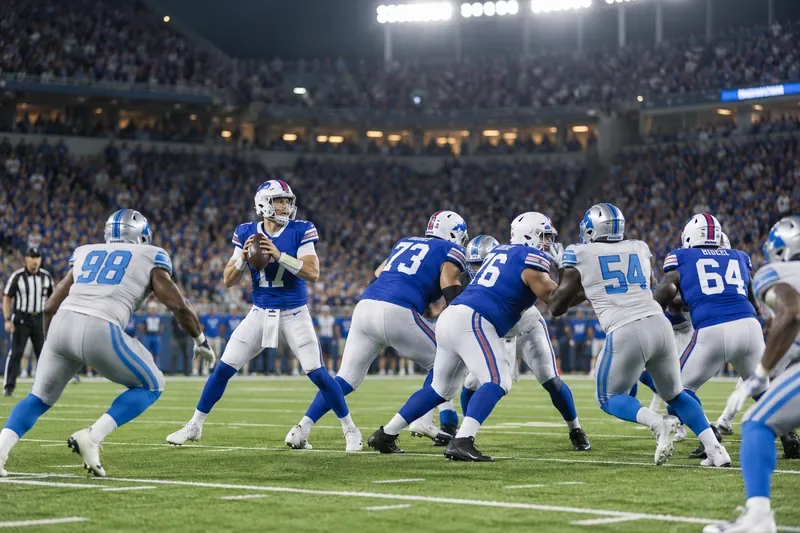
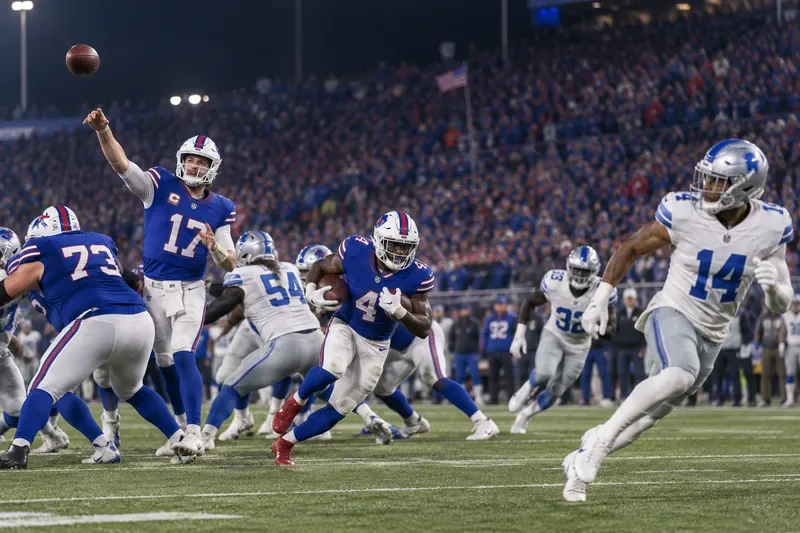
Night football action illustrates the kind of pocket passing and line play that shaped the Bills–Lions matchup.
Final score and the numbers that mattered most
Category
Detroit Lions
Buffalo Bills
Final score
31
41
Total yards
355
446
Yards per play
5.7
6.5
Plays
62
69
Rushing attempts
20
36
Time of possession
26:15
33:45
Turnovers
0
0
Penalties
10 for 58 yards
5 for 46 yards
The most important contrast is the rushing volume. Buffalo ran the ball 36 times, while Detroit had only 20 rushing attempts. That difference helped the Bills sustain drives, keep Allen out of a one-dimensional passing script, and hold the ball more than seven minutes longer. The total-yardage gap — 446 to 355 — was significant, but the possession and rushing differences explain how Buffalo created that gap.
How Buffalo took control early
The Bills scored first on an Allen rushing touchdown, then quickly expanded the lead when Allen hit Joshua Palmer for a 43-yard touchdown. By the end of the first quarter, Buffalo was up 14–0. That start mattered because it forced Detroit away from a patient game plan and toward catch-up football.
Buffalo pushed the lead to 21–0 in the second quarter on a short touchdown pass to Dawson Knox. Detroit finally responded when Goff found Jahmyr Gibbs for an 11-yard score, but Allen answered again with a 16-yard touchdown pass to Dalton Kincaid. A late Detroit field goal made it 27–10 at halftime.
For a reader trying to understand why the final margin stayed at 10 points even though Detroit’s passing numbers were strong, this is the key sequence. Detroit’s offense was productive after halftime, but Buffalo’s three-score cushion changed the conditions of the game. The Lions had to throw aggressively, while the Bills could continue mixing runs and passes.
Josh Allen’s line: efficient passing plus two rushing scores
Allen finished 20-of-31 for 248 passing yards, three passing touchdowns, and no interceptions. He also ran 14 times for 69 yards and two touchdowns. That gave him five total touchdowns on the night.
His passing volume was not huge by modern NFL standards, but his efficiency in scoring situations was the difference. He produced touchdowns through the air to Palmer, Knox, and Kincaid, then added rushing scores in the first and third quarters. Buffalo did not need Allen to throw 40-plus times because the run game was productive enough to keep the offense balanced.
That distinction is useful when comparing quarterback box scores. Goff had more passing yards and more passing touchdowns, but Allen’s combined rushing and passing impact produced more total scoring and came within an offense that controlled the game from the opening quarter.
James Cook gave Buffalo the balance Detroit could not match
James Cook was the game’s leading rusher with 21 carries for 135 yards and one touchdown. His 6.4 yards per carry helped Buffalo avoid obvious passing situations and gave the Bills a reliable way to protect their lead without becoming conservative.
Cook’s 35-yard run was his longest of the game, and his one-yard touchdown with 2:53 left in the fourth quarter effectively restored Buffalo’s multi-score cushion after Detroit had pulled within 10 earlier in the period. This is an important example of why raw quarterback passing totals do not tell the full story: Buffalo had a back who could create explosive gains and finish drives while the Lions’ rushing game never reached comparable volume.
Detroit’s comeback was real, but it started from too far behind
Jared Goff completed 26 of 38 passes for 327 yards, four touchdowns, and no interceptions. Statistically, it was a strong passing performance. He found Amon-Ra St. Brown for two touchdowns, Gibbs for one, and Sam LaPorta for another.
The problem was timing. Detroit entered the second half down 27–10. Goff opened the third-quarter scoring with a short touchdown pass to St. Brown, but Allen answered with his second rushing touchdown. In the fourth quarter, Goff hit LaPorta for a score and later found St. Brown for a 27-yard touchdown with 1:48 remaining. By then, Buffalo had already reached 41 points.
So the Lions’ final offensive numbers should be read with context. The production was meaningful — this was not empty offense — but it came in a game state that required aggressive passing. Detroit still never fully erased the early deficit.
113 scrimmage yards, but limited rushing efficiency
Sam LaPorta, Lions
6 catches, 52 yards, 1 TD
Useful short-area and red-zone production
Why the game was not simply “Allen beat Goff”
Quarterback comparisons are tempting, but this game was shaped by team structure. Buffalo had 69 offensive plays to Detroit’s 62, ran the ball 16 more times, and averaged 6.5 yards per play. Neither team committed a turnover, so there was no single giveaway that explains the difference.
Instead, Buffalo’s advantage came from consistently favorable down-and-distance situations and fewer self-inflicted mistakes. The Bills were penalized five times for 46 yards; Detroit was penalized 10 times for 58. The yardage difference from penalties was not enormous, but twice as many flags can disrupt tempo and force an offense to recover from bad situations.
Detroit also entered the game missing two starting offensive linemen, right tackle Blake Miller and left guard Christian Mahogany, according to the Lions’ official inactive report. That context does not erase Buffalo’s performance, but it matters when evaluating Detroit’s ability to establish the run and protect Goff consistently.
What the fourth quarter tells us
Detroit scored 14 points in the fourth quarter, but Buffalo still answered with seven. The Lions cut into the lead on LaPorta’s touchdown with 10:57 remaining. Cook then scored with 2:53 left to make it 41–24. St. Brown’s 27-yard touchdown with 1:48 remaining produced the final 41–31 margin.
The lesson is that Detroit’s comeback pressure was legitimate, but Buffalo kept finding one more answer. Because the Bills still had an effective run game late, they did not need Allen to take unnecessary risks. After the final Detroit score, Buffalo recovered the onside kick and closed the game with kneel-downs.
Bottom line
The simplest breakdown is also the most accurate: Buffalo won because it combined an early scoring burst with sustained rushing efficiency and Allen’s five-touchdown performance. Detroit’s passing game was good enough to make the second half competitive, but the Lions could not overcome the 27–10 halftime hole.
For readers looking only at the quarterback passing lines, Goff’s 327 yards and four touchdowns may look superior to Allen’s 248 yards and three passing scores. But once Allen’s 69 rushing yards and two rushing touchdowns are included — along with Cook’s 135-yard night — the shape of the game becomes much clearer. Buffalo had more ways to move the ball, controlled possession, and dictated the scoreboard from the opening quarter.