01. Historical Context
Bitcoin in context: scarcity is intact, but liquidity still sets the multiple
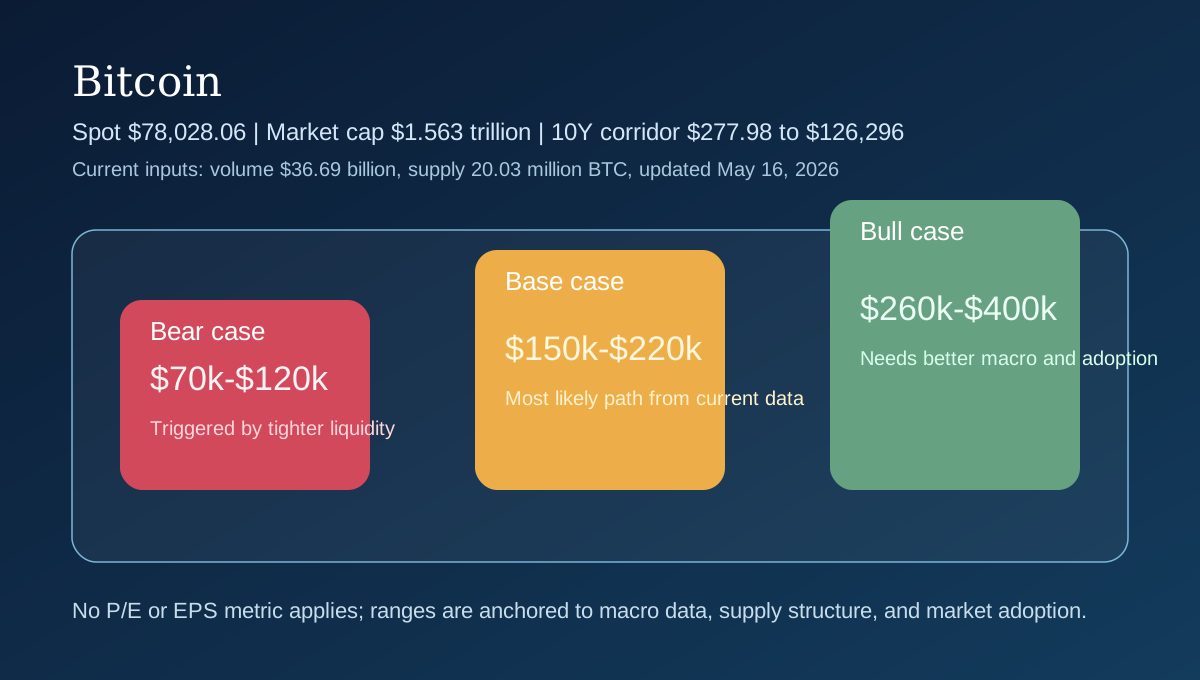
Base case: Bitcoin still screens as a structurally scarce asset with real institutional access, but the path to higher prices remains rate-sensitive. Spot BTC traded around $78,028 on May 16, 2026, versus an all-time high of $126,080, so the market is no longer paying peak-cycle prices even after U.S. spot ETF approval and a post-halving supply reset.
| Horizon | What matters most | What would strengthen the thesis | What would weaken the thesis |
|---|---|---|---|
| 1-3 months | ETF flows, CPI/PCE, real yields, and risk appetite | Spot BTC holds above macro panic lows while inflation cools | Persistent ETF outflows with hotter inflation prints |
| 6-18 months | Post-halving supply tightness versus macro liquidity | Falling real rates and renewed ETF accumulation | Growth scare or sticky inflation keeps policy restrictive |
| To 2027+ | Institutional ownership depth and global reserve diversification | Treasury adoption broadens beyond early allocators | Regulation tightens while demand stays cyclical |
The past decade matters because it shows both the upside and the drawdown risk. Coinbase exchange data put BTC near $277.98 on July 20, 2015, with a 10-year exchange high of $126,296 on October 6, 2025; that still works out to roughly 68.3% annualized appreciation over the period. That long-run compounding rate is too high to extrapolate mechanically, but it does justify using a wide scenario range rather than treating BTC like a mature low-volatility asset.
Traditional equity metrics do not apply here. Bitcoin has no issuer, so trailing P/E, forward P/E, EPS, and EPS growth are not meaningful. The better valuation proxies are price versus realized institutional adoption, market cap versus the addressable store-of-value thesis, ETF assets, market-share dominance, and how close the asset is trading to prior cycle extremes.
02. Key Forces
Five forces that matter most from current levels
Macro still dominates the near-term multiple. The April 2026 U.S. CPI release showed headline inflation at 3.8% year over year and core CPI at 2.8%; BEA's March 2026 PCE release showed headline PCE at 3.5% and core PCE at 3.2%. That is not a clean disinflation backdrop, so Bitcoin still needs help from falling real yields or a weaker dollar to re-rate aggressively.
Institutional access is no longer hypothetical. The SEC approved listing and trading of spot bitcoin ETPs on January 10, 2024, and BlackRock's iShares Bitcoin Trust ETF reported $70.13 billion in net assets as of January 9, 2026. That does not guarantee upside, but it means the buyer base is materially broader than in prior cycles.
Scarcity remains the central structural support. CoinGecko showed 20,030,109 BTC in circulation against a 21 million maximum supply on May 16, 2026. That hard cap is the reason Bitcoin behaves differently from risk assets with elastic supply, but scarcity alone does not prevent multi-quarter drawdowns when liquidity contracts.
Current market structure is still constructive rather than euphoric. Bitcoin traded about 38% below its all-time high while retaining a market cap above $1.56 trillion and roughly 60.23% crypto market dominance. That combination usually means leadership is intact, but not immune to macro de-risking.
On-chain cash-flow analogs remain modest relative to the headline market cap. CoinGecko showed only $253,093 of daily fees in the latest 24-hour snapshot, which is a reminder that Bitcoin's price is still driven more by monetary premium and balance-sheet demand than by network-fee monetization.
| Factor | Why it matters | Current assessment | Bias | Current posture |
|---|---|---|---|---|
| Macro and rates | BTC re-rates when disinflation and easier financial conditions improve risk appetite. | April 2026 CPI 3.8% y/y; core CPI 2.8%. March 2026 core PCE 3.2% y/y. | Neutral | Rate-sensitive |
| Institutional demand | ETF access can compress frictions and deepen capital pools. | IBIT net assets $70.13B as of Jan. 9, 2026. | Bullish | Adoption is real |
| Supply discipline | 21M cap is BTC's clearest structural differentiator. | 20,030,109 BTC circulating versus 21M max. | Bullish | Scarcity intact |
| Valuation proxy | BTC lacks earnings, so price versus ATH and market cap do the work. | Spot near $78k, still about 38% below ATH $126,080. | Neutral | Not cheap, not peak |
| Positioning | Leadership can help on the way up and hurt when flows reverse. | BTC dominance 60.23%; 7-day move -2.9%. | Neutral to bullish | Leadership holds |
Current-state analysis is more useful here than generic rhetoric. Bitcoin does not need perfect data to work, but it does need a directionally better mix of macro conditions, institutional demand, and asset-specific reinforcement than what the market saw in the latest inflation and price snapshots.
03. Countercase
What would break or delay the thesis
The cleanest bear case is macro, not narrative. If headline CPI stays near the April 2026 pace of 3.8% and core PCE remains above 3%, the market may keep demanding high real yields. That combination is usually hostile to a non-yielding asset whose multiple depends on future liquidity.
The second risk is a failed institutional bid. BlackRock's AUM confirms that spot ETF adoption is real, but it also means flow reversals now matter more. If ETF demand stalls while Bitcoin remains well above its 10-year exchange midpoint, the market can de-rate without any change to the 21 million cap.
The third risk is that BTC's monetary-premium thesis outruns the evidence. CoinGecko's latest 24-hour snapshot showed $253,093 in fees against a $1.56 trillion market cap. That gap is not a flaw if investors are explicitly paying for reserve-asset optionality, but it becomes a problem if macro conditions stop rewarding that optionality.
A final risk is regulatory asymmetry across jurisdictions. The SEC approval removed one barrier for U.S. allocators, but it did not eliminate policy risk globally. Any material tightening in exchange access, custody, or tax treatment would hit the marginal buyer before it hits the long-term holder.
| Risk | Latest data | Why it matters now | Current assessment |
|---|---|---|---|
| Sticky inflation | April 2026 CPI 3.8% y/y; March 2026 core PCE 3.2% y/y | Keeps real yields high and caps multiple expansion | Bearish if inflation does not roll over |
| ETF flow reversal | IBIT AUM large enough to matter for sentiment and price discovery | Institutional demand is now a swing factor, not just upside optionality | Neutral, but watch weekly flows |
| High implied monetary premium | Market cap $1.563T versus 24h fees $253k | BTC depends more on store-of-value demand than fee generation | Bearish if macro turns hostile |
| Peak-cycle memory | Still down roughly 38% from ATH $126,080 | Prior-cycle drawdown behavior can reappear quickly | Neutral |
The practical point is that a valid long-run thesis can still produce a bad entry window. That distinction matters because readers should be able to see when the evidence is challenging the timing of the trade, the size of the range, or the thesis itself.
04. Institutional Lens
What institutional data actually say right now
Institutional insight is now observable through policy and balance-sheet data rather than conjecture. The SEC approved spot bitcoin ETP listings on January 10, 2024, which changed access, custody, and compliance constraints for U.S. allocators. BlackRock's IBIT then reached $70.13 billion in net assets by January 9, 2026, showing that regulated demand became material, not theoretical.
Macro still sets the corridor. The IMF's April 14, 2026 World Economic Outlook projected global growth of 3.1% in 2026 and 3.2% in 2027, while the IMF's U.S. Article IV published April 2, 2026 projected U.S. growth at 2.4% in 2026 and core PCE returning to 2% in the first half of 2027. That baseline is constructive for BTC only if inflation actually follows the softer path.
The right reading is therefore conditional: Bitcoin now has deeper institutional plumbing than any prior cycle, but the macro hurdle has not disappeared. In practice, BTC needs both regulated access and a friendlier real-rate regime to earn a durable re-rating.
| Source | Latest update | What it says | Why it matters here |
|---|---|---|---|
| SEC | January 10, 2024 | Approved listing and trading of spot bitcoin ETPs. | Opened the U.S. regulated ETF channel for BTC. |
| BlackRock IBIT | January 9, 2026 | Net assets of fund at $70.13B; benchmark level $90,298.40. | Shows institutional access has scale, but also makes ETF flows price-relevant. |
| IMF WEO | April 14, 2026 | Global growth projected at 3.1% in 2026 and 3.2% in 2027. | Supports a base case of slower but still positive nominal growth. |
| IMF U.S. Article IV | April 2, 2026 | U.S. growth projected at 2.4% in 2026; core PCE back to 2% in 1H27 under baseline. | Explains why BTC bulls still need disinflation confirmation. |
The key discipline is not to borrow institutional names without their data. Where the source gives a date, a number, or a rule change, it belongs in the analysis. Where the source does not give a crypto-specific forecast, the article should say so and avoid dressing inference up as a citation.
05. Scenarios
Probability-weighted scenarios with measurable triggers
A 2030 forecast should start by slowing the historical growth rate. Neither Bitcoin nor Ethereum is likely to repeat a near-68% annualized decade forever, so the base case deliberately assumes materially lower compounding than the last 10 years.
That still leaves upside because both assets now have deeper capital-market access than they had in earlier cycles. The question is whether that access becomes structurally sticky before the next macro tightening cycle arrives.
The downside case is mainly about time, not extinction. If disinflation disappoints or institutional demand stays narrower than bulls expect, the assets can still rise over a multi-year window while badly missing aggressive headline forecasts.
| Scenario | Probability | Target range | Trigger conditions | When to review |
|---|---|---|---|---|
| Bull case | 25% | $260k-$400k | Institutional adoption broadens beyond ETFs, sovereign or corporate reserve demand expands, global liquidity supportive | Review each year after IMF WEO and U.S. inflation trend |
| Base case | 50% | $150k-$220k | BTC remains the dominant crypto reserve asset and grows slower than its prior decade CAGR | Major review in 2028 and 2029 |
| Bear case | 25% | $70k-$120k | Rates stay structurally higher and adoption plateaus after early ETF wave | Reassess if BTC cannot reclaim prior cycle highs by 2028 |
Those ranges are intentionally wider than an equity-style target because there is no issuer-level earnings stream to anchor a tighter valuation model. The appropriate discipline is to keep updating the probability weights as CPI, PCE, GDP, ETF AUM, market structure, and asset-specific demand evolve.
References
Sources
- CoinGecko Bitcoin page
- Coinbase Exchange BTC-USD candles API
- SEC statement on approval of spot bitcoin ETPs
- BlackRock iShares Bitcoin Trust ETF (IBIT)
- IMF World Economic Outlook, April 2026
- IMF 2026 Article IV Consultation with the United States
- BLS CPI release for April 2026
- BEA Personal Income and Outlays, March 2026
- BEA GDP (Advance Estimate), 1st Quarter 2026
- Bitcoin.org FAQ