01. Historical Context
BNB in context: the token still has utility and burn support, but the thesis remains ecosystem-dependent
Base case: BNB still has a credible medium-term upside case because supply keeps shrinking and BNB Chain still posts large user and liquidity numbers, but the asset is more dependent on the Binance and BNB Chain ecosystem than Bitcoin or Ethereum are on any single operator. At roughly $654.16 on May 16, 2026, BNB is down about 52% from its October 2025 peak of $1,369.99, so the market is no longer pricing peak-cycle conditions.
| Horizon | What matters most | What would strengthen the thesis | What would weaken the thesis |
|---|---|---|---|
| 1-3 months | Price reaction to macro data, Binance ecosystem activity, and BNB burn optics | BNB holds above key support while chain usage and fee activity stay firm | Macro pressure combines with softer chain activity |
| 6-18 months | BSC and opBNB user retention plus supply reduction | DAU, TVL, and fee burn all remain healthy after the latest burn cycles | Utility fades while regulatory pressure rises |
| To 2027+ | Whether BNB keeps compounding as a quasi-equity on Binance/BNB Chain activity | User and liquidity growth continue without major structural damage | The ecosystem loses share or regulated access remains narrow |
The long-run chart is still powerful, just shorter than a full 10-year window. Yahoo chart data start in December 2017 at roughly $8.64 monthly close, with a monthly trough near $5.08 in November 2018 and a monthly high near $1,088.96 in October 2025. Even after the pullback to about $653.64, that works out to roughly 66.82% annualized compounding since the first full month of public price history.
Standard equity valuation metrics do not apply. BNB has no issuer-level earnings stream, so trailing P/E, forward P/E, EPS, and EPS growth are not meaningful. The better lenses are burn pace, network utility, exchange-linked demand, chain activity, and whether the token still deserves a premium as the economic hub of the BNB ecosystem.
02. Key Forces
Five forces that matter most from current levels
Macro still matters even for an exchange-linked token. April 2026 U.S. CPI came in at 3.8% year over year and March 2026 core PCE at 3.2%, which means the broad risk-asset discount-rate backdrop is still only partially supportive.
The supply side remains one of BNB's clearest supports. BNB Chain's 35th burn on April 15, 2026 destroyed 1,569,307.34 BNB, worth about $1.02 billion at the time, and brought reported remaining total supply down to 134,786,916.53 BNB. The stated long-run target remains 100 million BNB.
Operating traction is still material. The BNB Chain homepage showed 3.385 million daily active users, $5.771 billion in TVL, $5.118 billion in trading volume, average gas fees near $0.003345, and finality around 1.125 seconds when checked on May 16, 2026.
The valuation challenge is concentration. CoinGecko's latest snapshot showed only $309,548 in 24-hour fees and $31,198 in 24-hour project revenue, so the market is still paying far more for ecosystem optionality than for current on-chain cash generation alone.
Institutional proof remains thinner than for BTC or ETH. SEC filings show real product-development interest, but the reviewed primary sources show BNB mostly at the filing stage rather than at the scale of a large, already-established U.S. ETF asset base.
| Factor | Why it matters | Current assessment | Bias | Current posture |
|---|---|---|---|---|
| Macro and rates | BNB still trades like a crypto beta asset when liquidity tightens. | April 2026 CPI 3.8% y/y; March 2026 core PCE 3.2% y/y. | Neutral | Rate-sensitive |
| Supply reduction | Auto-burn and real-time burn are the cleanest long-run support. | 35th burn removed 1.57M BNB on Apr. 15, 2026. | Bullish | Deflationary support intact |
| Chain activity | BNB's premium depends on actual chain use. | 3.385M DAU; $5.771B TVL; $5.118B trading volume. | Moderately bullish | Usage still large |
| Fee capture | Utility is real but current fee generation is still small versus market cap. | 24h fees $309,548; 24h revenue $31,198. | Neutral | Economics lag valuation |
| Institutional access | Regulated wrappers can deepen demand if they move beyond filings. | SEC filings exist, but no large verified live U.S. AUM base reviewed here. | Neutral to bearish | Pipeline exists, scale unclear |
The right question is not whether BNB has a narrative. It is whether the latest macro data and the latest operating data still justify paying the current multiple for that narrative.
03. Countercase
What would break or delay the thesis
The cleanest downside risk is that BNB remains too cyclical for the multiple it still carries. With CPI at 3.8% and core PCE at 3.2% in the latest U.S. releases, there is still room for high real yields to keep pressuring crypto beta.
The second risk is ecosystem dependence. BNB's utility is meaningful, but the token is still more tied to Binance and BNB Chain activity than BTC is to any one platform. If daily users, TVL, or on-chain trading volume weaken materially from current levels, the market can compress that ecosystem premium quickly.
The third risk is that burn support gets overinterpreted. A 1.57 million BNB quarterly burn is material, but burn mechanics do not override falling demand. If adoption weakens, a shrinking supply alone may not hold the price at a premium multiple.
A final risk is regulatory asymmetry. The primary sources reviewed here show filings for BNB-related exchange-traded products, but not the kind of large, already-proven regulated demand base that now exists for some other majors. That leaves BNB more exposed if risk appetite narrows.
| Risk | Latest data | Why it matters now | Current assessment |
|---|---|---|---|
| Sticky inflation | April 2026 CPI 3.8% y/y; March 2026 core PCE 3.2% y/y | Keeps broader crypto multiples under pressure | Bearish if inflation does not cool |
| Ecosystem concentration | BNB remains the native token of one ecosystem rather than a neutral reserve asset | Utility and price are more tightly linked to platform health | Neutral to bearish |
| Fee/revenue mismatch | 24h fees $309,548 versus $88.16B market cap | Highlights the gap between current economics and valuation | Bearish if growth stalls |
| Thin institutional base | Reviewed primary sources show filings, not a large live U.S. AUM base | Limits downside protection from regulated allocators | Neutral |
A valid long-run thesis can still produce a poor near-term setup. The purpose of the countercase is to show exactly which data points would move the article from constructive to cautious or from cautious to outright defensive.
04. Institutional Lens
What institutional and official sources actually show
The institutional read-through for BNB is real but still early-stage. The SEC's EDGAR system shows a Grayscale BNB ETF S-1 filing dated January 23, 2026, and a VanEck BNB ETF filing dated October 30, 2025. Those filings matter because they show product-development interest from traditional issuers.
That said, the reviewed primary sources do not show a large live U.S. BNB ETF asset base comparable to what exists in some other crypto exposures. For that reason, the current institutional signal should be treated as a pipeline signal rather than as proof of broad allocators already absorbing large supply.
Operationally, the stronger hard evidence is still on-chain. BNB Chain's own homepage showed 3.385 million daily active users, $5.771 billion in TVL, and 1.125-second finality. For now, those ecosystem metrics are more important than unproven hopes of immediate wall-street-style repricing.
| Source | Latest update | What it says | Why it matters here |
|---|---|---|---|
| SEC EDGAR | January 23, 2026 | Grayscale BNB ETF filed S-1 registration statement. | Shows regulated product interest, not yet proof of scale. |
| SEC EDGAR | October 30, 2025 | VanEck BNB ETF filing appears in EDGAR. | Confirms multiple issuers are exploring BNB wrappers. |
| BNB Chain | April 15, 2026 | 35th burn destroyed 1,569,307.34 BNB; remaining supply 134.79M. | Burn mechanics still anchor the tokenomics case. |
| BNB Chain | May 16, 2026 snapshot | Homepage showed 3.385M DAU, $5.771B TVL, $5.118B trading volume. | Operational traction is the strongest current support. |
That distinction matters. A filing, an effective registration, a futures launch, and a live AUM number are not interchangeable. The article only treats them as evidence to the extent the underlying source supports that claim directly.
05. Scenarios
Probability-weighted scenarios with measurable triggers
The 2027 base case should assume slower compounding than the historical launch-era run but still allow for upside if macro conditions improve and the network-specific thesis holds together.
The bull case requires both better liquidity and validation from operating data. The bear case requires either macro pressure or a breakdown in the specific chain or token economics that currently justify a premium.
Actionability matters more than certainty here, so the useful framework is a probability-weighted range with explicit review points after macro releases and asset-specific milestones.
| Scenario | Probability | Target range | Trigger conditions | When to review |
|---|---|---|---|---|
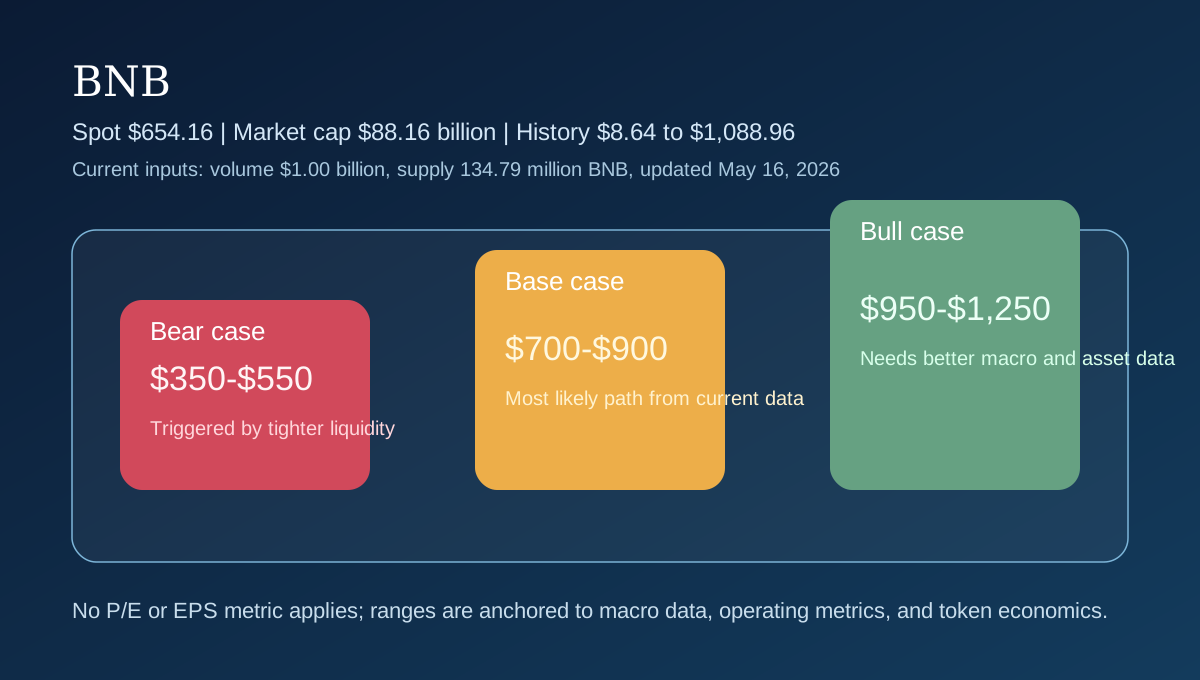
| Bull case | 25% | $950-$1,250 | CPI and core PCE trend lower, BNB Chain activity remains near current scale, and burn pace continues without ecosystem damage | Review after each quarterly burn and monthly inflation cycle |
| Base case | 50% | $700-$900 | Macro softens gradually and BNB retains most of its current user and liquidity footprint | Major review by Q2 2027 |
| Bear case | 25% | $350-$550 | Inflation stays sticky, ecosystem dependence is repriced, or chain activity weakens materially | Reassess on consecutive quarters of weaker chain metrics |
Those ranges are intentionally wider than an equity-style target because these assets do not have issuer earnings. The disciplined approach is to keep updating the probability weights as macro data, market structure, and asset-specific operating evidence change.
References
Sources
- CoinGecko BNB page
- Yahoo Finance chart endpoint for BNB-USD
- BNB Chain 35th burn
- BNB Chain homepage
- BNBBurn
- SEC filing detail for Grayscale BNB ETF
- SEC filing detail for VanEck BNB ETF
- BLS CPI release for April 2026
- BEA Personal Income and Outlays, March 2026
- BEA GDP (Advance Estimate), 1st Quarter 2026
- IMF World Economic Outlook, April 2026