Home
» Today
»
Bose Earbuds: How to Choose the Right Model for Your Needs
Bose Earbuds: How to Choose the Right Model for Your Needs
Choosing Bose earbuds in late 2026 is less about finding one “best” pair and more about deciding what you want your earbuds to do. Bose now splits its lineup between sealed in-ear models built around active noise cancellation and open-ear models designed to keep you aware of your surroundings. That single choice—block the world out or stay connected to it—usually narrows the field faster than comparing every feature.
This guide reflects Bose’s U.S. lineup and official specifications checked on September 29, 2026. Prices and availability can change, especially because Bose announced two new open-ear models for an October 1 release. For the latest U.S. listings, check the official Bose earbuds page.
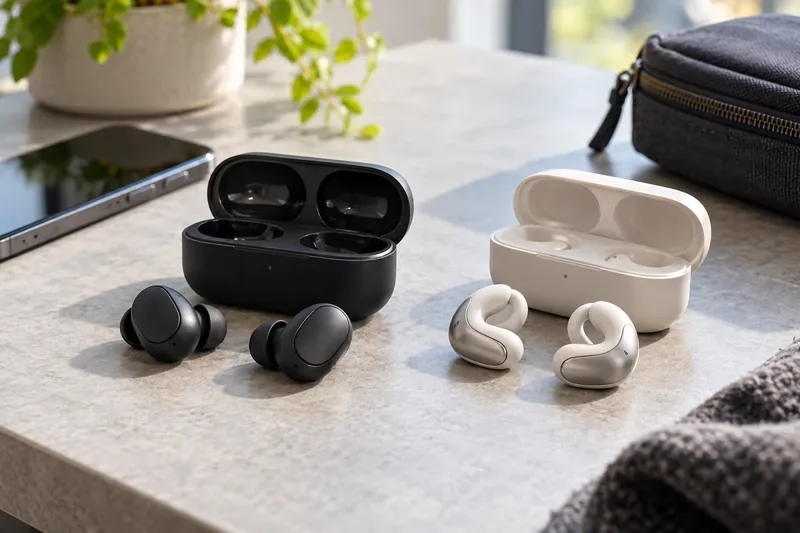
Sealed in-ear earbuds and open-ear designs solve different problems: one prioritizes isolation and noise cancellation, while the other prioritizes awareness and long-wear openness.
Do you want noise cancellation or an open-ear design?
Start here. If you commute by plane or train, work in a noisy office, or simply want a quieter listening bubble, choose an in-ear QuietComfort model. Bose’s QuietComfort Earbuds and QuietComfort Ultra Earbuds (2nd Gen) both use active noise cancellation (ANC), meaning microphones and signal processing reduce external sound before it reaches you.
If you run outdoors, need to hear coworkers, or dislike the plugged-up feeling of silicone tips sealing your ear canal, look at the open-ear models instead. Bose’s Ultra Open family and the new Sport Open Earbuds leave the ear canal open. Bose explicitly states that its open-ear models do not offer ANC because they are designed for situational awareness. See the company’s September 17, 2026 open-ear announcement for the design rationale.
Which Bose earbuds are best for strong noise cancellation?
QuietComfort Ultra Earbuds (2nd Gen): choose them for Bose’s most advanced in-ear feature set
The QuietComfort Ultra Earbuds (2nd Gen) are the flagship choice if your priorities are noise cancellation, immersive audio, and Bose’s higher-end personalization features. Bose lists adjustable ANC, Quiet and Aware modes, CustomTune ear calibration, Immersive Audio, Bluetooth multipoint, an IPX4 water-resistance rating, and a wireless charging case.
Battery life is rated up to 6 hours with Immersive Audio off and up to 4 hours with it on. Bose says the case can provide up to three additional full charges. The second-generation model also adds improved call pickup, improved ActiveSense behavior, wireless charging, and the option to disable touch controls in the Bose app compared with the earlier Ultra generation. You can verify the current specifications on the official QuietComfort Ultra Earbuds (2nd Gen) product page and the Bose support specification page.
This model makes the most sense for frequent flyers, commuters, people who work around steady background noise, and buyers who care about Bose’s premium in-ear feature set more than maximum battery runtime.
QuietComfort Earbuds: choose them for value, battery life, and everyday ANC
The standard QuietComfort Earbuds are easier to justify if you want Bose noise cancellation without paying flagship pricing. Bose lists active noise cancellation, Quiet/Aware/Off settings, Bluetooth multipoint, IPX4 water resistance, a wireless charging case, and up to 8.5 hours of battery life on the current U.S. product page. Bose support documentation lists battery life as up to 9 hours under its test conditions, so it is safest to treat 8.5 hours as the current consumer-facing rating rather than assuming every user will reach the laboratory maximum.
The standard model does not include Bose Immersive Audio or CustomTune. That tradeoff is important: you get longer rated listening time and a lower list price, but fewer premium processing features. Bose also uses a separate Bose QCE app for this model. See the official QuietComfort Earbuds page and official support specifications.
Which Bose earbuds are best if you need to hear your surroundings?
Ultra Open Earbuds (2nd Gen): choose them for premium open-ear listening
Bose announced the Ultra Open Earbuds (2nd Gen) on September 17, 2026, with U.S. availability scheduled for October 1 at $299. As of September 29, they are still in the preorder window. Bose says the new model keeps the cuff-style open-ear fit while adding deeper bass, higher output, clearer calls, Cinema Mode, Auto Volume, a redesigned wireless-charging case, and longer battery life.
Rated playback rises to up to 9 hours, with up to 19.5 additional hours stored in the case. Bose also lists Bluetooth 5.4, multipoint connectivity with two devices, SBC and AAC support, Google Fast Pair, and aptX Adaptive through Snapdragon Sound on compatible Android devices. It remains an open-ear product with no ANC. If you want premium Bose sound features while still hearing traffic, announcements, or nearby conversation, this is the open-ear model to consider first after its October 1 release.
Original Ultra Open Earbuds: choose them when the discount matters more than having the latest generation
The first-generation Ultra Open Earbuds remain relevant because Bose was still selling them in the U.S. at a reduced price when this guide was checked. They offer the cuff-like open-ear fit, Bose Immersive Audio, Bluetooth multipoint, IPX4 water resistance, and up to 7 hours of rated playback on the current product page. They do not have ANC.
The decision is straightforward: if the original model is substantially discounted and you do not need the second generation’s longer battery life, newer case, Cinema Mode, and other updates, the older pair can be the value-oriented open-ear choice. Do not compare only the original MSRP; check the actual selling price at the time you buy. The official Ultra Open Earbuds page shows the current feature set.
Which Bose earbuds make the most sense for running and workouts?
Sport Open Earbuds: choose them for secure open-ear exercise use
The Sport Open Earbuds are another October 1, 2026 release, announced at $199. Bose designed them specifically for running, workouts, and outdoor activity. Their C-arm cuff uses a soft silicone finish and physical buttons, and Bose rates them IP54 for sweat, splash, and dust resistance. That is a more exercise-focused protection rating than the IPX4 rating on several other Bose earbuds because IP54 also includes a dust-ingress rating.
Bose rates playback at up to 7 hours, with up to 22 additional hours stored in the wireless charging case. The buds support Bluetooth multipoint and Bose OpenAudio, but not ANC or Immersive Audio. Auto Volume is designed to adjust loudness as ambient sound changes. The official details are in Bose’s 2026 product announcement and the current earbuds comparison page.
For outdoor runners, this is arguably the clearest use-case split in the Bose lineup: Sport Open prioritizes awareness, secure movement, physical controls, and IP54 protection. If your workout happens in a loud indoor gym and you would rather suppress background music and machine noise, QuietComfort Earbuds may be the better design despite their lower IPX4 rating.
How much should battery life influence your decision?
Battery life matters most if you regularly spend long stretches away from a charging case. Based on Bose’s current consumer-facing specifications, the QuietComfort Earbuds offer up to 8.5 hours, Ultra Open Earbuds (2nd Gen) up to 9 hours, Sport Open Earbuds up to 7 hours, original Ultra Open Earbuds up to 7 hours, and QuietComfort Ultra Earbuds (2nd Gen) up to 6 hours with Immersive Audio off.
Those numbers are not directly comparable in every situation. Volume, codec use, call time, temperature, ANC, Immersive Audio, and other settings can change real runtime. Bose itself notes that battery life varies by settings and use. The practical question is therefore not “Which number is biggest?” but “Will one charge cover my longest normal session?” If the answer is yes, fit and listening style usually matter more than an extra hour on paper.
Do you switch between a phone and a laptop all day?
Bluetooth multipoint should be on your shortlist. It allows compatible earbuds to stay connected to two devices and switch more smoothly between them. Bose currently lists multipoint on QuietComfort Earbuds, QuietComfort Ultra Earbuds (2nd Gen), Ultra Open Earbuds, Ultra Open Earbuds (2nd Gen), and Sport Open Earbuds.
That makes multipoint less useful as a way to separate Bose’s newest models from one another, but very useful when comparing against older Bose generations or sale inventory. Always verify the exact model name before buying, because similarly named older earbuds can differ in multipoint support.
How should you think about fit before buying?
Fit is not a minor comfort detail; it affects stability, bass response, and noise cancellation. The QuietComfort models use eartips plus stability bands, with Bose listing nine size combinations from three eartip sizes and three stability-band sizes. If you want ANC, getting a good seal is essential.
Open-ear models solve fit differently. Ultra Open uses a cuff-like Flex Grip design, while Sport Open uses a more exercise-oriented C-arm style. These avoid sealing the ear canal, which can be more comfortable for people who dislike in-ear pressure, but the tradeoff is that environmental sound remains audible by design.
If possible, buy from a seller with a clear return policy and test the fit during the kinds of sessions you actually do: a one-hour commute, a video meeting, a run, or a long desk session. Bose currently advertises a 30-day return policy for direct U.S. purchases, but you should confirm the terms at checkout because policies can change.
Quick comparison: which model fits which need?
Model
Best fit for
ANC
Rated earbud battery
Water/dust rating
Key tradeoff
QuietComfort Ultra Earbuds (2nd Gen)
Travel, focus, premium in-ear features
Yes
Up to 6 hours
IPX4
Shortest rated battery here; premium price
QuietComfort Earbuds
Everyday ANC and value
Yes
Up to 8.5 hours
IPX4
No Immersive Audio or CustomTune
Ultra Open Earbuds (2nd Gen)
Premium open-ear listening
No
Up to 9 hours
IPX4
No isolation from surrounding noise
Ultra Open Earbuds
Discounted open-ear option
No
Up to 7 hours
IPX4
Older generation
Sport Open Earbuds
Running and outdoor workouts
No
Up to 7 hours
IP54
No Immersive Audio or ANC
What should you buy if two models still seem equally good?
Use the feature that changes your daily behavior, not the feature that sounds most impressive in a spec sheet. Pick QuietComfort Ultra Earbuds (2nd Gen) if your first priority is premium noise cancellation and Bose’s most advanced in-ear processing. Pick QuietComfort Earbuds if you want ANC, longer rated battery life, and a lower price. Pick Ultra Open Earbuds (2nd Gen) if you want the flagship open-ear experience and are comfortable paying for it. Consider the original Ultra Open if its sale price is materially lower. Pick Sport Open if exercise stability, awareness, and IP54 protection are more important than isolation.
One final timing note matters in late September 2026: the Sport Open Earbuds and Ultra Open Earbuds (2nd Gen) are scheduled to become available on October 1. If either of those models matches your needs, waiting a few days is more sensible than buying an older open-ear model without first comparing the final retail price, return terms, and launch availability.
Bottom line: choose by listening environment first, fit second, and premium features third. Bose’s in-ear QuietComfort family is built for reducing outside noise; the Ultra Open and Sport Open families are built for hearing the world around you. Once you make that decision, the right model usually becomes much easier to identify.