01. Current Data
The market data shaping the current brent oil outlook
A serious energy article should start with the market that actually exists, not the market implied by stale narratives. Right now, that means grounding the discussion in official balances, storage or inventory trajectories, the latest benchmark pricing, and the macro conditions that can accelerate or interrupt the trend. Those anchors are more useful than generic talk about sentiment because energy markets are ultimately balanced by molecules and barrels, not by slogans.
For this rewrite, I prioritized primary or near-primary sources: EIA, IEA, the World Bank, the IMF, and the latest U.S. inflation releases. That matters because an energy article becomes genuinely actionable only when the reader can see exactly which figures are driving the conclusion. In this case, the anchor points are $95/b, 2.6 mb/d draw, and the still-relevant inflation backdrop of April 2026 U.S. CPI rose 3.8% year over year, April 2026 core CPI rose 2.8%, and March 2026 core PCE rose 3.2%.
| Period | Data point | Why it matters |
|---|---|---|
| April 2026 | Brent averaged $117/b | Crisis pricing became visible in official EIA data |
| April 7, 2026 | Brent hit $138/b | Shows how fast supply shocks can move the curve |
| May-June 2026f | EIA sees Brent around $106/b | Near-term floor remains elevated while inventories draw |
| 2026f | EIA Brent annual average $95/b | Base official benchmark for scenario work |
| 2027f | EIA Brent annual average $79/b | Official view assumes some easing as supply recovers |
Those figures establish the regime before any opinion enters the room. The core discipline is simple: if the balance data and price action are reinforcing each other, the thesis deserves more respect. If they are diverging, caution should rise. That principle matters more in energy than in many asset classes because spot moves can be extreme while the underlying balance can still normalize quickly.
02. Institutional Lens
What the latest institutional data actually say
The institutional picture for Brent is unusually data-rich right now because EIA, IEA, and the World Bank are all reacting to the same shock from different angles. The EIA's May 12, 2026 Short-Term Energy Outlook says Brent averaged $117/b in April 2026 after reaching $138/b on April 7. It expects prices to stay around $106/b in May and June, with the annual average at $95/b in 2026 and then easing to $79/b in 2027.
The reason those price levels matter is that they are attached to a clear balance view. EIA now assumes the Strait of Hormuz stays effectively closed until late May, with shipping only gradually picking up in June. On that assumption, it forecasts global oil inventories to fall by 2.6 mb/d in 2026 and by an average of 8.5 mb/d in 2Q26. That is not a soft narrative. It is a physically tight market.
The IEA's May 13, 2026 Oil Market Report adds the demand and supply damage in more explicit global terms. It says world oil demand is forecast to contract by 420 kb/d year over year in 2026 to 104 mb/d, or 1.3 mb/d less than its pre-war forecast. At the same time, it says global oil supply fell by 1.8 mb/d in April to 95.1 mb/d, with total losses since February reaching 12.8 mb/d. Its 2026 supply projection is 102.2 mb/d, down 3.9 mb/d on average.
The World Bank's April 2026 Commodity Markets Outlook gives the cross-commodity perspective. It says average energy prices are projected to rise 24% in 2026 and warns that if Middle East disruptions prove more prolonged or severe, Brent could average $95 to $115/b this year. Put together, the institutional lens is clear: Brent is not expensive because investors lost discipline. It is expensive because official agencies see a real supply shock colliding with still-positive global growth.
| Factor | Why it matters | Current Assessment | Bias | Current evidence |
|---|---|---|---|---|
| Spot and prompt structure | High prompt pricing usually signals real physical stress, not just narrative | Bullish | + | EIA and IEA both show crisis-era inventory draws and elevated prompt pricing |
| Inventory balance | Oil is most vulnerable when inventories are falling fast | Bullish | + | EIA forecasts global inventories down 2.6 mb/d in 2026 and 8.5 mb/d in 2Q26 |
| Supply recovery path | The speed of Middle East normalization decides whether the spike sticks | Mixed | 0 | EIA assumes flows improve from June, but not back to pre-conflict levels quickly |
| Demand resilience | Higher prices eventually destroy some demand | Mixed | 0 | IEA now sees world oil demand contracting by 420 kb/d year over year in 2026 |
| Long-run spare capacity | Spare barrels matter for how durable a rally can be | Bearish | - | EIA still sees OPEC spare capacity averaging 2.5 mb/d in 2027 |
The scoring table matters because it forces the article to stop hiding behind broad adjectives like bullish or bearish. Readers should be able to see the current tilt factor by factor. Right now, the evidence is not one-dimensional. Some signals support higher prices, some argue for caution, and some mainly show that time horizon matters more than conviction alone.
03. Countercase
The risks that could weaken the current thesis
The first risk to a bullish Brent thesis is that high prices do their job. The IEA already expects global oil demand to contract by 420 kb/d year over year in 2026, and it says the biggest hit is concentrated in 2Q26. If prices remain too high for too long, the market will not need a huge new supply wave to correct. It will simply need enough demand destruction in petrochemicals, aviation, and transport.
The second risk is that the current supply shock normalizes faster than spot prices imply. EIA's own base case assumes that shipping traffic through the Strait of Hormuz begins to recover in June and that crude prices drop to an average of $89/b in 4Q26. If that recovery proceeds more smoothly than feared, traders who bought the crisis premium late could face a fast de-rating.
The third risk is macro and policy sensitivity. The U.S. inflation backdrop remains sticky, with April 2026 CPI at 3.8%, core CPI at 2.8%, and March 2026 core PCE at 3.2%. If that keeps financial conditions tighter for longer, the oil market can face the uncomfortable combination of still-high spot prices and softening growth expectations. In that environment, the bull case can fail even without a clean supply rebound.
That is why the countercase has to be tied to current data and review dates rather than to textbook abstractions. An energy market can stay tense for longer than many models expect, but it can also normalize faster than many headlines imply. The useful question is not whether a risk sounds plausible. It is what number would confirm it and how quickly that number updates.
04. Forecast Framework
Brent Oil's 2035 outlook should be treated as a probability range, not a single destination
My 2035 base case stays in the middle band because long-range energy forecasting is mainly about regime durability, not point precision. The question is whether the current floor in prices becomes structurally embedded through geopolitics, exports, power demand, and infrastructure constraints, or whether the market gradually relearns how to absorb shocks with more flexibility.
For investors who are already profitable, that often argues for a more surgical approach than all-in conviction. Scaling out into the top of the bull band can make sense when prices have outrun the newest physical confirmation. For investors who are currently losing, the harder but more useful question is whether the original thesis still matches the updated balance data. If the balance is deteriorating, averaging down can simply magnify the wrong exposure. If the balance is tightening again, selective patience can be reasonable.
For readers without a position, the real distinction is between chasing a move and paying for a validated trend. If the market is confirming the thesis with fresh draws, tighter storage, or resilient demand, waiting indefinitely for a perfect pullback can be costly. If the market is already euphoric while the physical data are only mixed, patience is usually the better trade. In other words, the right action depends on entry point and evidence, not on a slogan about buying dips or fearing rallies.
Another discipline that improves long-horizon results is separating structural conviction from tactical sizing. Energy markets overshoot fair value in both directions because they are shock-sensitive and policy-sensitive at the same time. Position sizing, review dates, and trigger levels therefore matter as much as the thesis itself. They are the bridge between a good article and a defensible portfolio decision.
The scenario ranges in this article are meant to help different readers act differently. A trader may care most about weekly storage, inventory, and prompt-structure changes. A long-only allocator may care more about whether the base case is improving or deteriorating every six months. A business operator with fuel or gas exposure may care most about whether today's market still justifies hedging. The same research should be useful to all three audiences.
A final rule is to avoid treating volatility as proof that the thesis is wrong. In energy markets, volatility is often how the thesis expresses itself. The more important question is whether volatility is occurring alongside improving evidence or deteriorating evidence. If the underlying balance is strengthening, volatility can be an opportunity. If the evidence is weakening, the same volatility can be a warning. That distinction is what keeps scenario analysis grounded in process instead of emotion.
05. Scenarios
Actionable scenarios with probabilities, triggers, and review points
Scenario analysis becomes useful only when it includes explicit probabilities, measurable triggers, and a review schedule. Otherwise it is just polished ambiguity. The map below is designed to be monitored over time rather than admired once.
| Scenario | Probability | Range / implication | Trigger | When to review |
|---|---|---|---|---|
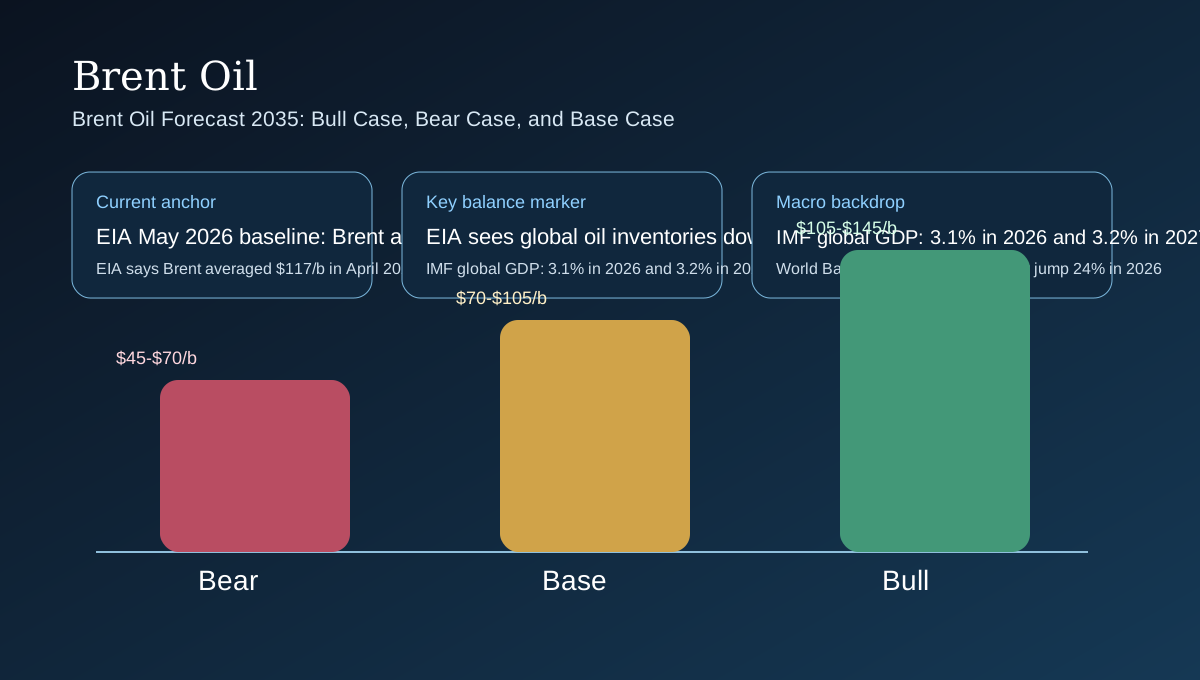
| Bull case | 25% | $191/b-$266/b | Repeated supply disruptions, slower non-OPEC growth, and resilient emerging-market demand | Reassess after each annual IEA and EIA balance update |
| Base case | 50% | $126/b-$159/b | The market normalizes from crisis pricing but keeps a geopolitical premium | Reassess every six months using inventories, spare capacity, and demand data |
| Bear case | 25% | $65/b-$94/b | Supply recovers, demand growth slows, and substitution/efficiency gains compound | Reassess if inventories rebuild and prompt tightness fades decisively |
The purpose of this table is not to create false precision. It is to force discipline. If a trigger is hit, the probability mix should change. If it is not hit, conviction should remain limited. That approach is especially important in energy because spot moves can be dramatic while the deeper balance evolves more gradually.
06. Sources