Bristol Myers Squibb entered October 2026 with a clear split between improving business news and weakening short-term share-price momentum. BMY closed at $58.81 on October 5 after five consecutive losing sessions, down from $68.09 on September 3 and well below its August 19 52-week high of $68.64. At the same time, the company had just secured an expanded FDA indication for CAMZYOS, reported positive multiple-myeloma data, and was approaching its October 29 third-quarter earnings report.
That combination creates a useful test for investors: a good clinical or regulatory headline does not automatically mean a stock should rise immediately, and a falling stock price does not automatically mean the underlying business has deteriorated. The best way to analyze BMY in October is to separate what is verified from what depends on context and what remains unknown.
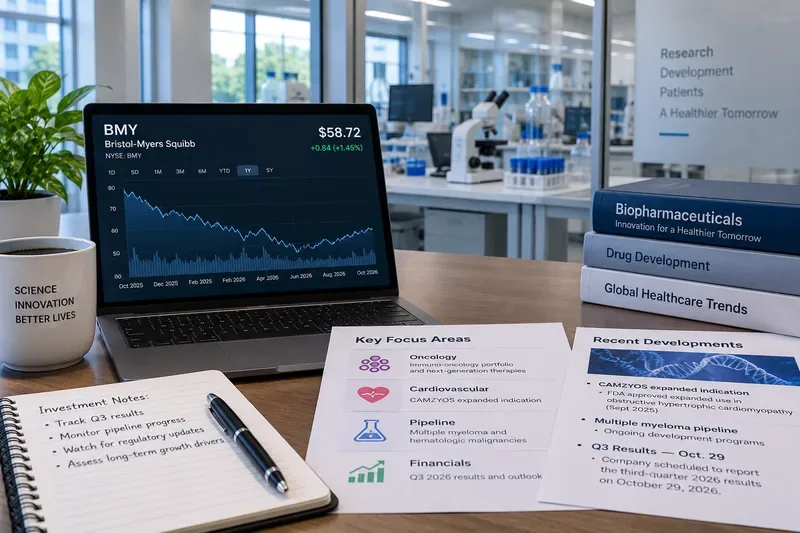
Verified: the short-term BMY price trend weakened sharply into October
Recent market data show BMY falling from $66.82 on September 4 to $58.81 on October 5, a decline of roughly 12% over 20 trading sessions. The October 5 session alone produced a 3.83% drop on volume well above the stock's recent daily average. The shares were also about 14% below their August 19 52-week high of $68.64.
Common misunderstanding: a sharp decline after a strong summer does not prove that the company's long-term thesis has failed. Price action tells investors what buyers and sellers are doing now; it does not by itself identify the cause or predict the next earnings report.
Useful action: treat approximately $58–$59 as the first short-term area to watch because that is where the latest selloff paused. A move back above roughly $61–$63 would improve the near-term picture. Continued weakness below the recent $58.33 intraday low would indicate that the downtrend is still unresolved.
Verified: Bristol Myers Squibb raised its 2026 outlook after Q2
The latest completed earnings report available in early October is the second quarter of 2026. Bristol Myers Squibb reported $13.0 billion of quarterly revenue, up 6% year over year, with Growth Portfolio revenue up 15%. GAAP earnings per share were $1.62 and non-GAAP EPS was $2.04. The company also increased its full-year 2026 revenue guidance to approximately $49.0 billion to $50.0 billion and raised non-GAAP EPS guidance to $6.75–$7.00. These figures are available in the company's July 30 earnings release filed with the SEC.
Common misunderstanding: raised guidance does not guarantee that BMY will meet or exceed the new range. Guidance is management's forward-looking estimate based on assumptions available at the time. It can change with product demand, competition, currency movements, expenses, regulation, litigation or pipeline outcomes.
Useful action: use the $49.0–$50.0 billion revenue range and $6.75–$7.00 non-GAAP EPS range as the baseline for the October 29 report. The most important question is whether management maintains, raises or lowers those ranges.
Verified: the Growth Portfolio is carrying more of the business
Bristol Myers Squibb's June-quarter filing shows why investors should not evaluate the company only through older blockbuster products. In Q2, Opdivo generated $2.485 billion, Opdivo Qvantig $261 million, Orencia $1.034 billion, Yervoy $769 million, Reblozyl $735 million, Breyanzi $484 million and CAMZYOS $416 million. CAMZYOS revenue rose substantially from $260 million a year earlier, while Reblozyl and Breyanzi also posted strong growth. The product-level data are available in the company's second-quarter Form 10-Q.
Opdivo itself declined 3% year over year in the quarter, but Opdivo Qvantig grew more than 200% from a small launch base. That distinction matters because some revenue is shifting within the franchise rather than disappearing outright.
Common misunderstanding: slower growth in one established drug does not necessarily mean the entire portfolio is shrinking. Investors need to distinguish between legacy products, product-formulation shifts and newer growth brands.
Useful action: on October 29, compare Growth Portfolio revenue growth with Legacy Portfolio erosion instead of focusing on a single drug. The investment case improves if newer medicines increasingly offset mature-product declines.
Verified: CAMZYOS received an important FDA label expansion on September 30
The FDA approved CAMZYOS (mavacamten) for symptomatic obstructive hypertrophic cardiomyopathy in adults and pediatric patients weighing at least 30 kilograms. Bristol Myers Squibb said the decision was based on the Phase 3 SCOUT-HCM trial, which met its primary endpoint. The company disclosed the approval in its September 30 announcement.
Common misunderstanding: an FDA approval is not the same thing as immediate material revenue growth. Commercial adoption depends on the size of the eligible population, physician uptake, payer coverage, patient identification, competitive alternatives and treatment logistics.
Useful action: watch future CAMZYOS sales growth rather than assuming the expanded label will immediately change BMY's valuation. A sustained acceleration in revenue is stronger evidence than the approval headline alone.
Verified: multiple-myeloma pipeline progress has improved, but important outcomes remain open
In September, Bristol Myers Squibb announced positive topline results from the registrational Phase 2 QUINTESSENTIAL trial of arlocabtagene autoleucel in heavily pretreated multiple myeloma. The company said the study met its primary endpoint of overall response rate and a key secondary endpoint of complete response rate. Investors can review the company's September 8 announcement.
ZENBEXUS also received FDA accelerated approval in August for a relapsed or refractory multiple-myeloma indication, and later Phase 3 data presented in September showed a materially higher minimal-residual-disease-negative complete-response rate versus the comparator regimen. Those developments strengthen the hematology pipeline narrative.
What remains unknown: early or accelerated approvals and positive response-rate data do not resolve every commercial and clinical question. Longer-term progression-free survival, overall survival where relevant, safety follow-up, market uptake and competitive positioning can still change the value of these programs.
Useful action: distinguish regulatory success from commercial success. Track launch sales, confirmatory-trial milestones and later efficacy data before assigning a full long-term value to newer assets.
Verified: BMY's dividend remains meaningful at the current share price
On September 16, the board declared a quarterly common-stock dividend of $0.63 per share, payable November 2 to shareholders of record as of October 2. At an annualized rate of $2.52 per share and a stock price near $59, the indicated yield is roughly 4.3%, subject to future board approval. Bristol Myers Squibb's September dividend announcement confirms the quarterly amount.
Common misunderstanding: a high dividend yield does not make a stock low-risk. Yield rises when price falls, so an apparently attractive yield can reflect investor concern as much as income opportunity. Dividends are also declared by the board and are not guaranteed indefinitely.
Useful action: evaluate the dividend together with cash generation, debt obligations, business-development spending and earnings durability. Income investors should not use yield as the only reason to buy BMY.
Context-dependent: is the October pullback a buying opportunity?
The answer depends on the investor's time horizon and what caused the weakness. For a long-term investor focused on cash flow and pipeline transition, a lower price can improve prospective returns if the raised 2026 guidance remains intact and newer products continue to grow. For a short-term trader, however, five consecutive losing sessions and a roughly 12% 20-session decline are evidence of negative momentum that has not yet clearly reversed.
Useful action: match the entry rule to the strategy. A long-term investor might scale into a position rather than buy all at once. A momentum-oriented investor could wait for BMY to reclaim recent resistance around $61–$63. An event-risk-sensitive investor could wait until after October 29 earnings.
Context-dependent: patent exposure still matters even when pipeline news is positive
Large pharmaceutical companies constantly replace aging revenue streams with newer medicines. Bristol Myers Squibb's Form 10-Q discusses patent and exclusivity risks across several products, including Eliquis and CAMZYOS-related patent litigation. The company also faces competition as older products mature.
Common misunderstanding: a strong pipeline does not eliminate patent-expiration risk; it changes the probability that lost revenue can be replaced. Investors need both sides of the equation.
Useful action: track the growth portfolio as a percentage of company revenue and compare its annual growth with declines in legacy brands. That is a more useful transition metric than simply counting FDA approvals.
Unknown: what will the October 29 earnings report change?
Bristol Myers Squibb has confirmed that it will report third-quarter results on Thursday, October 29, 2026, followed by an investor call at 8:00 a.m. ET. The schedule is verified in the company's official earnings-date announcement.
What is not yet known is whether third-quarter product demand, expenses, foreign exchange, launch spending and portfolio trends will support the guidance raised in July. The market may also react more strongly to management's comments about 2027 than to the reported quarter itself.
Useful action: before the report, write down the three items that would change your thesis: full-year guidance, Growth Portfolio growth and management's view of upcoming patent or launch dynamics. This reduces the temptation to react only to the headline EPS number.
October 2026 BMY outlook
BMY's October setup is neither a simple bullish story nor a clear fundamental breakdown. The stock has lost substantial short-term momentum, yet the latest verified business data include 6% Q2 revenue growth, 15% Growth Portfolio growth, raised 2026 revenue and EPS guidance, an expanded CAMZYOS indication and continued hematology-pipeline progress.
The key distinction is between verified progress and future monetization. Regulatory wins and trial results improve possibilities, but they do not establish future sales. Likewise, a weak stock chart confirms selling pressure but does not establish that earnings estimates must fall.
For investors analyzing Bristol Myers Squibb now, the most practical approach is to use the October 29 report as the next major checkpoint. Price stabilization around the high-$50s, a recovery through the low-$60s and reaffirmed or improved guidance would strengthen the case that the October decline was primarily a correction. A breakdown below recent lows combined with reduced guidance or weaker growth-portfolio trends would point to a more serious deterioration.
This analysis is for informational purposes only and is not personalized investment advice. Market prices change continuously, and investors should verify current quotes and primary-source company disclosures before making investment decisions.