Broadcom Inc. (Nasdaq: AVGO) entered October 2026 with a sharp rebound, strong AI semiconductor growth, and a valuation that leaves less room for execution mistakes. That combination creates a genuine trade-off for investors: the business momentum is powerful, but the stock still sits well below its 52-week high and trades at a premium earnings multiple.
This analysis uses market data available through the October 5, 2026 close and Broadcom's latest reported fiscal third-quarter results. The aim is not to declare AVGO universally attractive or unattractive. Instead, it compares the choices facing different types of investors and identifies the evidence that would strengthen or weaken each approach.
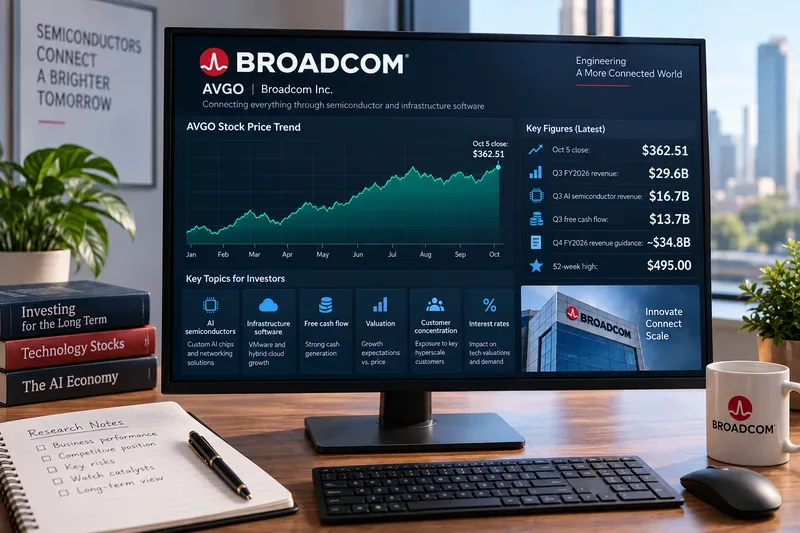
AVGO's early-October price action: rebound versus confirmation
Google Finance showed Broadcom closing at $362.51 on October 5, 2026, up 2.08% for the session. The stock opened at $357.79, traded as high as $363.86, and as low as $356.14. Reported volume was about 20.4 million shares, below the displayed average volume of roughly 25.1 million. The same market page listed a 52-week high of $495.00 and a 52-week low of $289.96. See the Google Finance AVGO quote.
The path into that close was volatile. AVGO closed at $351.19 on September 30, fell 2.15% to $343.64 on October 1, then rebounded 3.35% to $355.14 on October 2 before advancing again on October 5. From the October 1 close to October 5, the stock gained roughly 5.5%.
For a momentum-oriented investor, that is encouraging because the stock recovered quickly after a two-day decline. The trade-off is confirmation: October 5 volume was below its recent average, and the share price remained about 27% below the reported 52-week high. A rebound is not the same thing as a completed recovery.
Choice 1: Follow the rebound or wait for a cleaner breakout?
An investor who prioritizes momentum may prefer to act while AVGO is making higher closes. The practical advantage is earlier participation if the rebound continues. The cost is a greater chance of buying into a short-lived bounce.
A more confirmation-focused approach would wait for sustained closes above the recent $363-$365 area. October 5 reached $363.86 intraday, so that zone is a natural near-term test. A close above it on stronger volume would provide better evidence that buyers are willing to support higher prices.
Waiting has its own trade-off: if AVGO accelerates quickly, the entry price could be materially higher. For investors who care more about avoiding false breakouts than capturing the first part of a move, that cost may be acceptable.
Support levels matter more for risk control than prediction
The first practical support area is around $347-$355. October 2 traded down to $347.42 and closed at $355.14, while September 28 through September 30 also clustered around the high-$340s to mid-$350s. Holding that region would preserve the early-October recovery structure.
The more important downside zone is around $343-$344, near the October 1 close and low. A decisive break below that level would make the rebound less convincing and suggest that recent buyers are losing control.
These levels should not be treated as guaranteed floors or ceilings. They are simply places where recent trading has concentrated. For a short-term trader, they can define invalidation points. For a long-term investor, they are more useful as context than as automatic buy or sell triggers.
Choice 2: Buy the AI semiconductor story or demand a valuation cushion?
Broadcom's latest operating results make the AI case unusually strong. In fiscal Q3 2026, revenue reached $29.6 billion, up 86% from the prior-year period. Management reported $16.7 billion of AI semiconductor revenue, up 221% year over year and 54% sequentially. For fiscal Q4, Broadcom said it expected AI semiconductor revenue to accelerate to about $21.7 billion, up 236% year over year. See Broadcom's official fiscal Q3 2026 results.
For investors seeking direct exposure to custom AI accelerators and networking, those figures support the growth thesis. Broadcom is not relying only on a distant AI opportunity; AI semiconductor revenue is already a very large part of its reported business.
The trade-off is valuation. Google Finance displayed a trailing P/E ratio around 46 as of October 5. A high multiple can remain justified if earnings grow rapidly, but it also increases sensitivity to slower growth, customer delays, higher discount rates, or weaker margins. A valuation-sensitive investor may therefore prefer to wait for either a lower price or another quarter of execution before accepting the same growth expectations.
Choice 3: Focus on semiconductor growth or the diversification from infrastructure software?
Broadcom is no longer only a semiconductor company. Its infrastructure software portfolio, expanded substantially through VMware, gives it a second earnings engine. That diversification can reduce dependence on individual chip cycles and provides recurring enterprise-software revenue.
The trade-off is complexity. Semiconductor demand, especially AI accelerators and networking, can grow extremely fast but is cyclical and concentrated among large customers. Infrastructure software may be steadier, but integration, pricing, customer retention, and product strategy matter greatly. Investors evaluating AVGO should therefore avoid treating consolidated revenue growth as if every dollar carries the same risk and growth profile.
Broadcom's fiscal Q3 2026 Form 10-Q is the primary source for the company's segment disclosures, risks, debt, customer relationships, and accounting details.
Free cash flow strengthens the bull case, but does not eliminate concentration risk
Broadcom generated $14.2 billion of cash from operations in fiscal Q3. After approximately $0.5 billion of capital expenditures, the company reported $13.7 billion of free cash flow, equal to 46% of revenue. That cash generation gives Broadcom flexibility to service debt, pay dividends, invest in product development, and manage integration costs.
For an investor prioritizing cash generation, this is a major advantage. The trade-off is that Broadcom's AI business depends on a relatively small number of hyperscale customers. Large customers can support enormous volumes, but concentration increases the effect of project delays, internal chip programs, procurement changes, or bargaining power.
Broadcom's SEC filing discusses customer concentration and other business risks in detail. This is particularly relevant when growth expectations embedded in the share price are already high.
Choice 4: Treat the dividend as meaningful income or as a secondary benefit?
Broadcom declared a quarterly cash dividend of $0.65 per share, payable September 30, 2026 to shareholders of record on September 21. The dividend provides tangible cash return, and Broadcom's strong free cash flow supports the payment. The declaration is included in the company's Q3 earnings announcement.
However, at the October 5 share price, the indicated dividend yield was below 1%. Investors primarily seeking income can find securities where current yield plays a much larger role. For AVGO, the dividend is better viewed as a complement to the growth story rather than the central reason to own the stock.
Q4 guidance raises the bar for execution
Broadcom guided to approximately $34.8 billion of fiscal Q4 2026 revenue, representing 93% year-over-year growth, and approximately 66% non-GAAP operating income as a percentage of projected revenue. Management explicitly notes that this guidance is an estimate based on conditions at the time and that actual results can vary materially.
For growth investors, that outlook provides a clear catalyst: if Broadcom meets or exceeds it while AI semiconductor revenue continues accelerating, the fundamental trend remains strong. For more cautious investors, the same guidance is a risk because expectations are already very high. When a stock trades at a premium multiple, merely delivering strong growth may not be enough if investors expected even more.
Interest rates create a separate valuation trade-off
The Federal Reserve raised the federal funds target range by 25 basis points on September 16, 2026, to 3.75%-4.00%. The Fed said inflation remained elevated. See the official September FOMC statement.
Higher rates do not directly reduce demand for Broadcom's AI accelerators, but they can pressure the valuation investors are willing to pay for future growth. That distinction matters. AVGO can execute well operationally while its P/E multiple contracts because the broader discount-rate environment becomes less favorable.
Which approach fits which investor?
| Investor priority | Possible approach | Main trade-off | Evidence to watch |
|---|---|---|---|
| Short-term momentum | Participate while price holds above the mid-$350s | Higher false-breakout risk | Closes above $363-$365 and stronger volume |
| Confirmation first | Wait for sustained breakout above recent highs | Potentially higher entry price | Multiple closes above resistance |
| AI growth exposure | Emphasize AI semiconductor revenue acceleration | Customer concentration and high expectations | Q4 AI revenue versus the $21.7 billion outlook |
| Valuation discipline | Wait for a wider margin of safety | May miss continued momentum | Earnings growth versus P/E multiple and rates |
| Cash-flow quality | Focus on free cash flow and operating leverage | Cash flow can remain strong while valuation falls | FCF margin, debt, and operating income |
| Income | Treat dividend as supplemental | Yield is modest relative to income-focused assets | Dividend growth and free-cash-flow coverage |
What would change the October 2026 view?
The current evidence supports a constructive rebound with meaningful execution and valuation risk. A stronger bullish case would require AVGO to hold recent support, break above the mid-$360s with improved volume, and continue delivering AI growth close to management's aggressive outlook.
A more cautious view would be appropriate if the stock falls back below roughly $343-$344, if AI semiconductor revenue materially misses guidance, if large customers reduce commitments, or if operating profitability weakens while growth expectations remain elevated.
Investors should also distinguish a change in the stock trend from a change in the business. A valuation-driven selloff can occur even when Broadcom's revenue keeps growing. Conversely, a strong market rally can lift AVGO temporarily even if company-specific fundamentals are deteriorating.
Bottom line
Broadcom's October 2026 setup offers no single universally best choice. Momentum investors can point to a roughly 5.5% rebound from the October 1 close through October 5. Growth investors can point to 221% year-over-year AI semiconductor growth and Q4 guidance for further acceleration. Cash-flow investors can point to $13.7 billion of quarterly free cash flow.
The opposing case is equally concrete: AVGO remained about 27% below its 52-week high, traded at a premium earnings multiple, and depends heavily on continued AI spending by a relatively concentrated group of large customers. Higher interest rates add another source of valuation pressure.
For investors who prioritize momentum, the key test is whether price can hold the mid-$350s and clear the mid-$360s with better participation. For investors who prioritize valuation discipline, the key question is whether earnings and cash flow can grow fast enough to justify the current multiple. For investors primarily seeking income, Broadcom's dividend is useful but secondary to the growth thesis.
This analysis is based on information available through October 6, 2026, including market prices through the October 5 close. It is not a live quote, price target, or investment recommendation.