01. Historical Context
The 2030 CAC case is about franchise quality more than French GDP
CAC 40 contains some of Europe's strongest listed franchises, but the index is too concentrated to be judged purely on macro valuation screens.
| Horizon | What matters most | Current assessment | What would weaken the thesis |
|---|---|---|---|
| 1-3 months | Rates and guidance | Mixed | Top holdings guide down together |
| 6-18 months | Eurozone growth normalization | Tentative | Growth remains flat |
| To 2030 | Quality franchise compounding | Positive if concentration keeps delivering | Premium names lose pricing power |
That is why Euronext's official factsheet matters: top ten weight at 59.64%, dividend yield at 2.96%, and valuation ratios that are respectable rather than distressed.
For 2030, the question is whether those global leaders keep compounding fast enough to offset a still modest domestic and eurozone macro backdrop.
02. Key Forces
What matters for CAC 40 into 2030
First, core inflation has improved more than growth. That is a favorable backdrop for discount rates, but not sufficient by itself for powerful earnings acceleration.
Second, concentration means stock selection inside the index still matters a great deal. CAC 40 can outperform with flat GDP if its biggest multinationals keep gaining globally.
Third, the regional macro corridor still matters because a eurozone slowdown would affect both industrial and financial components.
Fourth, the starting dividend yield provides some support, but not enough to excuse weak earnings.
| Factor | Current assessment | Bias | Bullish trigger | Bearish trigger |
|---|---|---|---|---|
| Concentration | High | Neutral | Top holdings continue global compounding | A few misses dominate returns |
| Valuation | Reasonable quality premium | Neutral | Profitability stays high enough to defend multiples | Growth fades but quality stays overpriced |
| Inflation | Improving | Bullish | Low core inflation persists | Energy shock reverses progress |
| Domestic growth | Soft | Bearish | French GDP broadens beyond flat | Domestic activity stays inert |
| Eurozone backdrop | Fragile but positive | Neutral | Regional GDP and earnings improve together | Stagnation persists |
Fifth, the long-range case improves materially only if France and the eurozone can pair lower inflation with better investment activity.
03. Countercase
The 2030 countercase is that CAC remains expensive quality without enough growth
The most plausible long-range bear outcome is not a collapse in franchise quality. It is a market where strong businesses remain strong, but the index as a whole fails to deliver much because starting valuations never get another major lift.
That can happen if domestic growth remains soft, if eurozone demand stays subdued, or if the biggest holdings lose some of their global pricing power.
For a concentrated index, that kind of underperformance can last longer than investors expect.
| Risk | Latest data point | Why it matters | What to monitor next |
|---|---|---|---|
| Premium without growth | Official valuation ratios still elevated versus flat GDP | Upside becomes multiple-limited | Profit margins and revision breadth |
| Weak domestic economy | Q1 2026 GDP flat | Limits breadth beyond global leaders | Consumption and investment data |
| Regional fragility | Euro area GDP +0.1% q/q | A weak region constrains cyclicals | Eurostat GDP and HICP |
| Concentration | Top ten 59.64% | Raises single-name risk at index level | Top-holding guidance |
The long-range lesson is that quality alone is not enough if the macro and revision backdrop stays mediocre.
04. Institutional Lens
Institutional context favors careful optimism, not exuberance
Public institutional commentary on Europe still helps, but CAC needs more nuance than a single regional call. UBS's April 2026 downgrade of eurozone equities to Neutral because of energy shock risk is a reminder that even quality-heavy Europe trades can face macro interruptions.
Goldman Sachs Asset Management's valuation work shows Europe is not priced like the U.S., which is supportive for long-run returns. But official Euronext data also show CAC is not a distressed bargain.
| Institution / source | Updated | What it says | Why it matters here |
|---|---|---|---|
| Euronext | March 31, 2026 | Official valuation, yield and concentration data | Best index-specific long-range anchor |
| INSEE | April-May 2026 | Growth soft, inflation better behaved | Defines the domestic policy and demand backdrop |
| UBS | April 2026 | Eurozone equities cut to Neutral because of energy shock risk | Explains the fragility in the regional bull case |
| GS Asset Management | May 2, 2026 | Developed Europe on 15.4x forward P/E | Puts CAC into a broader regional valuation frame |
The most defensible 2030 stance is therefore moderate optimism rooted in franchise quality and some valuation discipline.
05. Scenarios
Scenario map into 2030
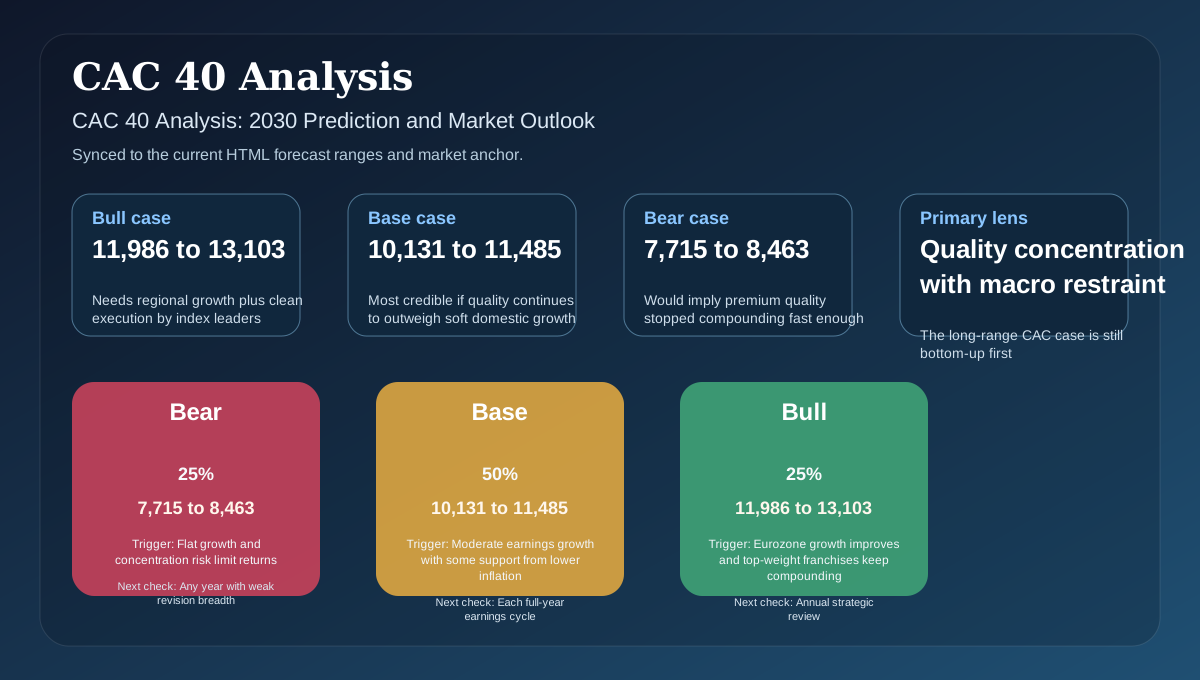
These ranges are analytical ranges based on current official valuation data and public regional outlooks.
The base case assumes quality names continue compounding while the macro backdrop slowly improves. The bull case assumes stronger eurozone activity and cleaner breadth. The bear case assumes the market stays premium-rated without enough earnings growth.
| Scenario | Probability | Working range | Measured trigger | Review window |
|---|---|---|---|---|
| Bull | 25% | 11,986 to 13,103 | Eurozone growth improves and top-weight franchises keep compounding | Annual strategic review |
| Base | 50% | 10,131 to 11,485 | Moderate earnings growth with some support from lower inflation | Each full-year earnings cycle |
| Bear | 25% | 7,715 to 8,463 | Flat growth and concentration risk limit returns | Any year with weak revision breadth |
A 2030 investor should focus on whether concentration remains a benefit. If the answer weakens, the whole case weakens.
CAC 40 can still do well from here, but the path is likely to be steadier than spectacular.
References
Sources
- Euronext CAC 40 Index Factsheet, as of March 31, 2026
- INSEE, consumer prices in April 2026
- INSEE, GDP stalled in Q1 2026
- Eurostat, euro area GDP up 0.1% in Q1 2026
- Investing.com CAC 40 historical data
- Goldman Sachs Asset Management, Market Monitor, week ending May 1, 2026
- Investing.com summary of UBS Eurozone equities update, April 2026