01. Historical Context
CAC's decade case is strongest when concentration keeps earning its premium
Over a decade, CAC 40 is less a bet on France and more a bet on whether a concentrated list of European leaders can keep monetizing global demand.
| Horizon | What matters most | Current assessment | What would weaken the thesis |
|---|---|---|---|
| 1-3 months | Guidance and rates | Balanced | Top holdings disappoint |
| 6-18 months | Regional stabilization | Tentative | Eurozone weakens |
| To 2035 | Franchise durability | Positive but concentration-heavy | Large-cap quality loses pricing power |
That can work well, but it also means the index is vulnerable to shifts in luxury demand, industrial capex, energy profits and regulation.
The decade case is therefore attractive only if investors accept that quality concentration is both the source of outperformance and the main risk.
02. Key Forces
What matters for a decade-long CAC forecast
The first force is whether premium businesses continue to deserve premium valuations.
The second force is whether Europe avoids repeated macro shocks severe enough to compress those valuations.
The third force is payout and cash-flow discipline, which matters more over ten years than one quarter's GDP print.
The fourth force is breadth. If more than a handful of names can contribute to returns, the decade case becomes much more robust.
| Factor | Current assessment | Bias | Bullish trigger | Bearish trigger |
|---|---|---|---|---|
| Franchise quality | High | Bullish | Global leaders keep taking share | Premium names decelerate |
| Concentration | Very high | Bearish | Concentration remains deserved | Index becomes too dependent on a few names |
| Macro regime | Improving inflation, weak growth | Neutral | Europe finds a steadier growth mix | Recurrent shocks keep compressing multiples |
| Income support | Useful but secondary | Neutral | Dividend support remains intact | Cash-flow pressure weakens payouts |
| Regional valuation | Below U.S., not distressed | Neutral | Reallocation into Europe lifts the regional premium | Europe remains a low-conviction allocation |
The fifth force is global competitive positioning in luxury, industrial automation, healthcare and energy transition.
03. Countercase
The decade bear case is concentration without enough growth
A weak 2035 outcome does not require France to fall into recession repeatedly. It only requires CAC's biggest names to grow too slowly for the premiums investors continue to pay.
That risk becomes more serious if Europe stays a low-growth region or if energy and trade shocks keep interrupting the compounding process.
Because the index is concentrated, a decade of underperformance can be driven by surprisingly few disappointments.
| Risk | Latest data point | Why it matters | What to monitor next |
|---|---|---|---|
| Premium fatigue | Official valuation ratios still imply quality premium | Premiums can unwind over years | Sector margins and valuation spread |
| Stuck growth | France GDP flat in Q1 2026 | Weak domestic growth narrows the support base | Investment and productivity data |
| Concentration | Top ten at 59.64% | Single-theme weakness can dominate returns | Weight concentration and guidance |
| Regional shocks | Euro area inflation 3.0% in April 2026 | Repeated energy shocks would hit Europe-wide multiples | Energy-led HICP swings |
That is why the decade thesis needs more than quality branding. It needs durable earnings delivery.
04. Institutional Lens
Institutional evidence argues for a selective, not euphoric, long-range stance
Public institutional work used here supports Europe selectively, not indiscriminately. That is a good fit for CAC because it is already a selective index.
Official Euronext, INSEE and Eurostat data also show why the decade case can work: lower core inflation, real dividend support, and high-quality franchises. They also show why it can fail: soft growth and concentration risk.
| Institution / source | Updated | What it says | Why it matters here |
|---|---|---|---|
| Euronext | March 31, 2026 | Official valuation, return and concentration data | Best long-run index anchor |
| INSEE | April-May 2026 | Growth stalled but inflation moderated | Defines the current French macro base |
| UBS | April 2026 | Eurozone downgraded to Neutral on energy-shock risk | Keeps long-run optimism disciplined |
| GS Asset Management | May 2, 2026 | Europe cheaper than the U.S. on forward P/E | Provides some valuation cushion over a decade |
A credible 2035 view therefore stays constructive but selective.
05. Scenarios
Scenario ranges into 2035
These are analytical ranges meant to keep the decade debate honest rather than precise.
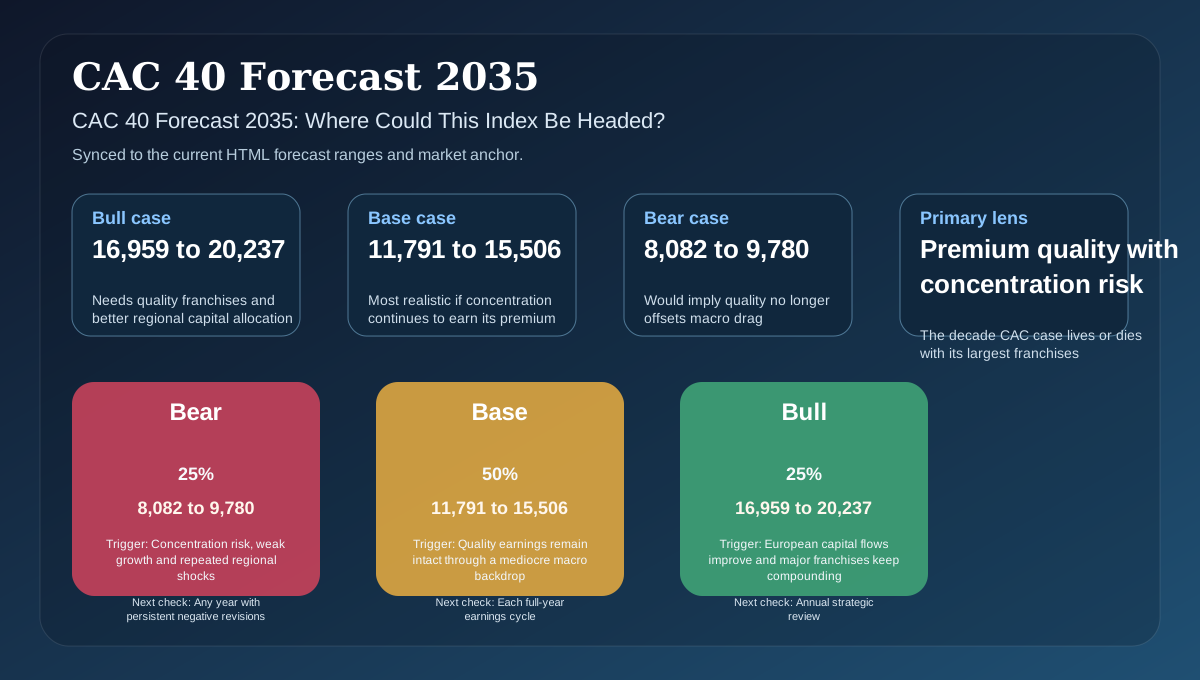
The base case assumes premium businesses keep compounding through uneven regional growth. The bull case assumes Europe becomes a stronger destination for capital. The bear case assumes concentration and weak growth dominate.
| Scenario | Probability | Working range | Measured trigger | Review window |
|---|---|---|---|---|
| Bull | 25% | 16,959 to 20,237 | European capital flows improve and major franchises keep compounding | Annual strategic review |
| Base | 50% | 11,791 to 15,506 | Quality earnings remain intact through a mediocre macro backdrop | Each full-year earnings cycle |
| Bear | 25% | 8,082 to 9,780 | Concentration risk, weak growth and repeated regional shocks | Any year with persistent negative revisions |
Over a decade, the most important review questions are whether concentration is broadening, whether premium margins hold and whether Europe's macro regime is becoming less fragile.
If those answers improve together, CAC can exceed the base case. If not, respectable businesses can still produce mediocre index returns.
References
Sources
- Euronext CAC 40 Index Factsheet, as of March 31, 2026
- INSEE, consumer prices in April 2026
- INSEE, GDP stalled in Q1 2026
- Eurostat, euro area GDP up 0.1% in Q1 2026
- Investing.com CAC 40 historical data
- Goldman Sachs Asset Management, Market Monitor, week ending May 1, 2026
- Investing.com summary of UBS Eurozone equities update, April 2026