01. Historical Context
CAC 40 needs earnings delivery because the French macro backdrop is improving only slowly
CAC 40 has a different problem from DAX. It is not a pure domestic cyclical index and it is not obviously cheap. The top of the benchmark is dominated by global luxury, industrial, healthcare, energy and financial names, so company-specific execution matters as much as French GDP.
| Horizon | What matters most | Current assessment | What would weaken the thesis |
|---|---|---|---|
| 1-3 months | Luxury, energy and rates | Mixed: low core inflation helps, flat GDP does not | Luxury demand or oil backdrop weakens sharply |
| 6-18 months | Eurozone earnings rebound | Possible if Europe avoids an energy shock | French and eurozone activity stay stalled |
| To 2027 | Can global leaders carry the index? | Yes, but only with steadier revisions | Top holdings lose margin momentum |
Still, the domestic macro backdrop matters at the margin. INSEE reported that France's GDP was flat in the first quarter of 2026 after 0.2% growth in Q4 2025, while consumer prices rose 2.2% year on year in April 2026 and core inflation was only 1.2%. That mix is softer than Germany on growth and calmer than Germany on inflation.
Euronext's own March 31, 2026 factsheet showed CAC 40 down 4.08% year to date, with a 3.24 price-to-book ratio, 2.55 price-to-sales ratio and 14.58 price-to-cash-flow ratio. That leaves room for upside, but it also argues against pretending the index is statistically washed out.
02. Key Forces
Five forces that matter most for CAC 40
The first force is valuation quality rather than simple cheapness. Euronext's official ratios show CAC 40 is not a distressed market. The dividend yield near 3% helps, but the market still needs earnings quality.
The second force is macro asymmetry. France GDP was flat in Q1 2026, yet inflation cooled to 2.2% and core inflation to 1.2%. That is a better mix for rates than for immediate earnings acceleration, which is why the base case is steady rather than explosive.
The third force is index composition. Euronext's top ten names made up 59.64% of the index at March 31, 2026, led by TotalEnergies at 9.52%, Schneider Electric at 7.57%, LVMH at 6.63% and Air Liquide at 5.90%. In practice, CAC 40 is a concentrated basket of globally exposed champions.
The fourth force is the broader eurozone setup. Eurostat's flash estimate showed euro area GDP up only 0.1% quarter on quarter in Q1 2026. That is enough to avoid recession language, but not enough to justify aggressive optimism without earnings proof.
| Factor | Current assessment | Bias | Bullish trigger | Bearish trigger |
|---|---|---|---|---|
| Official valuation | P/B 3.24x, P/S 2.55x, P/CF 14.58x, dividend yield 2.96% | Neutral | Earnings stay firm enough to justify premium quality | Profit momentum slows while valuation stays elevated |
| France inflation | CPI 2.2%, core 1.2% in April 2026 | Bullish | Low core inflation supports a friendlier rate backdrop | Headline inflation re-accelerates again |
| France growth | GDP 0.0% q/q in Q1 2026 | Bearish | Q2 activity turns positive and broadens | Domestic demand remains flat |
| Concentration | Top ten weights 59.64% | Bearish | Leadership broadens beyond a few global champions | Luxury and energy weakness hit the same time |
| Eurozone backdrop | GDP +0.1% q/q, HICP 3.0% in April 2026 | Neutral | Growth firms while inflation calms | Energy shock revives stagflation fears |
The fifth force is sentiment toward Europe. UBS's April 2026 eurozone update cut eurozone equities to Neutral because of energy shock risk. That is relevant for CAC because a softer rates backdrop helps, but an energy shock would still hit European margins and confidence quickly.
03. Countercase
What would break the CAC 40 thesis
The first risk is concentration. With nearly 60% of the index in the top ten names, CAC 40 can look diversified while still relying on a narrow set of global profit engines.
The second risk is that flat domestic growth becomes a more important constraint. GDP was unchanged in Q1 2026. If that persists, rate relief alone may not be enough to lift broad earnings.
Third, the index remains exposed to Europe-wide energy stress and to global demand for luxury and industrial goods. Those are not the same risk, but they can hit together.
| Risk | Latest data point | Why it matters | What to monitor next |
|---|---|---|---|
| Flat growth persists | France GDP 0.0% q/q in Q1 2026 | Limits domestic earnings breadth | INSEE quarterly GDP and consumption data |
| Concentration shock | Top ten account for 59.64% of index weight | A few misses can move the whole index | Guidance from top luxury, industrial and energy names |
| Valuation without growth | P/B 3.24x and P/CF 14.58x | Not cheap enough to ignore revisions | Earnings revisions and margin commentary |
| Eurozone energy stress | Euro area inflation rose to 3.0% in April 2026, with energy at 10.9% | Can pressure both margins and rates | Eurostat HICP and gas/oil pricing |
The bear case is therefore a combination of concentration, soft growth and weaker external demand rather than one single macro accident.
04. Institutional Lens
Institutional context is constructive on Europe, but not blindly so
The public institutional signals relevant for CAC 40 are mostly regional. UBS cut eurozone equities to Neutral in April 2026 because of energy shock risk, even while still carrying a positive medium-term target structure for Euro Stoxx 50. That tells you Europe can still rise, but the path is conditional.
Goldman Sachs Asset Management's May 2026 Market Monitor adds a valuation benchmark. Its cross-market chart showed developed Europe on 15.4x next-12-month P/E, versus the UK at 13.2x and the U.S. at 22.0x. That is useful for CAC because it says Europe is not expensive versus the U.S., but no longer obviously cheap after the rally.
| Institution / source | Updated | What it says | Why it matters here |
|---|---|---|---|
| Euronext | March 31, 2026 | Official valuation and concentration data | Best public index-specific quantitative anchor |
| INSEE | April-May 2026 | GDP flat in Q1, CPI 2.2%, core 1.2% | Defines the domestic macro backdrop |
| UBS Eurozone update | April 2026 | Eurozone equities cut to Neutral on energy-shock risk | Explains why upside exists but is not clean |
| GS Asset Management | May 2, 2026 | Developed Europe at 15.4x next-12-month P/E | Provides regional valuation context for CAC |
For CAC specifically, the absence of clean public bank targets is itself informative. The index is best treated as a stock-pickers' quality benchmark within Europe, not as a macro index that one bank can summarize with a single heroic target.
05. Scenarios
Probability-weighted scenarios into 2027
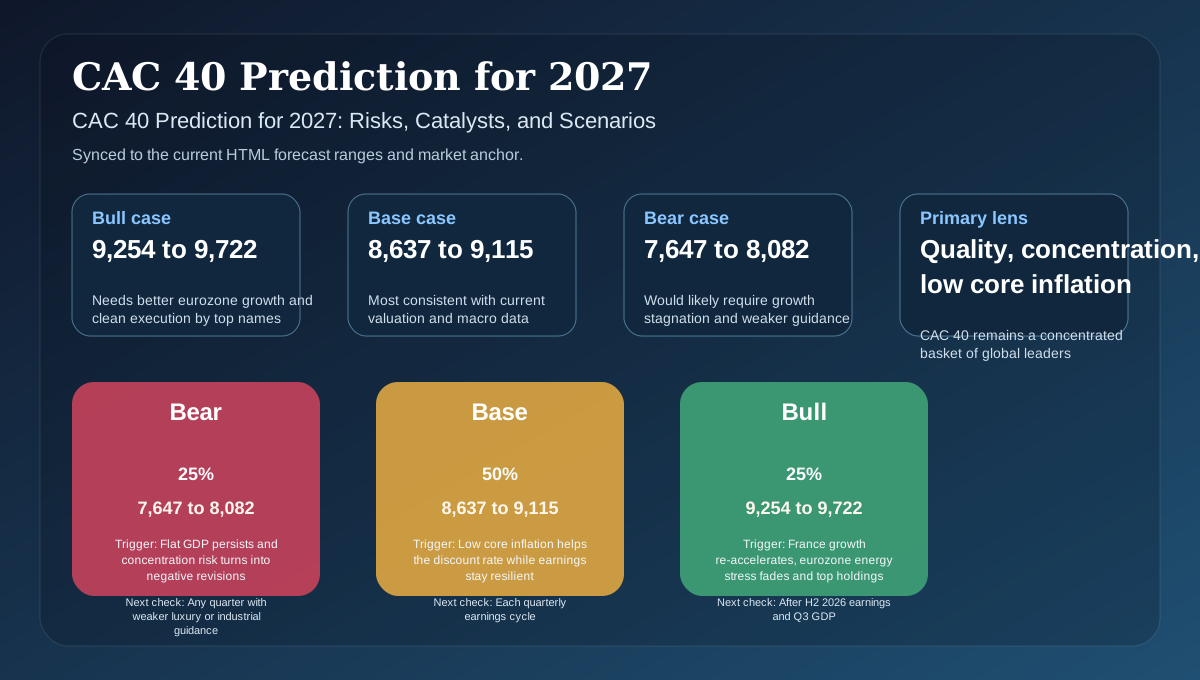
These 2027 ranges are analytical ranges built from official CAC 40 valuation data, current macro releases and public regional institutional views. They are not claimed as exact published bank targets.
The base case assumes low core inflation helps rates while global champions continue delivering. The bull case assumes France and the eurozone move from flat growth to gentle recovery. The bear case assumes concentration turns from a feature into a weakness.
| Scenario | Probability | Working range | Measured trigger | Review window |
|---|---|---|---|---|
| Bull | 25% | 9,254 to 9,722 | France growth re-accelerates, eurozone energy stress fades and top holdings deliver | After H2 2026 earnings and Q3 GDP |
| Base | 50% | 8,637 to 9,115 | Low core inflation helps the discount rate while earnings stay resilient | Each quarterly earnings cycle |
| Bear | 25% | 7,647 to 8,082 | Flat GDP persists and concentration risk turns into negative revisions | Any quarter with weaker luxury or industrial guidance |
The thesis should be reviewed after each INSEE GDP release and after earnings from the top-weight names because those are the clearest swing factors.
CAC 40 can still work into 2027, but the edge lies in quality and cash generation rather than in domestic macro acceleration.
References
Sources
- Euronext CAC 40 Index Factsheet, as of March 31, 2026
- INSEE, consumer prices in April 2026
- INSEE, GDP stalled in Q1 2026
- Eurostat, euro area GDP up 0.1% in Q1 2026
- Investing.com CAC 40 historical data
- Goldman Sachs Asset Management, Market Monitor, week ending May 1, 2026
- Investing.com summary of UBS Eurozone equities update, April 2026