Home
» Today
»
Canadian Gas Prices Fall Sharply: Why Pump Costs Are Easing | November 22, 2026
Canadian Gas Prices Fall Sharply: Why Pump Costs Are Easing | November 22, 2026
Information checked: November 21, 2026, 11:01 p.m. Eastern Standard Time (Toronto, UTC−05:00; November 22, 04:01 UTC). Canadian gasoline prices have fallen sharply in recent weeks, bringing some relief to drivers heading into late November. The Canadian Automobile Association (CAA) reported a national regular-gas average of 143.4 Canadian cents per liter in its November 21 update, versus 150.3 cents a week earlier and 171.2 cents a month earlier. That is a 6.9-cent weekly drop and a 27.8-cent monthly decline, although local prices may differ considerably.
The decline is best understood as the result of interconnected markets rather than a single announcement. Seasonal demand, wholesale gasoline prices, global crude oil conditions, refinery availability, the Canadian dollar and regional competition all influence the pump price. Importantly, Statistics Canada's November 16 inflation release found that gasoline prices were still 30.9% higher in October than a year earlier, even though they declined 2.5% from September. The recent fall does not erase the earlier increase.
Destaques
CAA's November 21 reading showed regular gasoline averaging 143.4 cents per liter nationally, down 27.8 cents from a month earlier.
Gasoline generally faces less driving-season demand in late fall, but seasonal patterns cannot, by themselves, prove the cause of this particular decline.
Crude oil, wholesale fuel prices, refinery supply and currency movements may push prices up or down, with different effects by region.
The federal consumer fuel charge ended in April 2025; it should not be portrayed as a new November 2026 policy change.
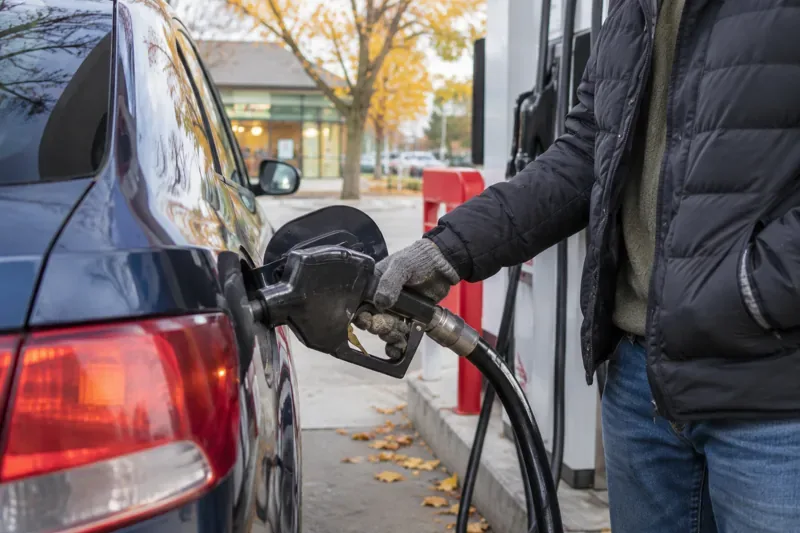
Illustrative photograph of a motorist refueling a car. Local gasoline prices vary by station and region.
How much have Canadian gas prices dropped?
CAA's daily Canadian gasoline tracker provides a useful snapshot of what motorists are seeing: 143.4 cents per liter on its November 21, 2026 update, 144.4 cents the previous day, 150.3 cents one week earlier, and 171.2 cents one month earlier. These are national averages for gasoline, not an identical price at every pump and not diesel prices. The monthly comparison suggests meaningful short-term relief, but it is not evidence that prices will keep falling at the same pace.
A 27.8-cent reduction amounts to about CAD $13.90 on a 50-liter fill-up, assuming the driver buys the same quantity at each price. That illustration describes a price comparison, not a prediction of household savings: actual consumption, station choice and driving distances determine the impact.
For the latest figures, check CAA's daily Canadian gas-price tracker. Its readings update regularly; the figures cited here belong to the dated November 21 snapshot rather than an all-time or permanent price level.
Why are gas prices falling in Canada right now?
Does cheaper crude oil automatically mean cheaper gas?
No. Crude oil is a key input, but refiners turn crude into gasoline, and the retail price also reflects wholesale-product markets, distribution, retail costs and taxes. Changes in global oil supply and demand can lower crude costs; disruptions or geopolitical tension can raise them. Without a verified day-by-day attribution of November's drop, it would be misleading to say crude oil alone caused the full decline. The Canadian Fuels Association's explanation of pump-price components identifies crude, wholesale fuel, retail margins and taxation as distinct influences.
Why does gasoline often get cheaper after summer?
Motorists typically drive more during the warmer months, and demand eases outside the peak summer travel season. Fuel blends also change seasonally. These shifts can relieve pressure on gasoline markets, especially if supply remains available. Natural Resources Canada lists seasonal demand, inventories, local competition and global oil prices among the reasons gasoline fluctuates. A seasonal pattern is a plausible contributor, however, not proof that it explains every cent of the latest Canadian decrease.
What role do refineries and wholesale gasoline play?
Retailers generally respond to the replacement cost of fuel, which can move when wholesale markets change. Refinery maintenance, unplanned outages, storms, pipeline capacity and available inventories can shift supply even when crude prices are stable. The Canada Energy Regulator notes that refined-product pricing is highly regional: a supply bottleneck can affect one area more than another. Gas stations also compete locally, so changes at the wholesale level do not translate into exactly the same pump-price movement everywhere.
Can the Canadian dollar change what drivers pay?
Yes. Oil and many refined fuels are traded in markets using U.S. dollars. If the Canadian dollar strengthens relative to the U.S. dollar, a U.S.-dollar-denominated purchase can become less expensive in Canadian-dollar terms, all else equal. A weaker loonie can offset reductions in global fuel costs. The Prince Edward Island Regulatory and Appeals Commission's fuel-price FAQ explicitly identifies exchange rates as one factor affecting local petroleum prices.
Did a Canadian tax change cause the November 2026 drop?
It is important to distinguish a tax already removed from a fresh market decline. The federal government ceased applying its consumer fuel charge on April 1, 2025, and later legislation permanently removed that framework from federal law. That change affected the tax structure but did not first occur in November 2026. Other federal, provincial and, in some places, municipal taxes can still contribute to pump prices. See Finance Canada's official announcement on removal of the consumer carbon price.
The Canadian Fuels Association also discusses an excise-tax reduction in 2026. Tax changes can influence the baseline price, but readers should not assume that a several-week November slide is entirely attributable to a tax adjustment without an accompanying price decomposition. The recent CAA readings measure changes motorists paid, not a breakdown assigning each cent to policy or commodity markets.
Why do pump prices differ so much between Canadian regions?
Canada does not have one retail gasoline market with one fixed price. Provincial tax structures differ, shipping costs are higher for some distant communities, and access to refineries, terminals and pipelines varies. Retail competition also differs by neighborhood. Consequently, a national average can fall while a particular town's stations move only slightly—or even rise temporarily.
Natural Resources Canada explains regional differences through taxes, transportation and local supply conditions in its guide to gasoline price changes. To understand the price actually paid, drivers should compare nearby stations selling the same grade of gasoline rather than assume a national figure is a local quote.
Are diesel prices dropping for the same reasons?
Not necessarily. Gasoline demand follows consumer driving patterns more closely, while diesel is used extensively in freight, industry and agriculture; winter heating demand can also influence related distillate markets. Both fuels respond to crude prices and refinery operations, but their product-specific demand and supply conditions may diverge. The Canada Energy Regulator's 2026 refined petroleum products overview distinguishes these markets. The CAA regular-gas average cited here should therefore not be applied to diesel.
Will Canadian gasoline prices continue to decline?
Further declines are possible if wholesale gasoline costs continue to ease, refinery supply remains adequate, and late-fall demand stays subdued. But the trend could reverse if crude oil markets tighten, a refinery or shipping disruption reduces supply, or the Canadian dollar weakens. These are conditional scenarios, not a verified forecast for next week or next month.
Statistics Canada's October 2026 Consumer Price Index release provides useful perspective: gasoline declined 2.5% month over month but was 30.9% higher year over year, partly because of the comparison with lower October 2025 prices. Short-term relief and elevated annual inflation can coexist. Drivers tracking the market should watch current local retail quotes, CAA's national trend and official inflation data without interpreting a single daily movement as a long-term promise.
Frequently asked questions
What is the latest verified Canadian gas-price average?
CAA's November 21, 2026 snapshot reported 143.4 Canadian cents per liter for regular gasoline nationally. Local stations may charge more or less, and this figure can change daily.
Is the 2025 carbon-price removal the reason gas is cheaper this November?
No single factor has been verified as the complete cause. The federal consumer fuel charge ceased in April 2025, while the recent decline also occurs in a market shaped by crude oil, wholesale prices, seasonal demand and regional conditions.
Will diesel fall as much as regular gasoline?
Not necessarily. Diesel has distinct freight, industrial and seasonal demand drivers. A drop in the gasoline average does not establish a matching diesel decline.