Home
» Today
»
Carney Signals Auto Industry Pivot as U.S. Trade Talks Continue — Nov. 16, 2026
Carney Signals Auto Industry Pivot as U.S. Trade Talks Continue — Nov. 16, 2026
Verified and updated: November 16, 2026, at 12:14 p.m. UTC.
Canadian Prime Minister Mark Carney says Canada could seek investment from Chinese, European or Japanese automakers if negotiations with U.S. President Donald Trump fail to preserve an integrated North American auto industry. Speaking in Phnom Penh on Monday, Carney said U.S. trade actions had made that market less integrated, while stressing that an agreement with Washington remains his priority. The comments sharpen the stakes for Canadian auto workers and manufacturers: the outcome could influence where future vehicle production and supply-chain investment land. The Associated Press reported Carney’s remarks from Cambodia.
The change is a more explicit public signal of possible alternatives, not an announcement that Canada has chosen a new auto partner or abandoned talks with the United States. Two days earlier, Carney said discussions with Trump had made progress but had not produced a deal. On Monday, he said any Chinese investment would need to include substantial Canadian manufacturing, proper labour standards, facilities and domestic supply chains. AP’s Nov. 14 report on the earlier trade update provides the context.
Destaques
Carney says U.S. negotiations remain Canada’s priority, but Canada could explore other automakers if a deal cannot sustain its auto industry.
He says possible Chinese investment would need Canadian production, workers and supply chains—not just vehicle assembly.
Canada’s January agreement with China lowered the tariff on Chinese electric vehicles to 6.1%, initially allowing up to 49,000 a year.
Talks with Trump remain unresolved; Canada’s upcoming CUSMA review adds pressure to define predictable continental trade rules.
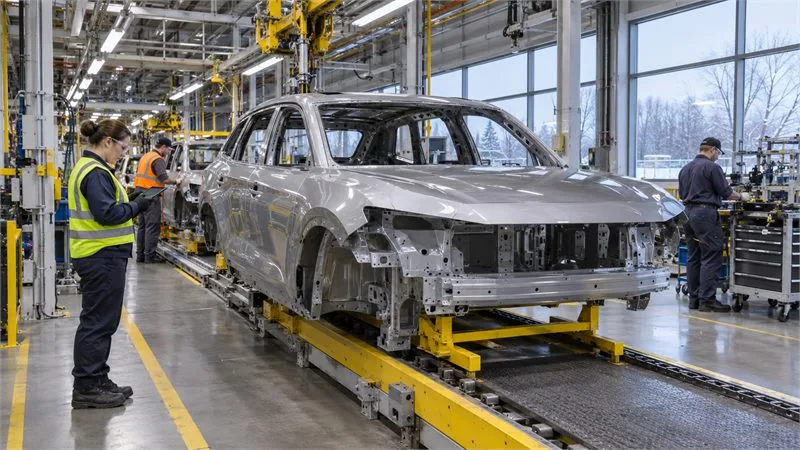
An illustrative view of auto manufacturing, the sector at the centre of Carney’s latest comments. The image is not a photograph of a specific Canadian plant.
What did Mark Carney say about Canada and U.S. auto trade?
Carney’s focus was on keeping Canadian workers and factories fully involved in vehicle production across North America. He said the United States’ trade actions had weakened the integration that supports the industry, where parts and components can cross borders several times before a vehicle is completed. U.S. tariffs and pressure on automakers to move production south have added uncertainty for companies deciding where to build and invest.
Carney said negotiations with Washington are still the preferred path. But if Canadian workers and manufacturing assets are not used in a North American arrangement, he said, other opportunities could follow. He described the potential shift as a response to changing conditions, not a bargaining tactic. The alternatives he identified include European, Chinese and Japanese automakers.
The conditions he set for Chinese investment are significant. Carney said it should involve real manufacturing in Canada, meet labour standards and build domestic supply chains over time, including through Canadian critical minerals used in electric vehicles. In his framing, importing finished vehicles or assembling kits alone would not amount to the industrial partnership Canada wants.
How does the China EV agreement affect the talks?
Canada and China reached an agreement in January that reduced Canada’s tariff on Chinese electric vehicles from 100% to 6.1%, with an initial annual allowance of up to 49,000 vehicles and the cap set to rise over time. China, in turn, agreed to lower tariffs on Canadian agricultural products, including canola, according to AP’s account of the deal. The arrangement creates a channel for Chinese vehicles into Canada; it does not itself establish a Chinese-owned Canadian manufacturing operation.
Carney is expected to meet Chinese President Xi Jinping in Shenzhen later this week, where auto manufacturing is expected to be discussed. That planned conversation makes the timing of the comments notable, but it does not confirm that an investment agreement is imminent. Any new project would require decisions by companies as well as detailed terms on production, labour, sourcing and market access.
Why does the CUSMA review matter to Canadian auto workers?
The Canada-United States-Mexico Agreement (CUSMA, known as USMCA in the United States) underpins regional supply chains. Canada’s government says the countries exchanged nearly $3.5 billion in goods and services each day in 2025. The agreement’s first joint review began in 2026; it is a scheduled review, not an automatic expiry. CUSMA remains in force until 2036, while the review gives the three governments an opportunity to consider its operation and whether to extend its term. Global Affairs Canada explains the review process.
Exposure to a trade dispute remains high. Statistics Canada reported that 71.7% of Canada’s merchandise exports went to the United States in 2025, down from 75.9% in 2024. Exports to the U.S. fell 5.8% that year, while exports to other destinations rose 17.2%. Those figures show diversification is underway, but also how much Canadian trade still depends on the U.S. market. Statistics Canada’s annual merchandise-trade release details the figures.
Carney’s parallel push into Asia reinforces this strategy. On Nov. 14, the federal government announced the substantial conclusion of negotiations toward a Canada–ASEAN free-trade agreement and the conclusion of negotiations for a Canada–Philippines agreement. Both still require further steps before coming into force; Canada says it is working toward signatures in 2027. These agreements could broaden commercial options, but they do not quickly replace the scale or established production links of the U.S. market. The Prime Minister’s Office announcement describes their status and projected benefits.
What could happen next in Canada-U.S. trade talks?
The immediate question is whether the two governments can agree on terms that keep Canadian plants and workers part of a competitive continental industry. Carney told reporters on Nov. 14 that he and Trump had a lengthy, substantive conversation and saw a possibility of a bilateral deal, while acknowledging they were not there yet. He said any agreement must leave Canada with a viable auto industry. Discussions had resumed after Canada suspended negotiations in August and the United States imposed additional tariffs on Canadian goods.
There is no confirmed final deal or published timetable in the latest reports. If talks progress, companies will still need clarity on tariff treatment, sourcing rules, production commitments and the CUSMA review. If negotiations stall, Canada may pursue a wider range of investors and markets—but building new facilities and supply chains takes time, and announced trade frameworks do not guarantee immediate jobs or factory investment. For workers and suppliers, the practical test will be whether future agreements translate into sustained Canadian production.
Frequently asked questions
Has Canada agreed to replace U.S. automakers with Chinese companies?
No. Carney said Canada could explore Chinese, European or Japanese investment if U.S. talks fail to protect an integrated North American auto industry. He did not announce a replacement plan or a new manufacturing deal.
What would Canada require from Chinese auto investment?
Carney said it would need substantial manufacturing in Canada, appropriate labour standards, local facilities and supply chains that grow over time. Vehicle assembly alone would not meet the conditions he described.
Did Mark Carney and Donald Trump reach a trade deal?
No deal has been reported. Carney said on Nov. 14 that the leaders had made progress and that a bilateral deal was possible, but that the two sides had not reached one.