Home
» Today
»
Chicago Daylight Saving Time Ends November 1, 2026: Chicago–London Meeting Times for the One-Week Clock Gap
Chicago Daylight Saving Time Ends November 1, 2026: Chicago–London Meeting Times for the One-Week Clock Gap
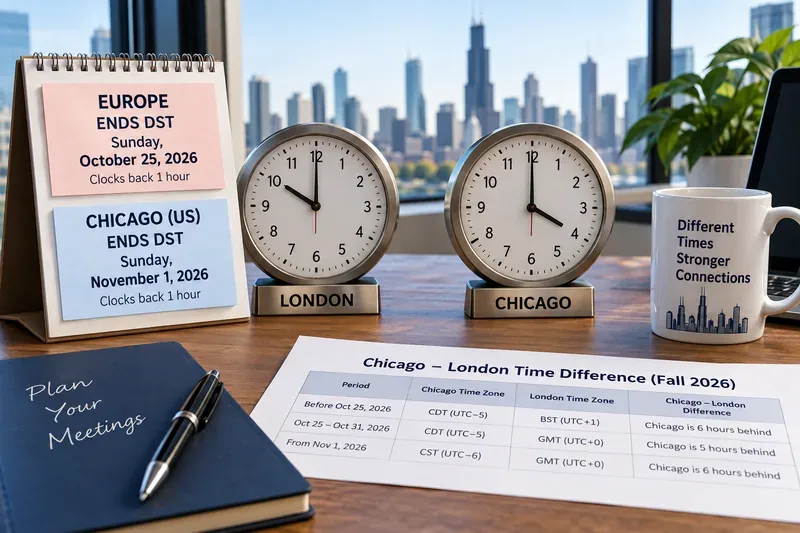
Chicago and London do not end daylight saving time on the same date in fall 2026. London switches back to Greenwich Mean Time on Sunday, October 25, 2026, while Chicago stays on Central Daylight Time for one more week and switches to Central Standard Time on Sunday, November 1, 2026.
For most daytime meetings, that creates a simple but important scheduling change: London is 5 hours ahead of Chicago from October 25 through October 31, 2026, instead of the more familiar 6-hour difference. From November 1 onward, the difference returns to 6 hours.
London returns to GMT on October 25, 2026, while Chicago remains on CDT until November 1. During the gap, London is 5 hours ahead of Chicago for ordinary daytime scheduling.
What exactly happens to the clocks in Chicago on November 1, 2026?
Chicago observes daylight saving time. Under the current U.S. rule, daylight saving time ends at 2:00 a.m. local time on the first Sunday in November. In 2026, that date is Sunday, November 1. At 2:00 a.m. Central Daylight Time, the clock moves back one hour to 1:00 a.m. Central Standard Time.
Before the change: Chicago is on CDT, UTC−5.
At the change: 2:00 a.m. CDT becomes 1:00 a.m. CST.
After the change: Chicago is on CST, UTC−6.
The local hour from 1:00 a.m. to 1:59 a.m. occurs twice.
The U.S. National Institute of Standards and Technology confirms that in 2026 daylight saving time runs from March 8 at 2:00 a.m. local time to November 1 at 2:00 a.m. local time. The U.S. Department of Transportation oversees federal time-zone and daylight-saving rules. See the NIST daylight saving time rules and the U.S. Department of Transportation Uniform Time page.
When does London change clocks in 2026?
The UK changes one week earlier. GOV.UK lists Sunday, October 25, 2026 as the date the clocks go back. In London, 2:00 a.m. British Summer Time becomes 1:00 a.m. Greenwich Mean Time.
Before the change: London is on BST, UTC+1.
At the change: 2:00 a.m. BST becomes 1:00 a.m. GMT.
Why is Chicago only 5 hours behind London for one week?
Before October 25, Chicago is on CDT at UTC−5 and London is on BST at UTC+1. The difference is 6 hours.
When London returns to GMT on October 25, London moves from UTC+1 to UTC+0, but Chicago remains on CDT at UTC−5. That temporarily shrinks the difference to 5 hours.
When Chicago changes to CST on November 1, Chicago moves from UTC−5 to UTC−6. London remains on GMT at UTC+0, so the difference returns to 6 hours.
Period
Chicago
London
Difference
Before London changes on Oct. 25
CDT (UTC−5)
BST (UTC+1)
London is 6 hours ahead
After London changes Oct. 25 through Oct. 31
CDT (UTC−5)
GMT (UTC+0)
London is 5 hours ahead
From Chicago's Nov. 1 change onward
CST (UTC−6)
GMT (UTC+0)
London is 6 hours ahead
Strictly speaking, the offset changes at the exact transition instants rather than at midnight. For normal business-hour scheduling, however, “October 25 through October 31” is the useful working rule because London's clock change is complete long before the workday begins.
Chicago to London meeting-time table for common working hours
If you schedule meetings from Chicago, the following table shows what common Chicago business hours become in London.
Chicago meeting time
Before Oct. 25 London = +6 hours
Oct. 25–31 London = +5 hours
From Nov. 1 London = +6 hours
8:00 a.m.
2:00 p.m.
1:00 p.m.
2:00 p.m.
9:00 a.m.
3:00 p.m.
2:00 p.m.
3:00 p.m.
10:00 a.m.
4:00 p.m.
3:00 p.m.
4:00 p.m.
11:00 a.m.
5:00 p.m.
4:00 p.m.
5:00 p.m.
12:00 p.m.
6:00 p.m.
5:00 p.m.
6:00 p.m.
1:00 p.m.
7:00 p.m.
6:00 p.m.
7:00 p.m.
2:00 p.m.
8:00 p.m.
7:00 p.m.
8:00 p.m.
3:00 p.m.
9:00 p.m.
8:00 p.m.
9:00 p.m.
What does a normal London workday look like in Chicago during the gap?
For teams centered on London hours, the one-week gap shifts London meetings one hour later on the Chicago clock than many people expect.
London time
Before Oct. 25
Oct. 25–31
From Nov. 1
9:00 a.m.
3:00 a.m. Chicago
4:00 a.m. Chicago
3:00 a.m. Chicago
12:00 p.m.
6:00 a.m.
7:00 a.m.
6:00 a.m.
3:00 p.m.
9:00 a.m.
10:00 a.m.
9:00 a.m.
5:00 p.m.
11:00 a.m.
12:00 p.m.
11:00 a.m.
For a typical cross-Atlantic meeting, this often means a slot that is normally 9:00 a.m. Chicago / 3:00 p.m. London becomes 9:00 a.m. Chicago / 2:00 p.m. London during October 25–31. If the London participant wants to keep the meeting at 3:00 p.m. local time, the Chicago participant would meet at 10:00 a.m. instead.
How can you tell whether a calendar invitation is correct?
The most reliable signal is that the event is stored with named time zones rather than manually typed labels. A calendar entry tied to “America/Chicago” and “Europe/London,” or their equivalent named zones in your calendar application, can apply the correct seasonal offsets when the time-zone database is current.
Before a meeting in the October 25–November 1 gap, check the invitation in both zones. For example, a meeting scheduled for 9:00 a.m. Chicago on October 28 should display as 2:00 p.m. London, not 3:00 p.m. If it still shows a 6-hour gap, inspect whether one side used a fixed UTC offset such as UTC−6 or UTC+1 rather than a city-based zone.
Will phones and computers change automatically?
Many modern phones and computers update automatically when automatic date, time and time-zone settings are enabled and the device has current time-zone data. NIST notes that many computer clocks and cell phones update automatically. UK government guidance likewise warns that mobile devices and computers may need manual attention if they are not configured to obtain the correct local time automatically.
Devices that often require manual checking include:
analog wall and desk clocks;
some appliance clocks, ovens and microwaves;
older alarm clocks;
heating or hot-water timers;
vehicle clocks without automatic time synchronization;
devices whose automatic time-zone setting is disabled.
For U.S. guidance, see the NIST Local Time FAQs. UK public guidance also explains that phones and computers may update automatically when correctly configured.
What should remote teams do before October 25?
The best outcome is not simply remembering that “Europe changes first.” It is making sure recurring meetings remain at the intended local time for the people who matter.
Review recurring Chicago–London meetings that fall between October 25 and November 1. These are the meetings most likely to shift unexpectedly.
Check which city is supposed to own the local meeting time. A “9:00 a.m. Chicago meeting” and a “3:00 p.m. London meeting” cannot both stay fixed during the offset gap.
Use named city time zones. Avoid hard-coding CDT, CST, BST or fixed UTC offsets in recurring invitations unless you intentionally want a fixed offset.
Verify one occurrence in the gap and one after November 1. This catches most recurring-calendar mistakes.
When should you stop relying on the simple 5-hour or 6-hour rule?
Use an actual time-zone-aware calendar or conversion tool when the meeting is close to either clock-change instant, when participants are outside Chicago or London, or when the event is legally or operationally time-sensitive. A rule such as “London is 5 hours ahead this week” is useful for ordinary daytime work, but it is not a substitute for an exact timestamp near the repeated hour.
Also remember that “Europe” is not one time zone. This article specifically compares Chicago and London. Other European cities may use different offsets even though many European countries also change clocks on the last Sunday in October.
Bottom line for Chicago–London scheduling in fall 2026
Chicago does change its clocks in fall 2026. On November 1 at 2:00 a.m. local daylight time, Chicago moves from CDT to CST and the clock returns to 1:00 a.m. London changes one week earlier, on October 25, moving from BST to GMT.
For everyday meeting planning, remember three periods: London is 6 hours ahead of Chicago before the UK change, 5 hours ahead during October 25–31, and 6 hours ahead again after Chicago changes on November 1. If your calendar shows those offsets for daytime meetings, your setup is behaving as expected.