Chipotle Mexican Grill (NYSE: CMG) enters October 2026 in an awkward but potentially important part of its stock cycle. The business showed measurable operating improvement in the second quarter, yet the share price weakened sharply in September and again in the first full trading week of October. That combination creates the key question for investors: is CMG reflecting a temporary reset in expectations, or is the stock correctly discounting a slower growth profile?
What is CMG stock doing in early October 2026?
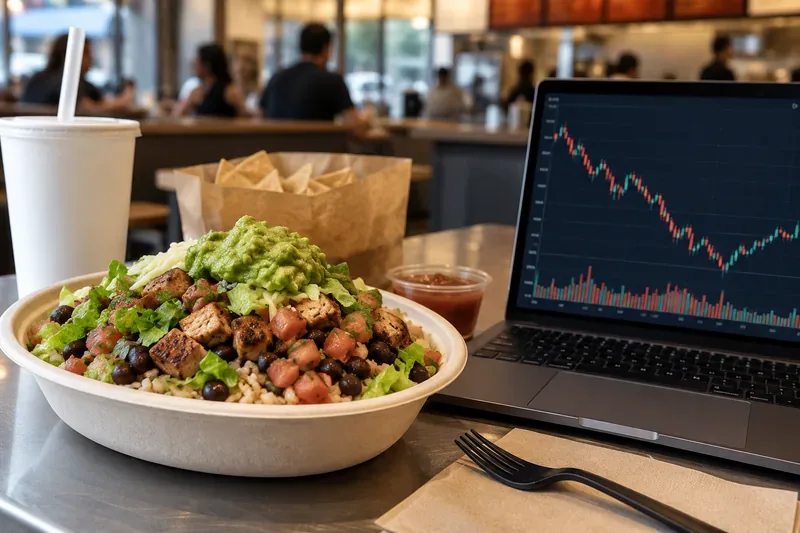
The short-term trend is bearish. CMG closed at $32.32 on October 1 and $32.36 on October 2, then fell 4.7% on October 5 to roughly $30.85 and finished October 6 near $30.83. For context, the stock had traded at $38.52 on September 2. That means the decline from the early-September close to October 6 was about 20%.
Investors should treat those figures as market snapshots rather than a forecast. The NYSE CMG quote page is the appropriate exchange reference for the listed security, while intraday and historical prices can vary slightly among data vendors because of timing and adjustment conventions.
Action: Before acting on a chart, confirm the current CMG quote and volume. A stock that is falling on unusually heavy volume can signal stronger conviction than the same price move on light trading.
Is the business trend as weak as the stock trend?
No. The latest reported operating numbers available as of October 7 show improvement, not contraction. Chipotle reported second-quarter 2026 revenue of $3.3 billion, up 9.3% year over year. Comparable restaurant sales increased 2.2%, including a 1.0% increase in transactions and a 1.2% increase in average check. This matters because traffic had been one of the central concerns around the company.
The quarter was also the second consecutive quarter of improving transaction comparisons. Based on that momentum, management raised its full-year comparable restaurant sales outlook to growth in the low-single-digit range. The company had entered 2026 expecting comparable sales to be approximately flat, so the July update represented a real improvement in management's outlook. These figures are available in Chipotle's official second-quarter 2026 earnings release and the company's Form 10-Q filed with the SEC.
Action: Track transaction growth separately from average check. For a restaurant growth story, healthier traffic generally provides a stronger foundation than revenue growth produced mainly by price increases.
Why is the stock under pressure if sales are improving?
The main reason is that growth quality is mixed. Revenue and comparable sales improved, but profitability moved in the opposite direction. Second-quarter operating margin fell to 15.7% from 18.2% a year earlier, while restaurant-level operating margin declined to 25.2% from 27.4%. Diluted earnings per share was unchanged at $0.32, and adjusted diluted EPS was also flat at $0.33.
That is an important distinction. A growth company can increase revenue and still disappoint investors if incremental sales do not translate into stronger earnings. CMG has historically commanded a premium valuation because investors expected rapid unit growth, strong store economics, and earnings expansion. When margins compress, the market may demand a lower valuation multiple even if revenue continues to rise.
Action: On the next earnings release, compare comparable sales, transaction growth, restaurant-level margin, and EPS together. A single strong sales number should not be treated as proof that the earnings trend has fully recovered.
Does restaurant expansion still support the long-term case?
Yes, and this remains one of Chipotle's clearest structural strengths. The company opened 100 company-owned restaurants in the second quarter, 80 of which included a Chipotlane. At June 30, Chipotle had 4,186 company-owned restaurants. Management continues to expect 350 to 370 new restaurant openings in 2026, including 10 to 15 international partner-operated locations, with roughly 80% of new company-owned stores expected to feature a Chipotlane.
Chipotle also announced in late September that it had reached 1,500 Chipotlanes. The company says these digital order pickup lanes help increase access, sales, margins, and returns at new restaurants. The broader growth story therefore depends not only on same-store sales but also on whether new units can continue producing attractive returns at scale. Investors can follow company milestones through Chipotle's official investor-relations news releases.
Action: Watch new-store opening pace and average restaurant sales together. Rapid unit expansion is less valuable if mature-store economics weaken materially.
What price levels matter now?
Technical levels are not guarantees, but they help frame risk. In recent trading, the $30 to $31 area has become the immediate zone to watch after CMG fell from the upper $30s in early September. A sustained break below that area would keep the short-term trend weak and could invite further selling. A recovery above roughly $32.50 to $33 would be an early sign that buyers are absorbing supply, while the $36 to $38 region is a more meaningful resistance zone because the stock spent much of early September there before the decline accelerated.
The important point is not to assume that a lower share price automatically makes the stock cheap. Price and valuation are different. CMG's appropriate valuation depends on future traffic, margins, unit economics, and earnings growth.
Action: If using technical levels, define an invalidation point before entering a position. Do not move a risk limit simply because the share price continues lower.
What should investors expect from the October 28 earnings report?
Chipotle has scheduled its third-quarter 2026 results for October 28, with a conference call at 4:30 p.m. Eastern Time. That date is the most important near-term catalyst currently confirmed by the company. The announcement is listed on Chipotle's official Investor Relations page.
The questions that matter most are straightforward: Did comparable restaurant traffic continue improving? Did restaurant-level margin stabilize? Is low-single-digit full-year comparable sales guidance still achievable? Is management maintaining the 350-to-370 opening target? And does the company see any change in consumer behavior across income groups?
Investors should be careful with unverified takeover rumors or social-media claims before earnings. Unless a transaction is disclosed by the company, an acquiring company, or through an appropriate regulatory filing, it should not be treated as established fact.
Action: Build an earnings checklist before October 28 and judge the report against operating metrics rather than the first after-hours price move.
How important are share repurchases at current prices?
Repurchases are becoming more relevant as the stock trades well below earlier highs. Chipotle used about $1.35 billion of cash to repurchase common stock during the first six months of 2026, according to its second-quarter Form 10-Q. In July, the company also disclosed an additional $1.3 billion board authorization for stock repurchases. The authorization does not force management to buy shares and can be modified, suspended, or discontinued.
A buyback can increase per-share value if management purchases stock below intrinsic value and the core business remains healthy. It is not, by itself, evidence that the share price has reached a bottom.
Action: Review the next filing for actual shares repurchased and average purchase price rather than focusing only on the headline authorization amount.
What is the October 2026 bull case for CMG?
- Comparable sales returned to positive growth and transaction trends improved in the first half of 2026.
- The company raised full-year comparable sales guidance after the second quarter.
- New restaurant growth remains aggressive, with Chipotlanes representing most planned company-owned openings.
- A lower stock price reduces some of the valuation risk that existed when expectations were higher.
- Share repurchases can support per-share economics if executed at attractive prices.
What is the bear case?
- Restaurant-level and company operating margins compressed despite higher revenue.
- The share price remains in a clear short-term downtrend entering October.
- Flat adjusted EPS in the second quarter shows that revenue growth has not yet translated into renewed earnings growth.
- Consumer spending pressure could slow traffic, especially if pricing becomes harder to use without affecting visits.
- Fast unit expansion increases execution demands, including staffing, throughput, food costs, and site selection.
So is CMG a buy in October 2026?
The answer depends on the investor's time horizon and tolerance for earnings-event risk. For long-term investors who believe Chipotle can restore margins while maintaining positive traffic and high-return unit expansion, the October decline may justify deeper valuation work. For momentum-oriented traders, however, the trend remains weak until the stock proves it can hold support and reclaim prior resistance. For investors unwilling to absorb a large earnings-driven move, waiting for the October 28 report may be the more disciplined choice.
The clearest conclusion today is that CMG's stock chart is weaker than its latest reported sales trend, while profitability has not yet matched the improvement in traffic. That mismatch is exactly what makes the next earnings report consequential. The most useful signal will not be whether the stock jumps or drops immediately after results, but whether traffic improvement, margin stabilization, and unit growth begin moving in the same direction.
This analysis is for informational purposes only and is not individualized investment advice. Market prices change continuously, and investors should verify current quotes and filings before making a decision.