01. Current Data
The market data shaping the current copper outlook
Any serious commodity forecast should begin with the current physical and macro regime, not with recycled narratives. That is especially true for copper, where short-term price behavior and long-run structural stories can point in different directions. The goal here is to establish the numbers that matter most before we move to valuation, scenarios, or advice.
For this rewrite, I prioritized primary or near-primary sources: official exchange material, institutional market studies, the IMF, the World Bank, IEA analysis, and U.S. macro releases. That matters because the difference between a useful commodity article and a thin SEO page is whether the analysis stays anchored to verifiable data. In this case, the anchor points are $13,030/t, 310 kt surplus, and the still-important inflation backdrop of April 2026 U.S. CPI rose 3.8% year over year, April 2026 core CPI rose 2.8%, and March 2026 core PCE rose 3.2%.
| Period | Data point | Why it matters |
|---|---|---|
| 2024 | ICSG refined balance -3 kt | Near-balance before the 2025 shift |
| 2025 | ICSG refined balance +462 kt | Supply improved faster than use |
| Jan-Feb 2026 | ICSG refined balance +310 kt | Visible surplus, but at elevated prices |
| Jan-Feb 2026 | World refined production +2.5% YoY to 4.701 Mt | Refining recovered |
| Jan-Feb 2026 | World refined usage flat at 4.391 Mt | Demand did not collapse, but it paused |
Those figures are enough to make one point clear. The current market is not a blank slate. It is already telling investors how much tension exists between today's balance and tomorrow's risk premium. A disciplined article should respect that tension instead of pretending the answer is obvious.
02. Institutional Lens
What the latest institutional data actually say
The institutional picture for copper is unusually clean right now because several primary sources point in the same direction, even if they emphasize different time horizons. The ICSG monthly data show that the near-term refined market is not screaming shortage: the group reported a 310 kt refined surplus in January-February 2026, world refined production of 4.701 Mt for the period, flat refined usage at 4.391 Mt, and end-period stocks of 2.168 Mt. That is the short-run restraint on any reckless bullish call.
But the same dataset also shows why copper refuses to trade like a weak industrial metal. Even with a reported surplus, the average LME copper price still ran at $13,030/t in January-February 2026. February alone averaged $12,968/t. Markets normally do not keep prices that high if they believe oversupply is easy to solve. They do so when the next supply response looks hard, slow, or politically uncertain.
The World Bank's April 28, 2026 Commodity Markets Outlook reinforces that interpretation from the top down. The Bank said base metals including copper are expected to reach all-time highs in 2026 because strong demand from data centres, electric vehicles, and renewables is colliding with tight supply. The IMF's April 2026 World Economic Outlook keeps global growth positive at 3.1% in 2026 and 3.2% in 2027, which is not boom-level demand but also not recessionary enough to kill the structural case.
The final institutional layer is the IEA. Its Electricity 2026 report projects global electricity demand growth of 3.6% annually from 2026 through 2030, roughly 1,100 TWh of additional demand each year. In the United States, it expects more than 420 TWh of extra electricity demand over five years, with data centres making up about 50% of that growth. That is not a copper price target, but it is the kind of official demand backdrop that explains why long-range copper bulls keep returning after every correction.
| Factor | Why it matters | Current Assessment | Bias | Current evidence |
|---|---|---|---|---|
| Physical price anchor | High prices despite a reported refined surplus imply the market still respects future scarcity | Constructive | + | ICSG showed a Jan-Feb 2026 surplus, yet the Jan-Feb LME average still ran at $13,030/t |
| Mine response | Supply growth is slow relative to the capital and permitting burden | Constructive | + | Mine output was only 3.657 Mt in Jan-Feb 2026, up 0.4% YoY |
| Refining and stocks | Higher refined output and rising stocks cap short-term upside | Mixed | 0 | World copper stocks reached 2.168 Mt at end-February 2026 |
| Macro demand | Growth is slowing but not rolling over | Mixed | 0 | IMF still sees global growth at 3.1% in 2026 and 3.2% in 2027 |
| Electrification and AI | Structural demand remains strong beyond the next quarter | Bullish | + | IEA expects global electricity demand growth of 3.6% annually through 2030 |
The scoring table matters because a reader should be able to see the current tilt factor by factor. Right now, the balance of evidence is not uniformly bullish or bearish. It is a weighted picture. Some signals support higher prices, some cap the upside, and some mainly tell you that the right strategy depends on time horizon.
03. Countercase
The risks that could weaken the current thesis
The main bear case for copper starts with the one number bulls tend to skip: the ICSG's 310 kt refined surplus in the first two months of 2026. A market can stay expensive in surplus for a while, but that does not make the surplus irrelevant. If visible stocks continue rising from the current 2.168 Mt, then a larger part of the market may start believing the physical tightness story is more future tense than present tense.
The second risk is macro. The IMF still forecasts growth, but it also says downside risks dominate the outlook in April 2026 because of war-related energy shocks and tighter financial conditions. The U.S. inflation backdrop is not fully benign either: April 2026 CPI was 3.8% year over year, core CPI 2.8%, and March 2026 core PCE 3.2%. If that keeps real rates higher for longer, industrial metals can struggle even without a deep recession.
The third risk is that AI enthusiasm arrives in equity valuations faster than in physical copper consumption. The IEA's electricity outlook is bullish for power demand, but actual metal draw can still be delayed by transformer shortages, grid interconnection queues, slower campus approvals, and corporate capex pacing. If the market priced in the AI narrative too quickly, copper can correct hard even while the long-term case survives.
That is why the countercase has to be framed with current data and not with textbook abstractions. When a risk is real, the article should say what number would confirm it, how often that number updates, and what would make the thesis worth revisiting. That is the difference between a warning and a useful investment framework.
04. Forecast Framework
Copper's 2035 outlook should be treated as a scenario range, not a single destination
My 2035 base case stays in the middle band because long-range commodity forecasting is mainly about regime durability. For copper, the right question is whether today's supply-demand imbalance becomes institutionalized through underinvestment, geopolitics, and rising power-system intensity. If yes, the bull case becomes credible. If not, price can still stay well above old-cycle averages without remaining euphoric.
For investors who are already profitable, that usually argues for discipline rather than emotional conviction. Trimming into strength can make sense when the price is pushing the top of the bull band without fresh confirmation from balances or macro data. For investors who are underwater, the better question is not whether the asset is "good," but whether the original thesis still matches the new data. If the data are improving, averaging thoughtfully may be defensible. If the data are weakening, blind averaging is just denial.
For investors with no position, the practical distinction is between trend confirmation and valuation discipline. If the market is still confirming the thesis, waiting for a pullback can be emotionally satisfying but operationally expensive. If the market is already euphoric while the data are only mixed, patience is more rational. In other words, the right action depends on both entry point and evidence, not on a generic buy-or-sell slogan.
Another discipline that improves long-horizon results is to separate structural conviction from tactical sizing. A metal can deserve a positive three- to ten-year view while still being a poor chase after a sharp momentum burst. That distinction matters because commodities frequently overshoot fair value in both directions. Position sizing, review dates, and trigger levels are therefore not optional details. They are the practical bridge between a good thesis and a defensible portfolio decision.
In that sense, the scenario ranges in this article are not just editorial decoration. They are meant to help different readers act differently. A trader may care most about trigger levels over the next quarter. A long-only allocator may care more about whether the base case is improving or deteriorating every six months. A business operator exposed to the metal may care most about whether today's pricing still justifies hedging activity. The same article should be usable for all three.
A final practical rule is to avoid treating volatility as proof that the thesis is wrong. In commodity markets, volatility is often the normal transmission mechanism through which the thesis expresses itself. The more important question is whether volatility is occurring alongside improving evidence or deteriorating evidence. If the balance sheet of the story is strengthening, volatility can be an opportunity. If the evidence is weakening, the same volatility can be an exit signal. That distinction is what keeps scenario analysis grounded in process rather than emotion.
05. Scenarios
Actionable scenarios with probabilities, triggers, and review points
Scenario analysis only becomes useful when it includes explicit probabilities, measurable triggers, and a review schedule. Otherwise it is just polished ambiguity. The map below is designed to be monitored over time, not merely read once.
| Scenario | Probability | Range / implication | Trigger | When to review |
|---|---|---|---|---|
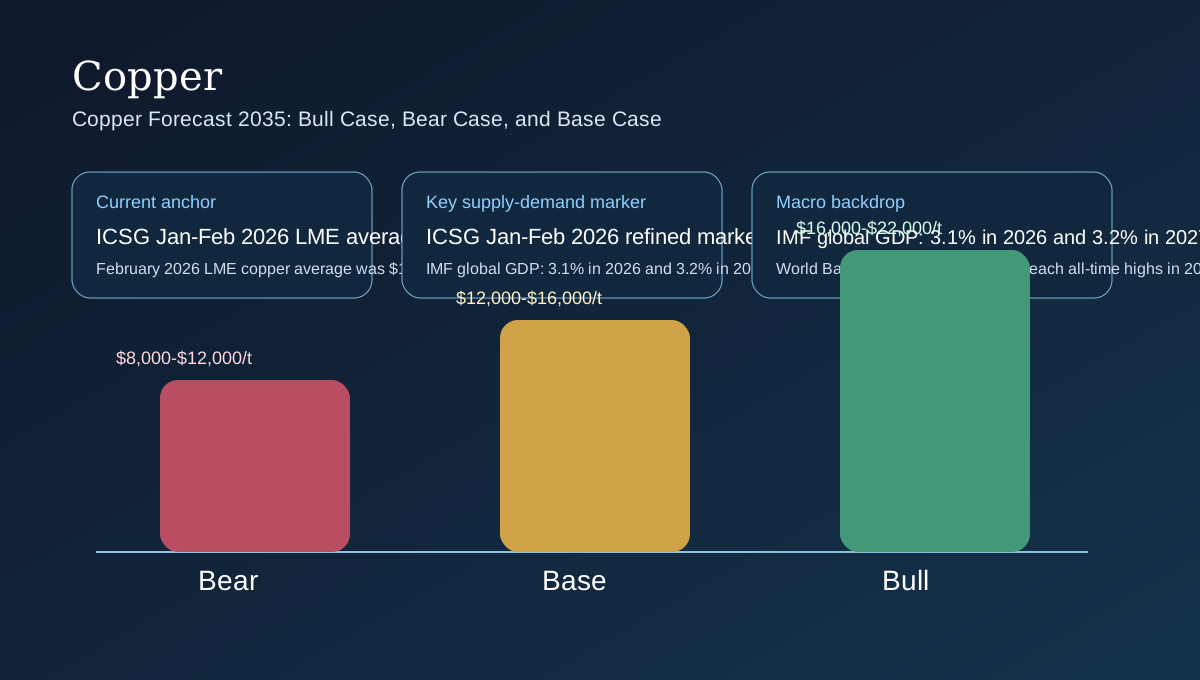
| Bull case | 30% | $299/t-$415/t | Mine delays persist, grid and AI demand compound, and inventories stay tight | Reassess after each annual ICSG forecast and major capex cycle |
| Base case | 50% | $199/t-$250/t | Supply expands, but not enough to kill the structural premium | Reassess every six months using ICSG, World Bank, and IEA updates |
| Bear case | 20% | $104/t-$150/t | Global growth disappoints and supply catches up through better refining and recycling | Reassess if stocks keep building and prices fail to hold above marginal cost |
The purpose of this table is not to create false precision. It is to force a disciplined process. If a trigger is hit, the probability mix should change. If it is not hit, conviction should stay limited. That approach is especially important in commodities because spot moves can be dramatic while the underlying physical trend changes much more slowly.
06. Sources
Primary and institutional sources used in this article
- ICSG Table 1: World refined copper production and usage trends
- ICSG press releases
- LME Copper contract page
- World Bank Commodity Markets Outlook, April 2026
- IMF World Economic Outlook, April 2026
- IEA Electricity 2026 demand outlook
- IEA mined supply and demand outlook for copper, 2026-2035
- USGS copper statistics and information
- BLS CPI April 2026
- BEA Personal Income and Outlays, March 2026