Home
» Today
»
Dairy vs. Vegan Milk Nutrition: What UK Research Shows (Nov. 5, 2026)
Dairy vs. Vegan Milk Nutrition: What UK Research Shows (Nov. 5, 2026)
Information checked: November 5, 2026, at 9:17 a.m. GMT (UTC+00:00), London, United Kingdom.
Dairy milk usually provides more protein and a more consistent range of naturally occurring nutrients than most vegan milk alternatives, but choosing a fortified, unsweetened plant-based drink can close important nutritional gaps. A UK supermarket study published in 2025 found that soy drinks were the closest plant-based match for milk's protein content. Calcium, vitamin B12 and particularly iodine were much less consistent across plant alternatives.
That distinction matters for shoppers replacing milk every day rather than using a splash in coffee. In its July 2025 assessment, the UK's Scientific Advisory Committee on Nutrition (SACN) and Committee on Toxicity (COT) concluded that none of the almond, oat or soy drinks covered by the available evidence was nutritionally equivalent to cow's milk. The committees nevertheless considered appropriately fortified, unsweetened plant-based drinks acceptable alternatives for adults and children ages five and older. This is guidance about the whole diet, not a finding that plant-based eating is inherently unhealthy.
Destaques
Protein: The UK product audit reported median levels of 3.5 g per 100 mL for cow's milk, 3.25 g for soy drink, 0.8 g for oat drink and 0.6 g for almond drink.
Fortification: Of nonorganic plant-based drinks sampled, 87% listed added calcium but only 34% listed iodine.
Best practical comparison: Choose an unsweetened product and check protein, calcium, iodine, vitamin B12 and vitamin D on the package.
For children: Plant drinks are not substitutes for breast milk or infant formula; families with young children need age-specific guidance.
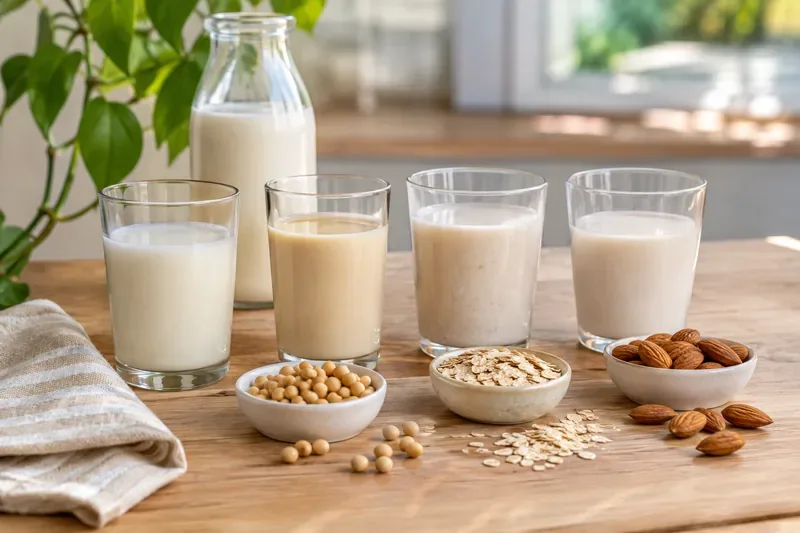
Illustrative comparison of dairy milk and plant-based drinks. Actual protein, calcium and vitamin levels depend on the product and its fortification.
What does the research say about dairy vs. vegan milk nutrition?
Researchers at the University of Hertfordshire analyzed package information, ingredients and prices for 191 plant-based milk alternatives and 195 dairy milks sold through major UK supermarkets. Their study appeared in Current Developments in Nutrition in 2025. This was an audit of products available for purchase, not a clinical trial measuring long-term health outcomes. The figures describe products in that sample, not guaranteed values for every carton sold in 2026. See the original UK nutrition study and its data tables.
The table below gives selected median values per 100 mL from the study. Dairy figures refer to the cow's-milk subgroup; soy, oat and almond values refer to their respective plant-based categories. Individual brands and recipes can differ substantially.
Drink
Calories
Protein
Saturated fat
Total sugars
Cow's milk
50 kcal
3.5 g
1.1 g
4.8 g
Soy drink
33.5 kcal
3.25 g
0.3 g
2.2 g
Oat drink
48 kcal
0.8 g
0.2 g
3.2 g
Almond drink
18 kcal
0.6 g
0.1 g
0.35 g
Source: Nowson, Fallaize and Earl (2025), Table 1. These are sample medians, not universal product specifications. "Total sugars" does not distinguish naturally occurring lactose from free sugars generated or added during production.
Which plant-based milk has the most protein?
Soy is the strongest protein match among the main plant-based types analyzed. For a 250 mL serving, the UK medians translate to about 8.8 g of protein from cow's milk, 8.1 g from soy, 2.0 g from oat and 1.5 g from almond. These serving figures are arithmetic conversions of the sample medians, not independent laboratory measurements.
People relying on their drink as a meaningful source of protein may therefore prefer dairy or a higher-protein, fortified soy product. Pea-based drinks can also be formulated with relatively high protein, but the UK study included only three pea products, too few to draw a reliable category-wide comparison. Oat and almond drinks can still work well in a varied diet when protein comes from other foods, such as legumes, tofu, nuts, eggs, fish or meat as appropriate.
Are calcium, iodine and vitamin B12 the biggest differences?
They are among the most important differences to check. Cow's milk naturally provides calcium, iodine, vitamin B12 and riboflavin (vitamin B2). Plant drinks can supply similar amounts of selected nutrients when manufacturers add them, but fortification is neither uniform nor guaranteed.
In the UK audit, among 154 nonorganic plant-based products, 87% were fortified with calcium, 79% with vitamin B12, 56% with riboflavin and just 34% with iodine. Among products with calcium fortification, the reported median was 120 mg per 100 mL, compared with a dairy reference value of roughly 124 mg per 100 mL. This shows why an appropriately fortified carton can compare well for calcium even when the unfortified plant ingredient supplies relatively little.
Iodine deserves particular attention. It supports thyroid function and is important during pregnancy. UK milk and dairy foods are established dietary sources, while many plant drinks do not include iodine. The British Dietetic Association's iodine guidance advises choosing an iodine-fortified plant drink and avoiding kelp supplements as a casual substitute, because their iodine content can be excessive or inconsistent.
Vitamin D is a different case: cow's milk in the UK generally contains little naturally occurring vitamin D, while many plant-based drinks are fortified. The type and amount must still be checked on the carton. Equal nutrient quantities on labels also do not necessarily guarantee identical absorption; the government assessment notes remaining uncertainty about the bioavailability of some added nutrients.
Is oat or almond milk healthier because it has less fat or sugar?
Not automatically. The UK audit found that most plant drinks contained less saturated fat than dairy milk in comparable fat categories, although coconut drinks were an exception worth watching. Almond drinks tended to be lower in calories and protein; oat drinks commonly supplied more carbohydrate than almond or soy. Meanwhile, lower-fat dairy milk retains much of its calcium and protein while reducing saturated fat compared with whole milk.
Milk's naturally occurring sugar is lactose. A plant drink marketed as "no added sugar" can still contain sugars from processing, particularly when starches are broken down. This is why a nutrition label's total-sugar number is useful but does not by itself tell the whole story about free sugars. UK government advisers recommend plant-based drinks that are unsweetened and do not contain free sugars or non-sugar sweeteners. The NHS Eatwell Guide also recommends lower-fat, lower-sugar dairy choices and unsweetened, calcium-fortified alternatives.
What does UK government guidance recommend in 2026?
The most directly relevant official assessment remains the SACN and COT report published July 16, 2025. It recommends fortifying plant drinks with calcium, iodine, vitamins A and B12, and riboflavin at levels comparable to semi-skimmed milk, alongside vitamin D. Those recommendations should not be confused with a claim that every manufacturer already follows a legally required nutrient standard.
For adults and children ages five and up, the committees describe fortified, unsweetened soy, oat and almond drinks as acceptable alternatives. They do not recommend unfortified or sweetened plant drinks as direct nutritional replacements for milk. The report also notes that UK drinks labeled organic cannot be fortified with nutrients under the applicable organic rules, so an organic label should never be treated as proof of equivalent calcium or iodine content.
For children ages one through four who consume animal products, the committees prefer whole or semi-skimmed cow's milk while recognizing that fortified, unsweetened plant alternatives may be suitable. When a young child follows a vegan diet, fortified, unsweetened soy is generally the preferred main milk alternative because it provides more protein than oat or almond; the report also recommends variety rather than relying heavily on soy foods alone. NHS guidance for babies and young children says plant alternatives should not replace breast milk or infant formula before age one, and rice drinks should not be given to children younger than five because of arsenic concerns. Seek individual professional advice if a child has a milk allergy or restricted diet.
How should shoppers compare dairy and plant milks at the supermarket?
Start with the role of the drink. Is it a small ingredient in coffee or a daily source of protein and minerals? That changes which nutrient gaps matter.
Compare like with like. Use the values per 100 mL rather than per package, then check what a typical serving contributes.
Check protein first if replacing a daily glass of milk. Soy tends to be closest among widely available plant options; don't assume every oat, almond or pea product is similar.
Read the micronutrient list. Look for calcium, iodine, vitamin B12, riboflavin and vitamin D. A short ingredient list is not a substitute for adequate fortification.
Check sugars, saturated fat and allergens. Compare plain and unsweetened versions, and account for soy or nut allergies. Lactose-free dairy is a separate option for lactose intolerance, not a suitable choice for a true milk-protein allergy.
Price also affects daily choices. The 2025 audit reported average prices of £1.95 per liter for plant-based alternatives and £1.19 per liter for dairy milk in its sample. These are historical study figures, not verified November 2026 shelf prices; promotions, brands and retailers can change the comparison.
What could change next?
The government committees have recommended minimum fortification standards and better monitoring of nutrient composition. Whether and when any additional binding requirements take effect must be checked against future official announcements. More research on nutrient absorption and long-term dietary outcomes could also refine recommendations. For now, the product label and the rest of a person's diet matter more than simply whether the carton says "dairy," "vegan" or "plant-based."
FAQ: Dairy milk vs. vegan milk
Is soy milk as nutritious as cow's milk?
It is often similar in protein, but not automatically in calcium, iodine and vitamins. Choose a fortified, unsweetened soy drink and check its full nutrient label.
Does almond milk provide enough calcium?
Some fortified almond drinks contain calcium at levels similar to cow's milk, but unfortified versions may not. Protein is generally much lower, so compare both nutrients.
Can a vegan diet meet nutritional needs without dairy milk?
Yes, with a varied diet and careful use of fortified foods or suitable supplements where needed, especially for vitamin B12, iodine, calcium and vitamin D. The NHS vegan diet guidance provides practical UK advice.