01. Historical Context
DAX to 2030 is a thesis on Germany's investment cycle meeting global industrial demand
Unlike more defensive European indices, DAX has real cyclical torque. If Germany's fiscal turn and Europe's investment cycle persist, the index has a credible structural earnings path into 2030.
| Horizon | What matters most | Current assessment | What would weaken the thesis |
|---|---|---|---|
| 1-3 months | Inflation and rates | Still the main volatility source | Energy inflation pushes yields higher again |
| 6-18 months | Order books and revisions | Constructive | Earnings momentum fades before capex arrives |
| To 2030 | Structural investment cycle | Positive if German fiscal pivot is real | Policy execution lags and exports weaken |
The reason to stay disciplined is that the market knows this. BlackRock's DAX proxy showed 18.02x earnings in early May 2026, while public bank research was already talking about double-digit earnings growth for 2026 and 2027.
The long-range edge in DAX therefore lies in earnings duration, not in pretending the market is still cheap. Investors need to decide whether the next four years deliver enough real activity to justify today's optimism.
02. Key Forces
What can drive DAX into 2030
First, the German fiscal pivot matters more here than in most other European benchmarks because DAX constituents are directly linked to capital goods, infrastructure and industrial software.
Second, the earnings setup is already visible in public institutional research. Deutsche Bank cited analyst expectations for 15% growth in both 2026 and 2027, which means the medium-term runway can be strong if execution matches the story.
Third, inflation remains the brake. Destatis reported April 2026 CPI at 2.9%, which means the market cannot assume a frictionless low-rate future.
Fourth, the starting multiple is healthy but not permissive. DAX can still compound well, yet any macro disappointment is likely to show up first through valuation compression.
| Factor | Current assessment | Bias | Bullish trigger | Bearish trigger |
|---|---|---|---|---|
| Fiscal impulse | Supportive | Bullish | Infrastructure and defense capex become visible in earnings | Execution disappoints |
| Earnings path | Double-digit expectations are public | Bullish | Growth broadens across industrials, software and insurers | Only a few leaders deliver |
| Inflation | Still too warm for complacency | Bearish | Energy shock fades and inflation normalizes | Sticky CPI keeps discount rates high |
| Valuation | Reasonable, not cheap | Neutral | EPS growth outpaces price gains | Multiple de-rates before earnings catch up |
| External demand | Critical | Neutral | Exports and capex both recover | Trade or China-related weakness returns |
Fifth, DAX still benefits from being one of the purest public-market ways to express a European industrial recovery. That strategic role should matter through 2030 if the macro base holds.
03. Countercase
The 2030 countercase is a stalled investment cycle
The easiest way to lose money in a good narrative is to pay for it before the data arrive. That is the central DAX risk into 2030.
If fiscal support proves slower than markets expect, if energy remains a recurring shock, or if global industrial demand softens, the index can spend years digesting a full-ish starting multiple.
That does not require a collapse in Germany's economy. It only requires the investment upcycle to be weaker, later or narrower than the market has already discounted.
| Risk | Latest data point | Why it matters | What to monitor next |
|---|---|---|---|
| Policy lag | Fiscal optimism is high in public bank research | DAX is priced for better execution | Public spending, order intake, private capex |
| Inflation pressure | April 2026 CPI 2.9% | Keeps valuation sensitive to rates | Energy and core inflation |
| External weakness | Export-sensitive index composition | Global demand still matters more than domestic politics alone | German exports and PMIs |
| Valuation fatigue | 18.02x P/E | Less room for error | Revision breadth versus index performance |
The long-range bear case is therefore underdelivery, not necessarily crisis.
04. Institutional Lens
Institutional evidence favors DAX over vaguer Europe cyclicality
Deutsche Bank and DZ Bank were both explicit that DAX's earnings setup is unusually good if the German growth recovery persists. That is more useful than a generic 'Europe up' argument because it identifies the actual transmission mechanism: orders, industrial capex and sector earnings.
The counterweight is official inflation data. Destatis is still showing a macro environment where real rates can matter. That is why the 2030 bull case remains cyclical and conditional rather than structural and unconditional.
| Institution / source | Updated | What it says | Why it matters here |
|---|---|---|---|
| Deutsche Bank | August 2025 | 15% earnings growth expected in 2026 and 2027 | Supports a multi-year profit cycle view |
| DZ Bank | January 2026 | Broad-based earnings growth expected | Reinforces the view that the cycle is not limited to one stock or sector |
| Destatis | April-May 2026 | GDP improving but inflation elevated | Keeps the range of outcomes wide |
| BlackRock | May 6, 2026 | 18.02x P/E and 1.95x P/B | Reminds investors that the market already prices in a lot of improvement |
The strategic read is positive, but the quality of the thesis still depends on data delivery.
05. Scenarios
Scenario map into 2030
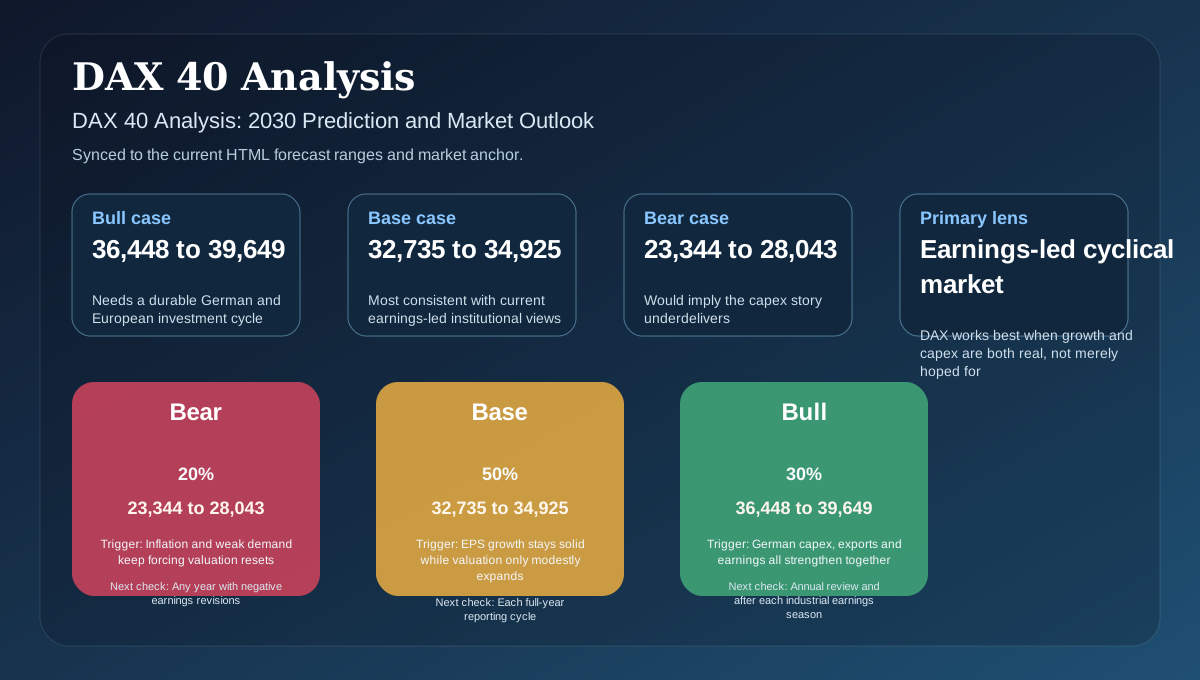
These 2030 ranges are analytical ranges built from current data and public institutional assumptions, not bank-published 2030 targets.
The base case assumes the German capex cycle lands, but not perfectly. The bull case assumes a stronger fiscal multiplier and persistent global industrial demand. The bear case assumes the market front-loaded too much of the future.
| Scenario | Probability | Working range | Measured trigger | Review window |
|---|---|---|---|---|
| Bull | 30% | 36,448 to 39,649 | German capex, exports and earnings all strengthen together | Annual review and after each industrial earnings season |
| Base | 50% | 32,735 to 34,925 | EPS growth stays solid while valuation only modestly expands | Each full-year reporting cycle |
| Bear | 20% | 23,344 to 28,043 | Inflation and weak demand keep forcing valuation resets | Any year with negative earnings revisions |
The thesis should be reviewed after every annual budget cycle, each major industrial earnings season and any renewed inflation shock.
DAX's advantage into 2030 is that the upside case is economically intuitive. Its risk is that the market already understands that.
References
Sources
- BlackRock iShares Core DAX UCITS ETF product page, portfolio characteristics and benchmark data (accessed May 2026)
- German Federal Statistical Office, inflation rate at +2.9% in April 2026
- German Federal Statistical Office, GDP in Q1 2026 up 0.3% quarter on quarter
- Deutsche Bank, DAX and MDAX: German equities in focus
- DZ Bank Research, DAX 2026: broad-based earnings growth expected
- Investing.com DAX historical data
- UBS House View, March 2026