01. Historical Context
The decade thesis is that DAX remains Europe's premier industrial and software beta
A decade from now, the most important question is whether Germany emerges from its old low-growth equilibrium with a larger investment base. If yes, DAX should be one of the clearest listed beneficiaries in Europe.
| Horizon | What matters most | Current assessment | What would weaken the thesis |
|---|---|---|---|
| 1-3 months | Inflation and sentiment | Volatile | Further energy shock |
| 6-18 months | Earnings validation | Constructive | Revisions deteriorate |
| To 2035 | Investment-cycle persistence | Positive but unproven | Growth reform fades or global demand weakens structurally |
The starting setup is supportive but not trivial. Growth improved in early 2026, public bank research projected strong earnings, and the index had already moved to record levels. That is a good launch point for compounding, but not for complacency.
The 2035 case therefore hinges on persistence: repeated earnings growth across multiple cycles, not just one fiscal announcement or one lucky year for exporters.
02. Key Forces
What matters for a 2035 DAX forecast
The first force is whether Germany actually spends and invests at scale over many years. DAX has a better decade case if fiscal policy changes the capital stock, not only sentiment.
The second force is technological composition. With SAP, Siemens, Siemens Energy, Airbus and other capital-goods leaders, DAX has meaningful exposure to industrial software, electrification and defense.
The third force is valuation discipline. Even strong decade stories suffer if they start from too much optimism. That is why the current 18.02x earnings multiple still matters.
The fourth force is energy and trade security. A decade view on Germany cannot ignore supply chains, export sensitivity and energy dependence.
| Factor | Current assessment | Bias | Bullish trigger | Bearish trigger |
|---|---|---|---|---|
| Investment cycle | Potentially strong | Bullish | Capex and reforms persist across governments | Policy enthusiasm fades |
| Sector quality | High industrial and software leverage | Bullish | Leaders keep converting secular trends into EPS | Old-economy exposure dominates |
| Inflation regime | Still unsettled | Neutral | Lower average inflation and more stable energy | Repeated spikes reset valuation |
| Starting valuation | Healthy, not cheap | Neutral | Earnings outgrow price | Decade begins with a de-rating |
| Global demand | Essential | Neutral | Trade and industrial demand stay robust | Long-run export headwinds intensify |
The fifth force is institutional capital allocation. If Europe keeps looking under-owned and Germany delivers cleaner growth, DAX can attract sustained flows rather than just episodic tactical buying.
03. Countercase
The decade bear case is not Germany collapse; it is chronic underdelivery
The central 2035 risk is that markets have finally become enthusiastic about Germany just as the actual economic payoff proves slower and smaller than expected.
If inflation remains volatile, if energy remains a recurring external shock, or if DAX earnings stay concentrated in a few winners, the market can spend years repricing optimism downward.
Another risk is strategic competition. German autos, machinery and exporters still face pressure from China, U.S. trade policy and industrial reshoring elsewhere.
| Risk | Latest data point | Why it matters | What to monitor next |
|---|---|---|---|
| Policy underdelivery | Fiscal optimism is already embedded in public research | Expectations are high | Capex spending and industrial orders |
| Inflation volatility | CPI 2.9% in April 2026 | Raises the hurdle for long-run rerating | Energy and core CPI trend |
| External competition | Export-heavy sector mix | Can erode margins and growth | Trade data and sector-level revisions |
| Narrow leadership | Concentrated index weights | Weak breadth reduces durability | EPS breadth across 40 constituents |
A poor 2035 result is therefore plausible without a crisis. It only requires the market to keep overestimating how broad and durable the earnings renaissance will be.
04. Institutional Lens
Institutional evidence supports a constructive long-run stance, but only if the cycle broadens
Public research from Deutsche Bank and DZ Bank shows a genuine institutional preference for German equities when earnings are tied to a fiscal and industrial upswing. That is a real edge relative to vaguer Europe-wide calls.
The caution is that official data still show inflation risk and only modest current GDP growth. The decade case remains attractive, but it has not become a risk-free structural certainty.
| Institution / source | Updated | What it says | Why it matters here |
|---|---|---|---|
| Deutsche Bank | August 2025 | Double-digit earnings growth expectations tied to Germany's return to growth | Supports the long-run industrial-upcycle thesis |
| DZ Bank | January 2026 | Broad-based earnings growth expected | Suggests the cycle can move beyond a handful of names |
| Destatis | April-May 2026 | Q1 GDP positive, CPI elevated | Shows the cycle is real but still inflation constrained |
| BlackRock | May 6, 2026 | Proxy valuation 18.02x earnings | Prevents overconfidence at the starting point |
For 2035, constructive and selective remains the right tone.
05. Scenarios
Scenario ranges into 2035
The ranges below are broad by design because the decade path will include more than one market regime.
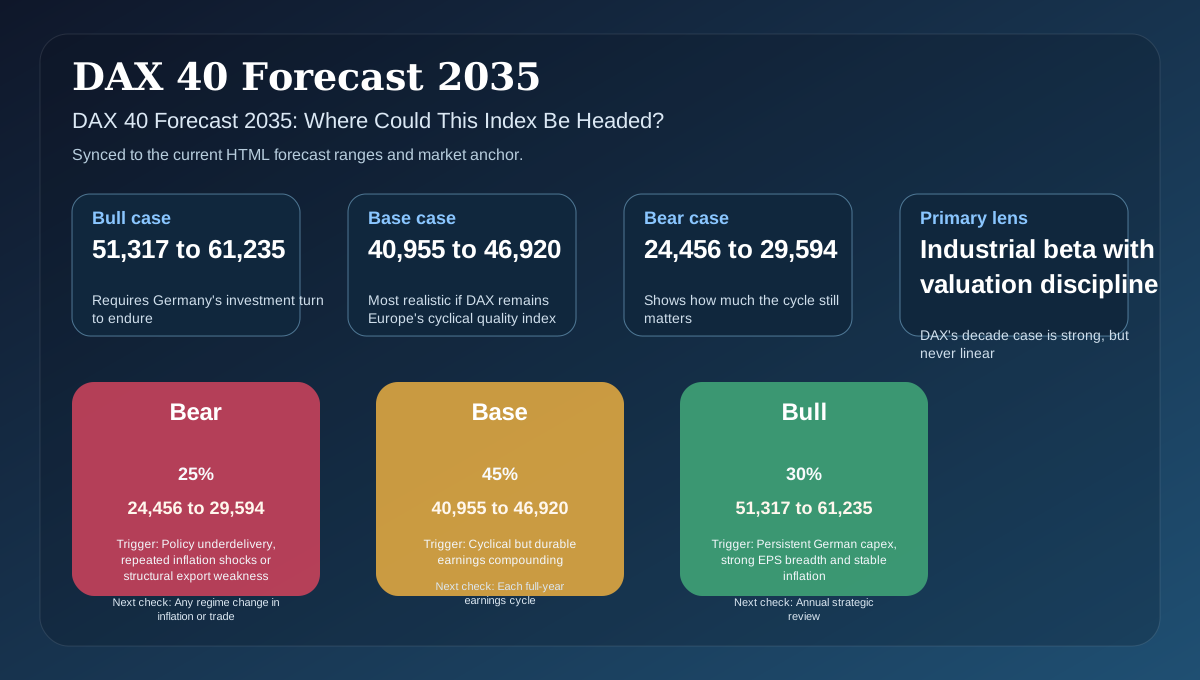
The bull case assumes Germany's fiscal and industrial reset compounds for years. The base case assumes strong but cyclical earnings. The bear case assumes the market keeps paying up before the delivery is broad enough.
| Scenario | Probability | Working range | Measured trigger | Review window |
|---|---|---|---|---|
| Bull | 30% | 51,317 to 61,235 | Persistent German capex, strong EPS breadth and stable inflation | Annual strategic review |
| Base | 45% | 40,955 to 46,920 | Cyclical but durable earnings compounding | Each full-year earnings cycle |
| Bear | 25% | 24,456 to 29,594 | Policy underdelivery, repeated inflation shocks or structural export weakness | Any regime change in inflation or trade |
A decade thesis should be reviewed around structural markers: fiscal execution, energy security, export competitiveness and breadth of earnings delivery.
DAX can be one of Europe's best long-run indices. It can also be one of the most painful when the cycle disappoints.
References
Sources
- BlackRock iShares Core DAX UCITS ETF product page, portfolio characteristics and benchmark data (accessed May 2026)
- German Federal Statistical Office, inflation rate at +2.9% in April 2026
- German Federal Statistical Office, GDP in Q1 2026 up 0.3% quarter on quarter
- Deutsche Bank, DAX and MDAX: German equities in focus
- DZ Bank Research, DAX 2026: broad-based earnings growth expected
- Investing.com DAX historical data
- UBS House View, March 2026