01. Historical Context
DAX 40 has strong cyclical leverage, and that cuts both ways into 2027
DAX entered 2026 with unusually strong momentum and broke above 25,000 in early January. That strength reflected not just better sentiment, but a market structure tilted toward industrials, software, capital goods and insurers that can respond quickly when global growth and fiscal expectations improve.
| Horizon | What matters most | Current assessment | What would weaken the thesis |
|---|---|---|---|
| 1-3 months | German inflation and bond yields | Growth improved, but CPI re-accelerated | Bund yields rise on sticky inflation |
| 6-18 months | Earnings breadth | Constructive if fiscal impulse feeds through | Revisions fail to follow price gains |
| To 2027 | Can EPS keep pace with valuation? | Yes, but not without continued macro follow-through | Industrial demand weakens while multiples stay rich |
The latest hard data justify some optimism. Destatis reported German GDP up 0.3% quarter on quarter in Q1 2026, after a 0.2% increase in Q4 2025. But the same statistical office also reported CPI at 2.9% year on year in April 2026, with energy prices up 10.1%. That combination keeps the DAX bull case alive, but it also keeps valuation risk on the table.
BlackRock's DAX proxy showed 18.02x P/E and 1.95x P/B on May 6, 2026. That is not bubble territory, but it is high enough that 2027 returns likely need earnings to validate the move.
02. Key Forces
Five forces that matter most for DAX now
The first force is earnings leverage. Deutsche Bank's public DAX and MDAX note said analysts were looking for 15% DAX earnings growth in both 2026 and 2027. That is the most important public bull input in the market because DAX has already done some of the price work.
The second force is inflation. Destatis reported German CPI at 2.9% in April 2026 and core inflation at 2.3%. That matters because a cyclical, export-heavy index can tolerate higher nominal growth, but it becomes more vulnerable if higher energy prices also keep real yields elevated.
The third force is fiscal impulse. Deutsche Bank highlighted Germany's debt brake reform and a pipeline of public and private investment commitments. If that translates into real orders, industrial capex and domestic activity, DAX has one of the clearest earnings channels in Europe.
The fourth force is starting valuation. BlackRock's proxy at 18.02x earnings and 1.95x book implies the index is no longer obviously cheap. That raises the standard for every earnings season.
| Factor | Current assessment | Bias | Bullish trigger | Bearish trigger |
|---|---|---|---|---|
| Valuation | 18.02x P/E, 1.95x P/B on May 6, 2026 | Neutral | EPS growth keeps P/E near current levels | P/E slips below 17x on hotter inflation |
| Macro growth | GDP up 0.3% q/q in Q1 2026 | Bullish | Consumption, exports and capex all stay positive | Q2 growth fades back to flat |
| Inflation | CPI 2.9%, core 2.3% in April 2026 | Bearish | Energy shock fades and CPI cools | Energy-led inflation stays above 2.5% |
| Earnings outlook | DB cites 15% growth expectations for 2026 and 2027 | Bullish | Revisions hold through reporting seasons | Order books weaken and revisions roll over |
| Fiscal impulse | Supportive but still early | Bullish | Infrastructure and defense spending feed through | Implementation lags and sentiment outruns spending |
The fifth force is composition. BlackRock's top weights include Siemens, SAP, Allianz, Siemens Energy and Airbus. In other words, DAX is a high-beta bet on capex, engineering, software and trade-sensitive industrial cash flows rather than on domestic consumption alone.
03. Countercase
What would break the DAX thesis
The first failure mode is simple: inflation stays high enough to keep financing conditions tight while investors keep paying a full multiple. With CPI at 2.9% and energy prices up 10.1% year on year in April 2026, that risk is not theoretical.
The second failure mode is earnings disappointment. DAX can support a richer valuation only if the earnings growth expected by analysts actually arrives. If the global industrial cycle slows, export demand cools or Chinese competition hits autos and capital goods harder, the revision cycle can turn fast.
The third risk is that fiscal enthusiasm proves too front-loaded in market prices. Policy announcements help sentiment quickly; shovel-ready spending and higher private investment take longer.
| Risk | Latest data point | Why it matters | What to monitor next |
|---|---|---|---|
| Higher-for-longer inflation | CPI 2.9%, core 2.3%, energy +10.1% | Reduces valuation room | Monthly CPI and Bund yields |
| Earnings miss | 15% 2026-2027 growth expectations cited by Deutsche Bank | Price already discounts strong follow-through | Revision breadth and order books |
| Growth relapse | GDP up 0.3% q/q in Q1 2026 | DAX needs growth to validate cyclicality | Q2 GDP, exports and industrial production |
| Policy lag | Fiscal optimism is high, but implementation is still unfolding | Narrative can outrun reality | Capex commitments and public-spending execution |
A broken 2027 thesis would therefore show up in the data as slower revisions, firmer inflation and weaker order momentum, not necessarily as an immediate recession call.
04. Institutional Lens
Institutional research points to an earnings-led, not sentiment-led, bull case
Deutsche Bank's public DAX and MDAX note is unusually explicit. It said analysts expected 15% DAX earnings growth in both 2026 and 2027 and argued that Germany's return to growth should benefit index constituents, even if the gains vary by foreign revenue exposure. That is a strong bull input, but it is clearly conditional on growth continuing.
DZ Bank's January 27, 2026 outlook used similar language and framed 2026 as a year of broad-based earnings growth. Together, those public bank views tell you the market's core long case is still corporate profit acceleration, not a blind multiple expansion thesis.
| Institution / source | Updated | What it says | Why it matters here |
|---|---|---|---|
| Deutsche Bank | August 2025 publication | Analysts forecast 15% DAX earnings growth in 2026 and 2027 | Provides the core EPS case behind upside scenarios |
| DZ Bank | January 27, 2026 | Broad-based earnings growth expected in 2026 | Confirms the profit-led thesis across sectors |
| Destatis | April-May 2026 | GDP improved, CPI re-accelerated | Explains why the bull case and the valuation risk are both real |
| BlackRock | May 6, 2026 | Proxy valuation at 18.02x earnings and 1.95x book | Shows DAX already needs continued execution |
The institutional read is constructive, but it also sets a high bar. Once earnings become the main argument, every reporting season matters more than the narrative.
05. Scenarios
Probability-weighted scenarios into 2027
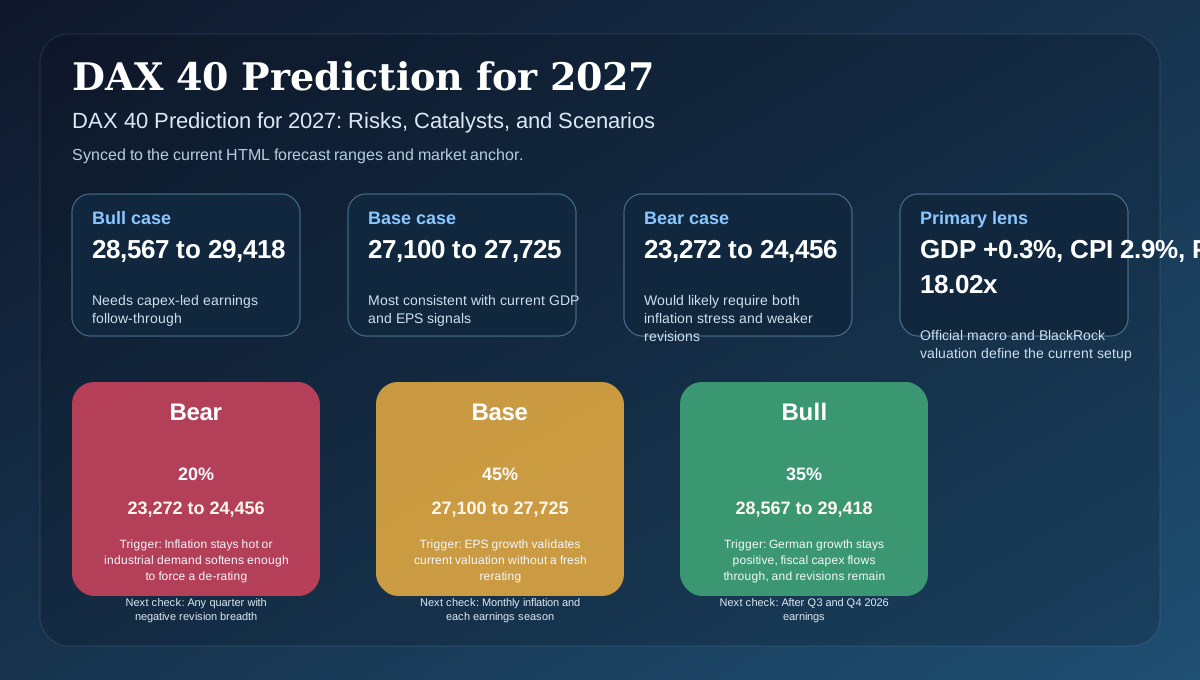
The DAX scenarios below are analytical ranges built from the current level, published earnings outlooks and official German macro data. They are not claimed as exact published bank targets for 2027.
The base case assumes growth remains positive, inflation gradually cools and earnings deliver enough to keep valuation stable. The bull case assumes fiscal support and capex intensity push revisions higher. The bear case assumes the market is forced to de-rate before the earnings story arrives.
| Scenario | Probability | Working range | Measured trigger | Review window |
|---|---|---|---|---|
| Bull | 35% | 28,567 to 29,418 | German growth stays positive, fiscal capex flows through, and revisions remain strong | After Q3 and Q4 2026 earnings |
| Base | 45% | 27,100 to 27,725 | EPS growth validates current valuation without a fresh rerating | Monthly inflation and each earnings season |
| Bear | 20% | 23,272 to 24,456 | Inflation stays hot or industrial demand softens enough to force a de-rating | Any quarter with negative revision breadth |
Investors should reassess the thesis after each quarterly reporting season and after every major inflation surprise because those are the two variables most likely to move the probability mix.
At this stage, DAX still looks like one of Europe's better cyclical setups, but it is no longer a no-questions-asked cheap market.
References
Sources
- BlackRock iShares Core DAX UCITS ETF product page, portfolio characteristics and benchmark data (accessed May 2026)
- German Federal Statistical Office, inflation rate at +2.9% in April 2026
- German Federal Statistical Office, GDP in Q1 2026 up 0.3% quarter on quarter
- Deutsche Bank, DAX and MDAX: German equities in focus
- DZ Bank Research, DAX 2026: broad-based earnings growth expected
- Investing.com DAX historical data
- UBS House View, March 2026