Home
» Today
»
Dominic LeBlanc’s Canada-U.S. Trade Talks: No Tariff Deal Yet as of November 20, 2026
Dominic LeBlanc’s Canada-U.S. Trade Talks: No Tariff Deal Yet as of November 20, 2026
Information checked: November 20, 2026, at 7:01 p.m. Indochina Time (ICT, UTC+07:00), equivalent to 12:01 UTC and 7:01 a.m. Eastern Standard Time (EST, UTC−05:00) in Ottawa and Washington.
Canada’s minister responsible for U.S. trade, Dominic LeBlanc, is pressing ahead with efforts to ease American tariffs, but the latest official account does not announce an interim agreement. On November 19, LeBlanc chaired a meeting in Ottawa with chief trade negotiator Janice Charette and Canadian Ambassador to the United States Mark Wiseman. Officials updated an economic advisory committee on discussions with Washington while businesses warned of continued pressure from U.S. trade measures, according to Global Affairs Canada’s November 19 readout.
The critical distinction for Canadian readers is between active diplomatic contact and an actual tariff breakthrough. Officials are still seeking terms they can defend as beneficial to Canada. Reporting from people familiar with the private briefing indicates significant differences remain; that characterization goes beyond the narrower public government readout and should not be mistaken for an official announcement of a failed or completed deal.
Destaques
Latest confirmed meeting: LeBlanc led the tenth Advisory Committee on Canada-U.S. Economic Relations session in Ottawa on November 19, 2026.
No announced breakthrough: The official readout confirms ongoing discussions, not a signed agreement, negotiated tariff rate, or scheduled signing.
Key participants: Chief negotiator Janice Charette briefed the committee, while Ambassador Mark Wiseman gave a Washington update.
Canadian stakes: Tariff-hit manufacturers, exporters, employees, and regions face uncertainty while governments explore possible relief and the future of CUSMA.
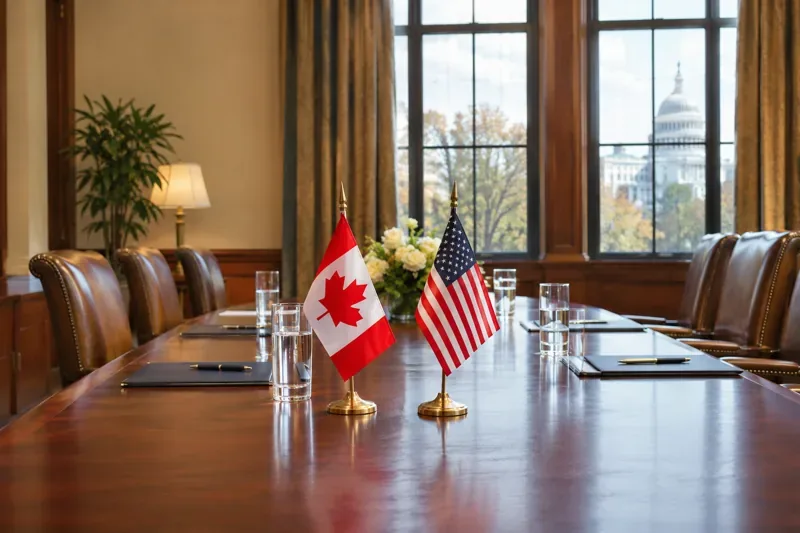
Illustration of a Canada-U.S. diplomatic meeting room, generated for this report. This is not a photograph of the November 19 meeting or a verified Washington negotiating session.
What happened in Dominic LeBlanc’s latest Canada-U.S. trade update?
The Canadian government said the November 19 meeting brought together representatives from business, labour and different regions to discuss bilateral trade priorities, sector-level damage from U.S. measures and the adequacy of federal support. LeBlanc and Charette updated the group about engagement with American counterparts. Ambassador Wiseman described developments from Washington. The government's account emphasizes economic growth, workers and businesses, and Canadian sovereignty.
The session took place in Ottawa on Thursday, November 19, 2026, when the city was on Eastern Standard Time (EST, UTC−05:00). The public readout supplies no verified start or end time, so none should be inferred. Washington, D.C., was also on EST (UTC−05:00) that day. The official document does not establish that LeBlanc held an in-person negotiation in Washington on November 19 or November 20. His role is to lead Canada's engagement with U.S. officials, including work conducted across the border and remotely.
Accounts attributed to participants in the private briefing portray Washington as offering limited movement on tariff relief since earlier talks stalled. Reuters’ November 19 reporting reported that LeBlanc was in regular contact with U.S. counterparts, including Commerce Secretary Howard Lutnick and U.S. Trade Representative Jamieson Greer. Those details are attributed reporting rather than publicly released minutes of the negotiations. They underscore why continued contact should not be confused with an agreed package.
Why are Canada and the United States struggling to reach a tariff deal?
The immediate negotiation is narrower than the entire North American trading relationship: Canada wants relief from measures affecting particular industries while protecting employment, investment, and the viability of supply chains linking Canadian factories to U.S. buyers. Steel, aluminum, autos and lumber are prominent pressure points. Different products can face different legal provisions, rates and exemptions, making a single headline tariff figure inadequate to describe the actual cost faced by each company.
The automotive industry demonstrates the stakes. Components often cross the border during production, so duties on finished vehicles or parts can affect manufacturing plans on both sides. For an exporter, even a partial reduction might improve its competitive position, but whether that relief translates into more orders or hiring would depend on which goods qualify and how long the arrangement lasts. Likewise, a higher duty could increase financial pressure without automatically proving that a particular plant will close.
Canada's own official information shows the scale of the relationship. According to the Government of Canada’s CUSMA review overview, Canada and the United States exchanged nearly $3.5 billion in goods and services per day in 2025. That historical measure illustrates the exposure of businesses and workers to policy uncertainty; it is not a figure for the November 2026 negotiating round.
How does the CUSMA review affect LeBlanc’s negotiations?
The Canada-United States-Mexico Agreement, known as CUSMA in Canada and USMCA in the United States, came into force on July 1, 2020. Its first mandatory joint review was scheduled for July 1, 2026. The review is a separate, three-country process from an interim bilateral tariff arrangement. An interim understanding could influence the political climate for that broader review, but it would not automatically rewrite the agreement or resolve every outstanding issue with Mexico.
The Canadian government's Government of Canada’s CUSMA review overview explains that the review is not itself an expiration date. CUSMA remains in force under its existing terms while the parties address questions about the agreement's future. For companies planning capital investments, the distinction matters: short-term tariff concessions may offer immediate breathing room, while the durability of North American trade rules shapes longer-term decisions.
What changes should Canadian businesses and consumers watch next?
The clearest sign of a breakthrough would be a jointly confirmed announcement specifying covered products, rates, implementation dates, exceptions and the legal authority for any changes. Until that happens, tariffs cannot be treated as reduced merely because officials held calls or briefed an advisory group. Businesses should follow the actual customs rules applying to their goods and avoid changing invoices, landed-cost projections or origin claims based on political expectations alone.
Importers and exporters can also monitor potential effects on contracts. If duties change, the party responsible for paying them will depend on shipment terms and applicable customs rules. Businesses may need to reassess sourcing, inventory timing or supply-chain financing. For households, any change in prices would be indirect and uneven: exchange rates, retailer margins, transport and demand matter alongside tariffs. There is no verified basis for promising a specific reduction in Canadian consumer prices.
Further meetings and an eventual interim arrangement remain possibilities, not established outcomes. The latest public update points to continued talks and domestic consultation rather than a completed negotiating settlement. Readers can check the official advisory committee overview for the advisory body's role and subsequent government updates, and look for statements from both governments before treating any proposed concession as final.
FAQ: Dominic LeBlanc and Canada-U.S. trade talks
Has Dominic LeBlanc secured a new Canada-U.S. tariff deal?
No deal was announced in the Canadian government's November 19, 2026 readout. Officials confirmed continued discussions with American counterparts.
Was LeBlanc negotiating in Washington on November 20?
The latest verified official meeting was in Ottawa on November 19. The sources checked do not confirm a November 20 in-person Washington meeting or a scheduled public meeting time.
Which sectors are most sensitive to tariff negotiations?
Autos, steel, aluminum and lumber are among the closely watched industries. The effects on any individual company depend on the product, tariff provisions, exemptions and supply-chain exposure.