Home
» Today
»
Electric Vehicles Explained: How They Work, Charging Costs, and Key Benefits
Electric Vehicles Explained: How They Work, Charging Costs, and Key Benefits
Short answer: A battery electric vehicle (BEV) stores electricity in a rechargeable battery and uses an electric motor to turn its wheels. For many drivers, its practical advantages are home charging, fewer routine powertrain service items, and potentially lower energy costs per mile. Whether those advantages matter to you depends on your electricity rate, access to reliable charging, driving pattern, vehicle price, and the range you need.
An EV is often a good fit if you can charge where the car is parked for several hours and your usual trips fit comfortably within its real-world range. It may take more planning if you rent without charging access, regularly drive long rural routes, tow, or depend on fast chargers that are scarce or expensive in your area.
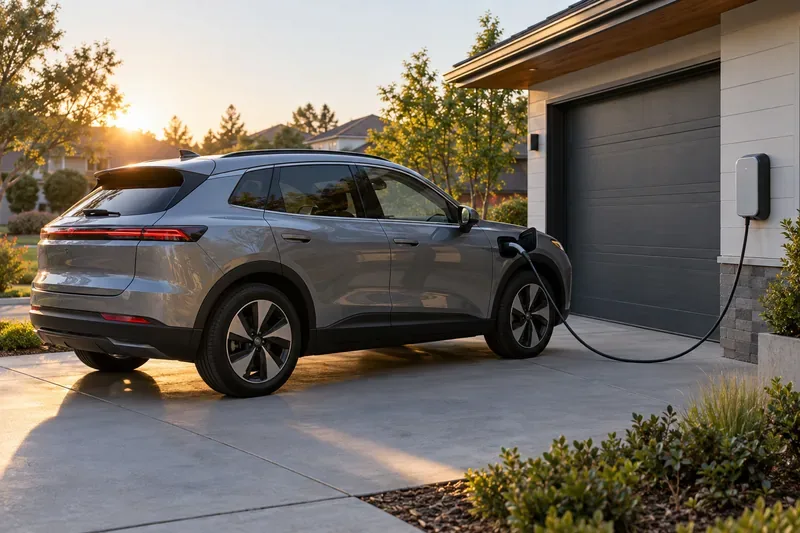
A home charging setup lets an EV replenish its battery while parked in a driveway.
How does an electric vehicle work?
In a BEV, the high-voltage traction battery stores energy. Power electronics control how electricity flows to an electric motor, which converts electrical energy into motion. The motor can deliver strong torque from a stop, so the driving feel is different from a gasoline engine that changes gears through a conventional transmission. A smaller low-voltage battery and electrical systems operate accessories and vehicle controls.
When you plug in, the car’s charging system manages the flow of power into the battery. With Level 1 or Level 2 charging, the supply is alternating current (AC), and the vehicle’s onboard charger converts it to the direct current (DC) the battery stores. A DC fast charger performs that conversion in the charging equipment and supplies DC to the vehicle. The car and charger communicate so the session stays within the limits of the battery, vehicle, and equipment.
BEV, hybrid, or plug-in hybrid: what is the difference?
Battery electric vehicle (BEV): Runs on electricity stored in a battery and has no gasoline engine or tailpipe.
Hybrid electric vehicle (HEV): Uses a gasoline engine and an electric motor; it is not plugged in for routine charging.
Plug-in hybrid electric vehicle (PHEV): Has a rechargeable battery and gasoline engine. It can drive some trips on electricity, then use gasoline when its electric range is depleted or conditions call for the engine.
This article focuses on BEVs. A PHEV can suit someone who can charge often but still wants a gasoline option for occasional longer trips. It also retains engine-related maintenance. A BEV makes the most sense when its range and charging access match your life without requiring frequent workarounds.
How much does EV charging cost?
Use your own electricity price and the vehicle’s efficiency rather than relying on a single national “cost to charge.” A useful estimate is:
Charging cost = energy used (kWh) × electricity price ($/kWh).
For a per-mile comparison, divide the electricity price by the car’s efficiency in miles per kWh. As an illustration only, suppose a vehicle averages 3.5 miles per kWh and your marginal electricity price is $0.16 per kWh. The energy cost is about 4.6 cents per mile ($0.16 ÷ 3.5). At 1,000 miles, that is about $46 before accounting for charging losses, fixed utility charges, or any public-network fees. Change either input and the result changes.
To estimate a charging session, multiply the kWh added by the price. Adding 30 kWh at $0.16 per kWh would cost $4.80 in energy. A session is not necessarily a full battery charge: drivers usually top up only what they need, and actual energy drawn from the meter can exceed the energy stored because charging is not perfectly efficient. Use the vehicle’s efficiency label or owner’s manual, your utility bill’s applicable rate, and the charger’s displayed price. The AFDC consumer guide explains why home charging often costs less than public charging and why fast charging can cost more. The Energy Information Administration’s electricity price tables show that rates vary across states and customer sectors; they are reference data, not a substitute for your utility tariff.
Home charging versus public charging
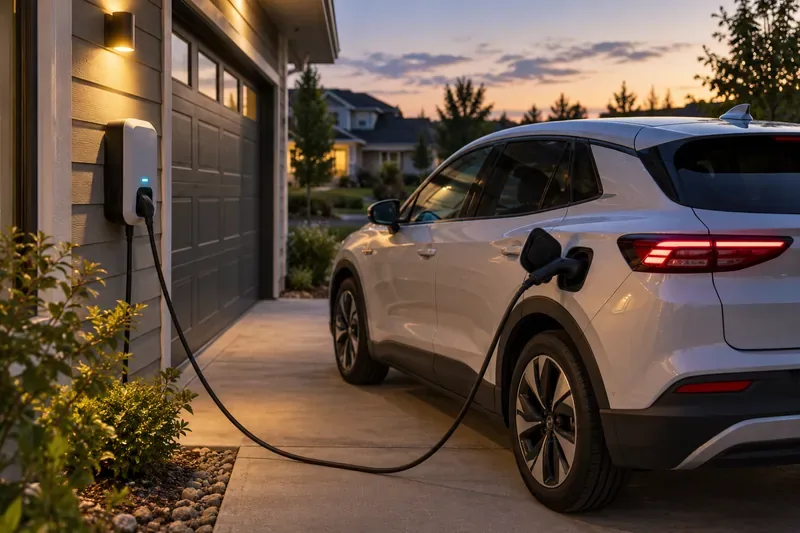
Home charging is convenient when you have a dedicated parking spot and a safe, suitable electrical connection. Some owners use a standard household outlet (Level 1); others install a 240-volt Level 2 unit to replenish more range while parked. Installation may require an electrician, permits, or an electrical-panel upgrade, so include those costs in your ownership comparison. Renters and apartment residents should ask the property manager about permission, installation responsibility, billing, and access before assuming a charger can be added.
Public Level 2 charging can work while you shop, work, or park for a few hours. DC fast charging is designed for quicker stops, especially on longer trips, but the session price and availability depend on the station and network. Operators may price by energy, time, or a combination, and idle or parking fees may apply. Check the live app or station display before plugging in. Charging time also varies with the car’s maximum charging rate, battery temperature and charge level, station output, and the taper in charging speed as the battery fills. The AFDC charging-station guide describes these factors.
Charging option
Useful when
What to check
Level 1 at home
The car is parked overnight and daily driving is modest
Outlet condition, circuit suitability, and the vehicle’s charge rate
Level 2 at home or work
You want more energy during a long parking window
Installation cost, permission, utility rate, and connector compatibility
Public DC fast charging
You need a quicker top-up on a trip
Working status, connector, price, route access, and expected wait
What are the main benefits?
Convenient charging while parked
For drivers with home or workplace charging, plugging in can replace some trips to a gas station. This benefit is strongest when the car is parked for hours in a place where charging is available. If you have no dependable home or workplace option, convenience depends on the public network near your home, job, and regular routes.
Potentially lower energy and routine maintenance costs
Electricity may cost less per mile than gasoline, especially when you charge at home at a favorable rate. But savings are not automatic: public fast charging can narrow the gap, and purchase price, insurance, registration, depreciation, tires, and financing also affect total ownership cost. Battery-electric cars generally have fewer routine powertrain service items because they do not need engine oil changes, spark plugs, or exhaust-system service. They still need tire, cabin-filter, brake, coolant-system, and other manufacturer-specified care. The AFDC maintenance and safety guide summarizes the differences.
No tailpipe emissions while driving
A BEV has no tailpipe, so it does not emit exhaust at the point of use. Electricity generation and vehicle manufacturing still have environmental impacts. The emissions associated with charging depend in part on the electricity mix and when and where the car charges. The EPA says lifetime greenhouse-gas emissions from EVs are typically lower than those of comparable gasoline vehicles, while the size of the difference varies. Use the EPA’s EV myths and lifecycle discussion and its location-based calculator tools for a more specific comparison.
What should you check before deciding?
Start with your routine, not the advertised maximum range. List a typical week of driving, your longest regular trip, winter or summer conditions, and whether you tow or carry a heavy load. Cold weather, high speeds, steep terrain, climate control, payload, and towing can reduce range. Leave a practical buffer instead of planning to arrive with an almost empty battery.
Confirm charging access. Identify where the car will charge most nights or workdays. If relying on public charging, check actual stations along your routine routes and whether you can use them without detours.
Check the specific car. Compare EPA-estimated range, energy use, included charging equipment, connector compatibility, warranty terms, and the manufacturer’s guidance. Range and charging capability differ substantially among models.
Calculate local costs. Use your utility’s time-of-use plan if applicable, likely public-charging prices, expected annual miles, and the car’s efficiency. Include home charger installation and any recurring network fees.
Compare the whole budget. Compare purchase or lease price, financing, insurance, taxes, registration, maintenance, tires, and expected resale value against a comparable gasoline car. Tax credits and utility programs can change; verify eligibility and current rules with the relevant government agency before counting them.
Who is an EV a good fit for?
An EV is especially promising for a driver who can charge at home or work, drives predictable daily distances, and can find compatible fast charging for occasional longer trips. It may be a harder fit for someone without reliable charging, someone who frequently travels beyond available charging corridors, or someone whose towing and payload needs sharply reduce practical range. In those cases, compare a PHEV, a hybrid, or a gasoline vehicle against your actual routes and costs.
The clearest decision test is simple: Can you charge where the car spends time, can the vehicle cover your regular trips with a comfortable buffer, and does the full budget make sense at local electricity and fuel prices? If all three answers are yes, an EV may fit well. If one is uncertain, resolve that point with a utility bill, a route check, or a test drive before committing.