01. Historical Context
Ethereum in context: a network asset with real utility, but still cyclical demand
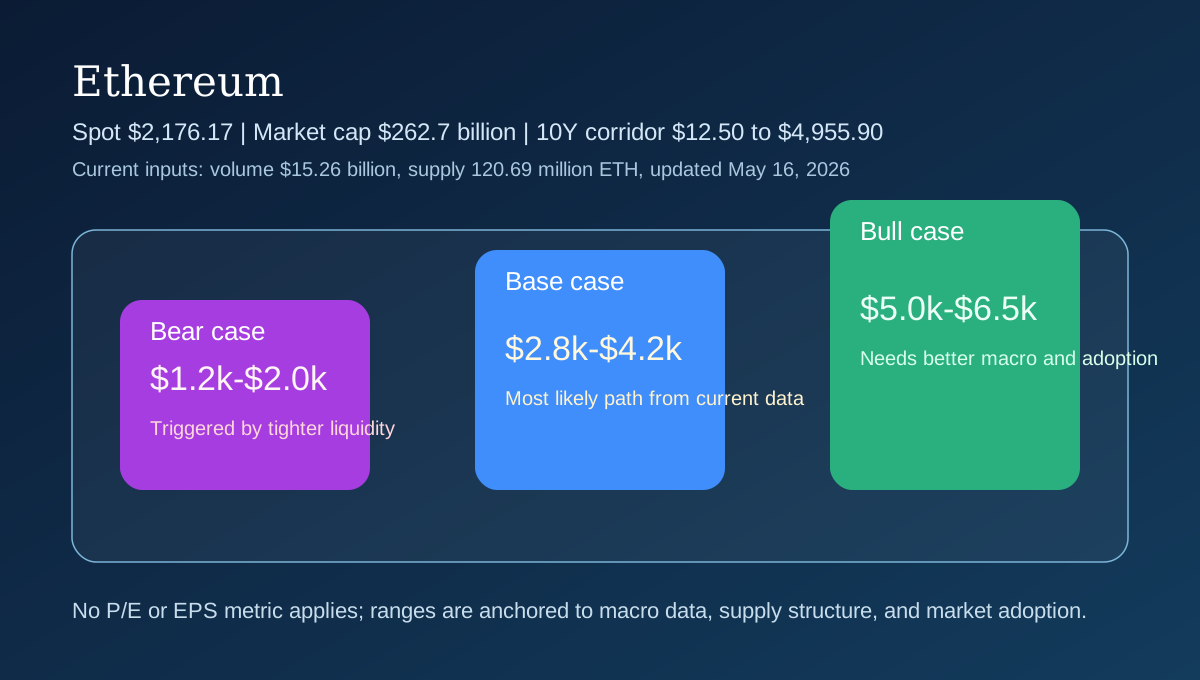
Base case: Ethereum has the stronger utility narrative, but its price still behaves like a high-beta macro asset. ETH traded around $2,176 on May 16, 2026, well below both CoinGecko's all-time high of $4,946.05 and Coinbase's August 24, 2025 intraday high near $4,955.90. That leaves room for upside if demand returns, but it also shows the network has not yet escaped cycle risk.
| Horizon | What matters most | What would strengthen the thesis | What would weaken the thesis |
|---|---|---|---|
| 1-3 months | ETF flows, gas demand, and macro tone | Spot ETH stabilizes while ETF demand and fee activity improve | Weak ETF demand and falling network activity |
| 6-18 months | Layer-1 usage, rollup settlement demand, and rate backdrop | Higher fee burn and better capital-market access | Usage migrates away while real yields stay high |
| To 2027+ | ETH as settlement collateral and institutional portfolio asset | Broader tokenization and machine-to-machine settlement | Utility fails to scale into durable value capture |
The long-run record is still exceptional. Coinbase exchange data place ETH near $12.50 on May 18, 2016 and roughly $2,175.45 on May 16, 2026, with a 10-year annualized gain near 67.6%. That history supports a long-duration upside case, but it also argues against forcing a straight-line forecast after such a large compounding period.
Like Bitcoin, Ethereum does not have earnings, so P/E, forward P/E, EPS, and EPS growth are not applicable. The more useful lenses are market cap, active institutional vehicles, fee generation, burn-versus-issuance mechanics, and whether on-chain demand is strong enough to keep ETH's monetary premium credible.
02. Key Forces
Five forces that matter most from current levels
Ethereum has the same macro hurdle as Bitcoin, but an extra execution hurdle: the network must keep proving that usage translates into value capture. April 2026 CPI came in at 3.8% year over year and March 2026 core PCE at 3.2%, so the discount-rate backdrop is still mixed for a long-duration asset.
Institutional access improved meaningfully after the SEC's May 23, 2024 spot ether ETP approval order. BlackRock's iShares Ethereum Trust ETF reported $7.49 billion in net assets as of May 6, 2026, which is smaller than BTC's ETF footprint but large enough to matter for price discovery and credibility.
Ethereum's token design is a real differentiator. Ethereum.org notes that the September 15, 2022 Merge reduced energy usage by about 99.95%, and EIP-1559 burns the base fee. That means ETH can behave differently from a simple inflationary utility token when on-chain demand rises.
Current usage is visible in market data, not just in theory. CoinGecko's latest snapshot showed $967,960 in 24-hour fees and $549,996 in project revenue. Those numbers are far smaller than the market cap, but they are still more direct economic signals than Bitcoin's fee-only monetary-premium model.
The valuation challenge is that ETH has no hard supply cap. CoinGecko listed 120,685,841 ETH outstanding with no maximum supply, so the bull case depends on burn, staking, and settlement demand offsetting issuance over time rather than on fixed scarcity alone.
| Factor | Why it matters | Current assessment | Bias | Current posture |
|---|---|---|---|---|
| Macro and rates | ETH is still valued as a duration-sensitive risk asset. | April 2026 CPI 3.8% y/y; March 2026 core PCE 3.2% y/y. | Neutral | Needs disinflation help |
| Institutional demand | ETF access lowers operational friction for allocators. | ETHA net assets $7.49B as of May 6, 2026. | Moderately bullish | Adoption is real but smaller than BTC |
| Network economics | Fee burn can offset issuance when demand is strong. | 24h fees $967,960; 24h project revenue $549,996. | Neutral to bullish | Utility exists, scale still debated |
| Supply structure | No max supply means ETH needs sustained value capture. | 120,685,841 ETH circulating; max supply infinite. | Neutral | Requires ongoing demand |
| Technical architecture | Merge and EIP-1559 improved the asset case materially. | Merge cut energy use ~99.95%; base fee is burned. | Bullish | Structural improvement already shipped |
Current-state analysis is more useful here than generic rhetoric. Ethereum does not need perfect data to work, but it does need a directionally better mix of macro conditions, institutional demand, and asset-specific reinforcement than what the market saw in the latest inflation and price snapshots.
03. Countercase
What would break or delay the thesis
The bear case for Ethereum starts with the same rate shock that hurts other long-duration assets. If core inflation stays sticky around the March 2026 core PCE pace of 3.2%, the market can keep treating ETH as a high-beta risk asset instead of a neutral settlement asset.
The second risk is weak value capture. CoinGecko's latest snapshot showed less than $1 million in 24-hour fees and about $550,000 in project revenue. If fee activity stays subdued while supply remains uncapped, the market can argue that usage is real but still not large enough to justify a materially higher monetary premium.
The third risk is underwhelming institutional adoption relative to BTC. ETHA's $7.49 billion in net assets is meaningful, but it is still a fraction of IBIT. If the regulated bid remains modest, ETH can lag BTC even in constructive crypto environments.
A fourth risk is competitive leakage. Ethereum still anchors a broad ecosystem, but if settlement demand and developer mindshare migrate faster than burn and staking economics improve, the market could compress ETH's role from dominant settlement asset to just one important chain among many.
| Risk | Latest data | Why it matters now | Current assessment |
|---|---|---|---|
| Sticky inflation | March 2026 core PCE 3.2% y/y; April 2026 CPI 3.8% y/y | Keeps the multiple under pressure | Bearish if real yields stay high |
| Weak fee capture | 24h fees $967,960; project revenue $549,996 | Utility is visible but still small versus a $262.7B market cap | Neutral to bearish |
| Smaller ETF footprint | ETHA net assets $7.49B as of May 6, 2026 | Institutional support exists but is less forceful than for BTC | Neutral |
| Elastic supply optics | No fixed max supply; value relies on burn and demand | Makes ETH more path-dependent than BTC | Neutral |
The practical point is that a valid long-run thesis can still produce a bad entry window. That distinction matters because readers should be able to see when the evidence is challenging the timing of the trade, the size of the range, or the thesis itself.
04. Institutional Lens
What institutional data actually say right now
Institutional context for Ethereum is now concrete enough to measure. The SEC approved spot ether ETP rule changes on May 23, 2024, giving U.S. allocators a regulated wrapper. BlackRock's ETHA reached $7.49 billion in net assets by May 6, 2026, confirming that a serious buyer base exists even if it is still smaller than Bitcoin's.
Macro still frames the corridor. The IMF's April 14, 2026 World Economic Outlook projected global growth of 3.1% in 2026 and 3.2% in 2027, while the IMF's U.S. Article IV published April 2, 2026 projected U.S. growth of 2.4% in 2026 and core PCE returning to 2% in the first half of 2027. That is supportive for ETH only if the disinflation path actually shows up in the data.
Ethereum's additional institutional edge is architectural, not just financial. Ethereum.org's documentation confirms that the Merge cut energy consumption by about 99.95%, and EIP-1559 permanently burns the base fee. Those features matter because they make ETH easier to underwrite as a network asset than it was in the proof-of-work era.
| Source | Latest update | What it says | Why it matters here |
|---|---|---|---|
| SEC | May 23, 2024 | Approved rule changes to list spot ether ETPs. | Opened the U.S. regulated ETF channel for ETH. |
| BlackRock ETHA | May 6, 2026 | Net assets of fund at $7.49B; benchmark level $2,345.17. | Shows institutional access is meaningful but still earlier-stage than BTC. |
| IMF WEO | April 14, 2026 | Global growth projected at 3.1% in 2026 and 3.2% in 2027. | Provides a still-positive macro base case for risk assets. |
| Ethereum.org | Updated through 2025-2026 docs | Merge reduced energy use ~99.95%; EIP-1559 burns the base fee. | Supports the structural case for lower issuance and cleaner value capture. |
The key discipline is not to borrow institutional names without their data. Where the source gives a date, a number, or a rule change, it belongs in the analysis. Where the source does not give a crypto-specific forecast, the article should say so and avoid dressing inference up as a citation.
05. Scenarios
Probability-weighted scenarios with measurable triggers
The base case assumes the macro backdrop improves, but not perfectly. U.S. inflation needs to trend lower than the April 2026 CPI and March 2026 PCE prints, while institutional access needs to keep converting into net demand rather than choppy rotation. That setup supports a grind higher rather than a vertical melt-up.
The bull case requires two measurable upgrades: cleaner disinflation and a renewed institutional bid. If those arrive together, the market can revisit much richer multiples because it will believe the cycle is moving from validation into broader acceptance.
The bear case does not require the long-run thesis to fail. It only requires inflation to stay sticky, real yields to stay high, or regulated demand to fade fast enough that the market decides the prior run-up already discounted too much optimism.
| Scenario | Probability | Target range | Trigger conditions | When to review |
|---|---|---|---|---|
| Bull case | 25% | $5.0k-$6.5k | Core inflation cools, ETH ETF flows improve, fee burn and settlement demand strengthen together | Review after monthly CPI/PCE data and rolling 90-day fee trend |
| Base case | 50% | $2.8k-$4.2k | Macro improves gradually and ETH keeps a credible settlement-asset role | Reassess by Q2 2027 |
| Bear case | 25% | $1.2k-$2.0k | Sticky inflation, weak fee capture, and smaller-than-expected ETF demand | Reassess on sustained fee weakness plus adverse macro data |
Those ranges are intentionally wider than an equity-style target because there is no issuer-level earnings stream to anchor a tighter valuation model. The appropriate discipline is to keep updating the probability weights as CPI, PCE, GDP, ETF AUM, market structure, and asset-specific demand evolve.
References
Sources
- CoinGecko Ethereum page
- Coinbase Exchange ETH-USD candles API
- BlackRock iShares Ethereum Trust ETF (ETHA)
- IMF World Economic Outlook, April 2026
- IMF 2026 Article IV Consultation with the United States
- BLS CPI release for April 2026
- BEA Personal Income and Outlays, March 2026
- BEA GDP (Advance Estimate), 1st Quarter 2026
- Ethereum.org: The Merge
- Ethereum.org: ETH Supply and Issuance
- EIP-1559