Home
» Today
»
EU Biometric Border Control Problems: What UK Travelers Need to Know
EU Biometric Border Control Problems: What UK Travelers Need to Know
You arrive at passport control, scan your passport, look at the camera, place your fingers on the reader — and the kiosk tells you to try again. Behind you, the line keeps growing. For many UK travelers entering the Schengen area, this is the most practical way the EU Entry/Exit System (EES) can become a travel problem: not because the rules are unclear, but because biometric capture, self-service equipment, staffing, and local border procedures do not always work smoothly at the same time.
As of September 18, 2026, the official EU position is that EES has been fully operational at external Schengen borders since April 10, 2026. However, the EU Agency for Fundamental Rights has documented malfunctioning or unused kiosks, rejected fingerprints, unreliable facial-image capture, limited staff guidance, and longer waits at some border crossing points. The safest approach is therefore to treat EES as a normal part of travel, while leaving enough time and knowing what to do if the automated process fails.
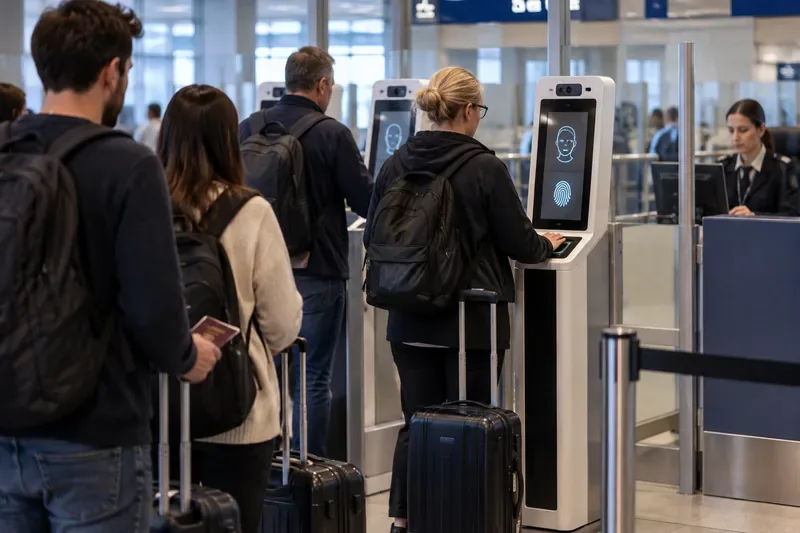
Travelers queue at biometric kiosks while a border officer assists passengers at a staffed desk, illustrating the mix of automated and manual processing used at modern border controls.
What is the EU Entry/Exit System?
EES is the European Union's digital border system for recording the entry and exit of most non-EU nationals making short stays in the Schengen area. It replaces routine passport stamping with an electronic record and can collect passport details, dates and places of entry or exit, a facial image, fingerprints, and any refusal of entry.
British citizens traveling on a UK passport for a short stay are generally covered by EES. The UK government's official EES guidance for British travelers explains that the system started on October 12, 2025 and now applies to short-stay travel to the participating Schengen countries.
The EU's official EES data page says the system stores travel-document information, entry and exit data, a facial image and fingerprints, subject to the traveler's circumstances. Children under 12 are currently not fingerprinted, although other EES checks can still apply to them.
Why are travelers still running into biometric border problems?
The system may be fully operational in legal and technical terms, but a border crossing is still a physical operation involving local equipment, network connections, staffing, passenger surges, document checks, and biometric capture. A problem in any one of those parts can slow the line.
In its 2026 migration and fundamental-rights bulletin, the EU Agency for Fundamental Rights reported issues including malfunctioning or unused self-service kiosks, rejected fingerprints, unreliable facial images, and insufficient guidance for travelers. It also cited waiting-time concerns associated with staffing shortages and technical problems at self-service terminals and central systems.
Common cause 1: the fingerprint reader does not get a usable scan
Dry skin, wet fingers, cuts, pressure on the scanner, or poor placement can make fingerprint capture fail. A rejected scan does not by itself mean there is a problem with your right to enter. It may simply mean the machine cannot get a sufficiently clear biometric image.
Common cause 2: the facial camera cannot match or capture you cleanly
Glare on glasses, a hat, hair covering the face, poor positioning, or a camera that is not aligned well with the traveler can make facial-image capture slower. Border staff may ask you to adjust your position or move to another device.
Common cause 3: the kiosk or local system is unavailable
A border authority can have working EES overall while individual kiosks are offline, not yet being used for a particular passenger flow, or temporarily unavailable. In that situation, staff may redirect passengers to a staffed desk or use a different procedure.
Common cause 4: too many people arrive at once
Even a working biometric process takes longer when several flights, ferries, trains, or coaches arrive together. First-time EES registration is also more involved than a simple passport scan, so queues can build quickly if many travelers need enrollment at the same time.
What should you do if the EES kiosk fails?
Start with the simplest fix and escalate only when needed. Repeatedly fighting the same kiosk can waste more time than asking for help.
Read the screen and try once more carefully. Remove anything obscuring your face if instructed, follow the camera positioning marks, and place the requested fingers flat on the reader.
Use another kiosk if staff direct you to one. A failure on one terminal does not necessarily mean your EES record is the problem.
Ask a border officer or airport employee for the correct lane. If the machine repeatedly rejects your fingerprint or face, a staffed check is usually the right next step.
Do not leave the border-control area assuming the process is complete. Your entry must be properly recorded. Follow the officer's instructions until you are cleared.
If you have a physical condition that makes fingerprint capture difficult, or you need assistance because of age or disability, tell border staff rather than repeatedly attempting the same automated step. The EU's September 2026 work on EES implementation has specifically highlighted the importance of accessible procedures and the needs of children, older people, and persons with disabilities.
How much extra time should UK travelers allow?
There is no single official waiting-time guarantee because conditions differ by airport, port, rail terminal, date, and arrival wave. The UK government advises travelers to be aware of extra border checks and to follow travel-operator guidance. For flights, a sensible practical rule is to follow the airline's recommended airport arrival time and avoid building a tight onward connection immediately after passport control.
If your itinerary includes a short connection after your first Schengen entry point, that first border is where immigration processing normally matters most. Build in more margin than you would for a purely domestic connection, especially during school holidays, weekends, and peak arrival periods.
Check your passport before blaming the biometric system
A failed trip can look like an EES problem when the real issue is passport validity. For short Schengen visits, UK government travel advice says a British passport generally must have been issued less than 10 years before arrival and must expire at least three months after the day you plan to leave the Schengen area. The UK government's Schengen entry guidance for Germany, for example, states these rules clearly and notes that visits across the Schengen area count toward the 90-days-in-180 limit.
Example: if your passport technically has several months left but its issue date is already more than 10 years before your planned arrival, the problem is document validity, not a faulty fingerprint scanner.
Do you need to register online before traveling?
Usually, you should not assume that a separate pre-trip registration is required for EES. The biometric border process itself is carried out at the external border. The EU does offer an optional Travel to Europe mobile app, but its availability is limited by country and function. The official EU page currently says it can be used for entry into Sweden and for selected functions in Portugal, with other countries potentially added later.
That means you should not download an unofficial app or pay a third party simply because a website claims you must "register for EES" before travel. Use the official EU Travel to Europe site or your carrier's instructions.
EES is not ETIAS
This is one of the easiest ways to get confused. EES is the border-recording system that is already in use. ETIAS is a separate future travel-authorization system for visa-exempt travelers.
As of September 18, 2026, the official EU Travel to Europe portal says ETIAS is not yet in operation and that no ETIAS applications are currently being collected. If a site asks you to pay for an ETIAS application before the EU announces the official launch, treat that as a warning sign.
What if your EES record is wrong?
An incorrect entry or exit record matters because EES helps calculate time spent in the Schengen area. If you believe your record is wrong, raise the issue with border officials and keep evidence of your travel, such as boarding passes, ferry tickets, rail tickets, accommodation records, or other dated documents.
The EU's official EES site explains that travelers have data-protection rights and can request access to or correction of personal data. The EES data and privacy page is the correct starting point for understanding those rights and finding the responsible national authority.
Who may be exempt from EES?
Not every traveler holding a non-EU passport is treated the same way. Certain people, including some holders of residence permits or long-stay visas and some family members covered by specific EU free-movement rules, may be outside normal EES registration. If you believe you are exempt, carry the document that proves your status rather than relying on an explanation at the kiosk.
The European Commission's July 2026 EES exemption guidance confirms that some categories are not recorded in EES and continue to present their passport together with the relevant residence or long-stay documentation.
A quick troubleshooting table
Problem
Likely explanation
Best next action
Fingerprint rejected
Poor biometric capture or scanner issue
Retry carefully once, then ask staff for help
Face scan will not complete
Positioning, glare, obstruction, or camera issue
Follow screen instructions; move to a staffed check if directed
Stay in the official queue, monitor your connection, and alert carrier staff if needed
You think you are exempt
Residence, long-stay, or other qualifying status
Show the document proving the exemption
Your recorded travel dates seem wrong
Data-entry or matching issue
Ask border authorities for correction and keep supporting evidence
Before you leave the UK: a five-minute self-check
Confirm that your destination is in the EES/Schengen system and check the latest official travel advice.
Check both the issue date and expiry date of your passport, not just the expiry date.
Make sure your total Schengen stay remains within the 90-days-in-180 rule if you are traveling visa-free.
If you hold a residence permit, long-stay visa, or other exemption document, carry it with you.
Follow your airline, ferry, rail, or coach operator's recommended arrival time and allow extra margin for immigration.
Use only official EU or government pages for EES and ETIAS information.
How to know you are ready
You are in a good position if you can answer five questions without guessing: Is my passport valid for this trip? Am I subject to EES or do I have documentary proof of an exemption? Have I allowed enough border-processing time? Do I know what to do if the kiosk rejects my biometrics? And am I using official information rather than an unofficial registration site?
The important point is that an EES problem is usually a processing problem, not a reason to panic. The system is designed to fall back on border staff when automated equipment cannot complete the check. Arrive with valid documents, leave enough time, follow staff instructions, and keep evidence of your travel if anything in your digital entry or exit record later appears wrong.