01. Historical Context
By 2030, Euro Stoxx 50 is a referendum on whether Europe can convert relief into durable growth
The medium-term attraction of Euro Stoxx 50 is simple: it packages Europe's most liquid large-cap cyclicals at a valuation still below U.S. peers.
| Horizon | What matters most | Current assessment | What would weaken the thesis |
|---|---|---|---|
| 1-3 months | Inflation and energy | Still volatile | Energy shock deepens |
| 6-18 months | Earnings recovery | Constructive | GDP remains too weak to support revisions |
| To 2030 | Durable regional growth | Possible but not proved | Europe remains a stop-start recovery market |
The strategic problem is also simple: Europe still needs to prove that lower rates, German fiscal support and industrial policy can produce growth that lasts longer than one rebound phase.
That is why the 2030 base case stays constructive but moderate. The current market deserves upside if earnings broaden. It does not yet deserve an unconditional rerating.
02. Key Forces
What matters for Euro Stoxx 50 into 2030
First, valuation still gives Europe a chance, but not a free pass. A mid-teens earnings multiple is workable, not distressed.
Second, the path of energy costs is central because April 2026 showed how quickly energy can reverse the inflation narrative.
Third, Germany's fiscal impulse can lift the whole region if it feeds into capex, industrials and banks.
Fourth, the earnings base needs to broaden across sectors to make the rally more durable.
| Factor | Current assessment | Bias | Bullish trigger | Bearish trigger |
|---|---|---|---|---|
| Starting valuation | Reasonable | Neutral | EPS keeps rising while P/E stays near current levels | Valuation compresses on weaker growth |
| Energy risk | Still elevated | Bearish | Energy inflation fades | Repeated spikes hit margins and rates |
| Regional growth | Positive but slow | Neutral | GDP trend strengthens across large economies | Europe stays near stagnation |
| Fiscal support | Promising | Bullish | German and EU spending feed through to EPS | Implementation disappoints |
| Institutional conviction | Constructive but fragile | Neutral | Targets are maintained or raised | Tactical downgrades persist |
Fifth, Europe needs a better growth identity. Without it, the market can remain tactically attractive but strategically discounted.
03. Countercase
The 2030 countercase is Europe staying tactically good but strategically mediocre
A disappointing 2030 outcome does not require a eurozone crisis. It only requires the region to keep cycling between weak growth and energy-led inflation spikes.
That kind of stop-start regime is especially damaging to equity multiples because investors never fully believe the earnings recovery is durable.
In that world, Euro Stoxx 50 can still rally sharply from time to time, but it struggles to hold a materially higher long-run trading range.
| Risk | Latest data point | Why it matters | What to monitor next |
|---|---|---|---|
| Recurring energy shocks | Energy inflation 10.9% in April 2026 | Derails both margins and disinflation | HICP energy and commodity prices |
| Weak growth | GDP only +0.1% q/q in Q1 2026 | Leaves Europe vulnerable to external shocks | Quarterly GDP and PMIs |
| Valuation fatigue | P/E 16.90x | Less room for recovery disappointment | Revisions versus price action |
| Fading institutional support | UBS shifted from Attractive in March to Neutral in April update | Shows the bull case is conditional | House-view changes and strategist targets |
The long-range bear case is therefore a credibility problem as much as a profit problem.
04. Institutional Lens
Institutional evidence still supports Europe, but only with conditions
UBS gave the strongest public positive framework in March 2026, with a 6,600 year-end 2026 target and 7% earnings growth. Reuters' strategist poll was more restrained at 6,200 for end-2026. Together, those views support upside, but not a one-way call.
Goldman Sachs Asset Management's May 2026 valuation work remains helpful because it shows Europe cheaper than the U.S. even after the rally. That makes a 2030 constructive stance defensible if the macro base improves.
| Institution / source | Updated | What it says | Why it matters here |
|---|---|---|---|
| UBS House View | March 2026 | 6,600 year-end 2026 target, 7% earnings growth | Most explicit public upside framework |
| Reuters poll | February 2026 | 6,200 end-2026 expectation | Shows public strategist caution |
| GS Asset Management | May 2, 2026 | Developed Europe still cheaper than the U.S. on forward P/E | Keeps the valuation case alive |
| Eurostat | April 2026 | Slow growth, renewed inflation pressure | Explains why the bull case still needs proof |
The right interpretation is that Europe has valuation and policy optionality, but it still needs cleaner growth delivery than it has today.
05. Scenarios
Scenario map into 2030
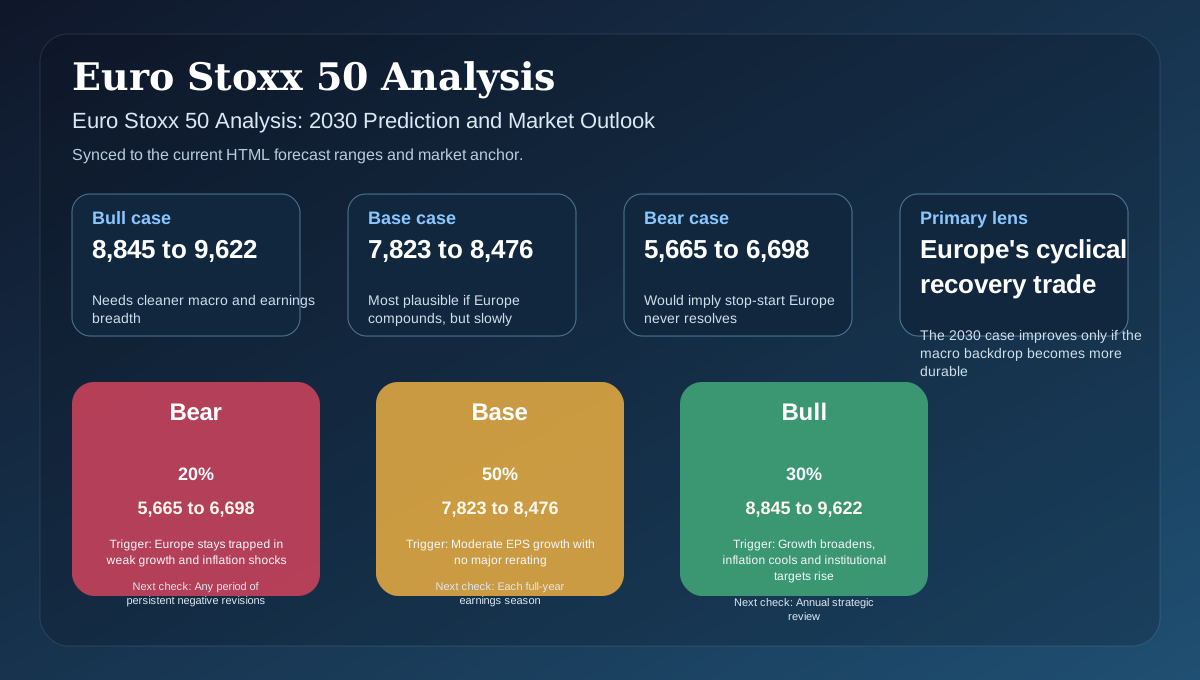
These ranges are analytical outputs built from current valuation, official macro releases and public strategist work.
The base case assumes Europe does enough to sustain moderate earnings growth. The bull case assumes German fiscal support and lower inflation combine successfully. The bear case assumes Europe never leaves a stop-start regime.
| Scenario | Probability | Working range | Measured trigger | Review window |
|---|---|---|---|---|
| Bull | 30% | 8,845 to 9,622 | Growth broadens, inflation cools and institutional targets rise | Annual strategic review |
| Base | 50% | 7,823 to 8,476 | Moderate EPS growth with no major rerating | Each full-year earnings season |
| Bear | 20% | 5,665 to 6,698 | Europe stays trapped in weak growth and inflation shocks | Any period of persistent negative revisions |
The thesis should be reviewed after every major inflation shock, annual budget cycle and full-year earnings season.
Europe does not need perfection to outperform from here. It does need fewer macro interruptions than it has suffered in recent years.
References
Sources
- BlackRock iShares Core EURO STOXX 50 UCITS ETF product page, portfolio characteristics and benchmark data (accessed May 2026)
- Eurostat, euro area annual inflation flash estimate for April 2026
- Eurostat, euro area GDP up 0.1% in the first quarter of 2026
- UBS House View, March 2026
- Reuters poll on European shares, via Investing.com, February 24, 2026
- Investing.com Euro Stoxx 50 historical data
- Goldman Sachs Asset Management, Market Monitor, week ending May 1, 2026