01. Historical Context
The decade thesis is that Europe eventually earns a steadier valuation, not necessarily a U.S.-style premium
Over ten years, Euro Stoxx 50 does not need to become America. It only needs to become a region where earnings are less vulnerable to every external shock.
| Horizon | What matters most | Current assessment | What would weaken the thesis |
|---|---|---|---|
| 1-3 months | Inflation shocks | Still active | Energy inflation accelerates again |
| 6-18 months | Earnings breadth | Positive but conditional | Revisions narrow or fall |
| To 2035 | Regional credibility | Improving but unproven | Europe stays a stop-start allocation |
Current data show why that is plausible and why it is not guaranteed. The market is not expensive in global terms, yet growth is still slow and inflation can re-accelerate quickly.
The decade case therefore rests on gradual credibility improvement: better investment, fewer energy shocks and more durable earnings breadth.
02. Key Forces
What matters for a decade-long Euro Stoxx 50 outlook
The first force is whether Europe can sustain capital spending and productivity improvements beyond one cycle.
The second force is whether inflation becomes less hostage to energy volatility.
The third force is relative valuation. Europe can do well without a huge multiple jump if the starting discount remains reasonable.
The fourth force is political and fiscal cohesion, because long-run earnings confidence depends on policy credibility.
| Factor | Current assessment | Bias | Bullish trigger | Bearish trigger |
|---|---|---|---|---|
| Relative valuation | Still below U.S. peers | Bullish | Discount narrows modestly | Discount persists for structural reasons |
| Energy sensitivity | Still high | Bearish | Energy shocks become less frequent | Recurring spikes keep hurting confidence |
| Growth identity | Unclear | Neutral | Europe becomes a steadier growth region | Growth remains episodic |
| Policy support | Promising | Bullish | Fiscal and capital-market reforms help | Fragmentation limits follow-through |
| Earnings breadth | Still developing | Neutral | More sectors sustain upgrades | Only narrow leadership persists |
The fifth force is breadth. A decade thesis improves materially when more sectors participate in revisions and returns.
03. Countercase
The decade bear case is Europe remaining cheap for a reason
A weak 2035 outcome does not need a euro crisis. It only needs Europe to remain a region of respectable companies but weak aggregate conviction.
That could happen if GDP stays structurally slow, if energy keeps creating inflation surprises, or if political fragmentation prevents a cleaner investment story from developing.
In that environment, Euro Stoxx 50 can still produce tactical rallies while failing to secure a meaningfully higher long-run valuation regime.
| Risk | Latest data point | Why it matters | What to monitor next |
|---|---|---|---|
| Persistent discount | Europe still trades below U.S. forward P/E in GSAM work | The discount can remain if growth does not improve | Relative earnings growth and capital flows |
| Energy-led inflation shocks | Energy inflation 10.9% in April 2026 | Undermines both margins and policy confidence | HICP energy and gas prices |
| Weak structural growth | GDP +0.1% q/q in Q1 2026 | Limits the case for a higher terminal multiple | Productivity, capex and labor-market data |
| Institutional fragility | UBS shifted stance within weeks in 2026 | Confidence remains conditional | House-view changes and strategist targets |
The bear case is therefore chronic underconfidence, not only weak profits.
04. Institutional Lens
Institutional evidence supports a constructive but conditional decade view
UBS's public scenario work and the Reuters poll together show the essence of the Europe debate: upside exists, but timing is sensitive and conviction is conditional.
Eurostat's official releases explain why. Growth is positive but not strong, and inflation can still swing with energy. Until those conditions improve, Europe will likely remain a value-and-cyclical allocation rather than a premium-growth one.
| Institution / source | Updated | What it says | Why it matters here |
|---|---|---|---|
| UBS House View | March 2026 | Constructive target structure and 7% earnings growth | Defines the positive public case |
| Reuters poll | February 2026 | More restrained strategist consensus | Keeps the long-run discussion grounded |
| Eurostat | April 2026 | Slow growth and renewed inflation pressure | Shows why the discount has not vanished |
| GS Asset Management | May 2, 2026 | Europe still cheaper than the U.S. on forward P/E | Provides decade-long valuation support |
That still leaves room for good 2035 outcomes. It just means the path is likely to be uneven and policy-sensitive.
05. Scenarios
Scenario ranges into 2035
These are analytical ranges designed to connect today's valuation and macro setup to long-range outcomes without pretending to know the exact path.
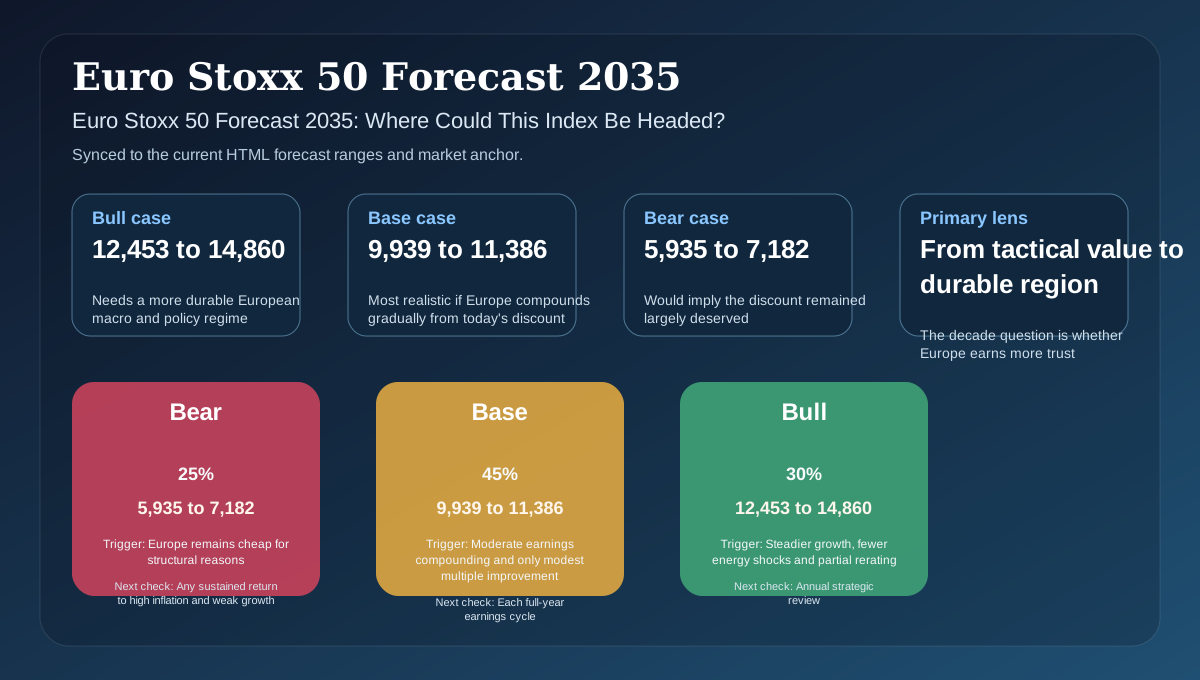
The base case assumes Europe compounds gradually and earns a slightly better valuation. The bull case assumes a more durable macro and reform regime. The bear case assumes Europe stays chronically discounted.
| Scenario | Probability | Working range | Measured trigger | Review window |
|---|---|---|---|---|
| Bull | 30% | 12,453 to 14,860 | Steadier growth, fewer energy shocks and partial rerating | Annual strategic review |
| Base | 45% | 9,939 to 11,386 | Moderate earnings compounding and only modest multiple improvement | Each full-year earnings cycle |
| Bear | 25% | 5,935 to 7,182 | Europe remains cheap for structural reasons | Any sustained return to high inflation and weak growth |
The most important long-run review questions are whether energy risk is structurally lower, whether earnings breadth is wider and whether investors trust Europe's policy framework more than they do today.
If those answers improve, the upside can exceed the base case. If not, Europe may remain investable but still under-aspirational.
References
Sources
- BlackRock iShares Core EURO STOXX 50 UCITS ETF product page, portfolio characteristics and benchmark data (accessed May 2026)
- Eurostat, euro area annual inflation flash estimate for April 2026
- Eurostat, euro area GDP up 0.1% in the first quarter of 2026
- UBS House View, March 2026
- Reuters poll on European shares, via Investing.com, February 24, 2026
- Investing.com Euro Stoxx 50 historical data
- Goldman Sachs Asset Management, Market Monitor, week ending May 1, 2026