01. Historical Context
Euro Stoxx 50 remains the cleanest listed expression of Europe's cyclical recovery trade
Euro Stoxx 50 sits at the center of the European equity story because it is both liquid and macro-sensitive. If eurozone growth, German fiscal support and ECB easing all line up, this is one of the first indices investors reach for.
| Horizon | What matters most | Current assessment | What would weaken the thesis |
|---|---|---|---|
| 1-3 months | Energy shock and policy repricing | Constructive but fragile | Energy inflation keeps pushing headline HICP higher |
| 6-18 months | Eurozone earnings recovery | Possible, but slower growth limits confidence | GDP remains stuck near zero |
| To 2027 | Can earnings outrun macro noise? | Yes, if energy fades and breadth improves | Inflation and growth move the wrong way together |
The problem is that the current macro mix is still imperfect. Eurostat reported GDP up only 0.1% quarter on quarter in Q1 2026 and annual HICP accelerating to 3.0% in April, with energy inflation at 10.9%. That is good enough to avoid a recession narrative, but not good enough to ignore energy and rates.
The valuation anchor is also less forgiving than it was two years ago. BlackRock's Euro Stoxx 50 proxy showed 16.90x P/E, 2.29x P/B and a 2.63% trailing yield as of March 26, 2026.
02. Key Forces
Five forces that matter most for Euro Stoxx 50
The first force is valuation. At 16.90x earnings and 2.29x book on BlackRock's proxy, Euro Stoxx 50 is no longer a fire-sale multiple. It is still cheaper than the U.S., but investors are already paying for some recovery.
The second force is the growth-inflation mix. Eurostat's Q1 2026 GDP estimate of 0.1% quarter on quarter is positive, but slow. The April 2026 inflation flash at 3.0%, with energy inflation at 10.9%, complicates the rates story.
The third force is institutional conviction. UBS's March 2026 House View kept eurozone equities Attractive, with a December 2026 target of 6,600, a positive scenario of 7,100 and a negative scenario of 4,400, while expecting earnings to grow 7% in 2026.
The fourth force is how quickly energy stress fades. The same UBS team downgraded eurozone equities to Neutral in an April 2026 update because of prolonged energy-shock risk. That shift is the clearest evidence that Europe's bull case is still hostage to input-cost stability.
| Factor | Current assessment | Bias | Bullish trigger | Bearish trigger |
|---|---|---|---|---|
| Valuation | 16.90x P/E, 2.29x P/B, 2.63% yield | Neutral | Earnings grow enough to hold the multiple | Multiple compresses below 16x |
| Growth | Euro area GDP +0.1% q/q in Q1 2026 | Neutral | Quarterly growth picks up above 0.2%-0.3% | Growth stalls again |
| Inflation | HICP 3.0%, energy 10.9% in April 2026 | Bearish | Energy fades and HICP falls back | Energy shock broadens into core inflation |
| Institutional targets | UBS 6,600 base, 7,100 bull, 4,400 bear for Dec. 2026 | Bullish | Targets are maintained or raised | House views turn decisively cautious |
| Earnings outlook | UBS sees 7% earnings growth in 2026 | Bullish | Revisions improve across sectors | Growth expectations are cut again |
The fifth force is breadth. A durable European rally needs more than banks and defense. It needs industrials, software, luxury, healthcare and cyclicals all contributing to revisions.
03. Countercase
What would break the Euro Stoxx 50 thesis
The first break point is obvious in the April 2026 Eurostat release: energy inflation at 10.9%. If that pressure persists, the market cannot count on a smooth disinflation path.
The second break point is growth. GDP expanding just 0.1% quarter on quarter is enough for a positive story, but it leaves very little margin for error.
Third, the market could simply have priced in too much of Europe's cyclical recovery too early. That is why the same UBS research franchise could be Attractive in March and then tactically downgrade eurozone equities to Neutral in April.
| Risk | Latest data point | Why it matters | What to monitor next |
|---|---|---|---|
| Energy shock persists | Energy inflation 10.9% in April 2026 | Hits both margins and rate expectations | Monthly HICP and gas/oil prices |
| Growth too weak | GDP +0.1% q/q in Q1 2026 | Leaves little room for downside surprises | Eurostat GDP updates and PMIs |
| Valuation reset | P/E 16.90x | No longer a distressed starting multiple | Revisions versus index price |
| Institutional downgrades | UBS cut eurozone equities to Neutral in April 2026 | Shows confidence can swing fast | Target revisions from major houses |
The bear case therefore looks like a slow disappointment: sticky energy inflation, flat GDP, softer revisions and less institutional conviction.
04. Institutional Lens
Institutional research is still the clearest guide to the 2027 setup
UBS's March 2026 House View provides the most concrete public framework: Attractive on eurozone equities, Euro Stoxx 50 current level at 6,162 as of February 25, 2026, 6,600 for December 2026, 7,100 in the positive scenario, 4,400 in the negative scenario, and 7% earnings growth expected in 2026. That is a solid base case, not a heroic one.
Reuters' February 24, 2026 poll of strategists, carried by Investing.com, was more cautious. It expected the index to slip to about 6,011 by mid-2026 before ending 2026 at 6,200. The gap between UBS and Reuters is useful because it shows the distribution of credible public views rather than a false consensus.
| Institution / source | Updated | What it says | Why it matters here |
|---|---|---|---|
| UBS House View | March 2026 | 6,600 base, 7,100 positive, 4,400 negative for Dec. 2026 | Best public scenario map for the index |
| UBS House View | March 2026 | Expected eurozone earnings growth of 7% in 2026 | Keeps the bull case anchored in profits |
| Reuters strategist poll | February 24, 2026 | 6,011 mid-2026 and 6,200 end-2026 | Shows a more cautious consensus path |
| Eurostat | April 2026 | GDP modestly positive, inflation back up to 3.0% | Defines the macro friction in the trade |
The right takeaway is that Europe still offers upside, but the timing is much more sensitive to energy, growth and policy than a simple U.S.-comparison argument suggests.
05. Scenarios
Probability-weighted scenarios into 2027
These ranges are analytical ranges derived from today's level, official macro data and public institutional targets. They are not presented as bank-published 2027 targets.
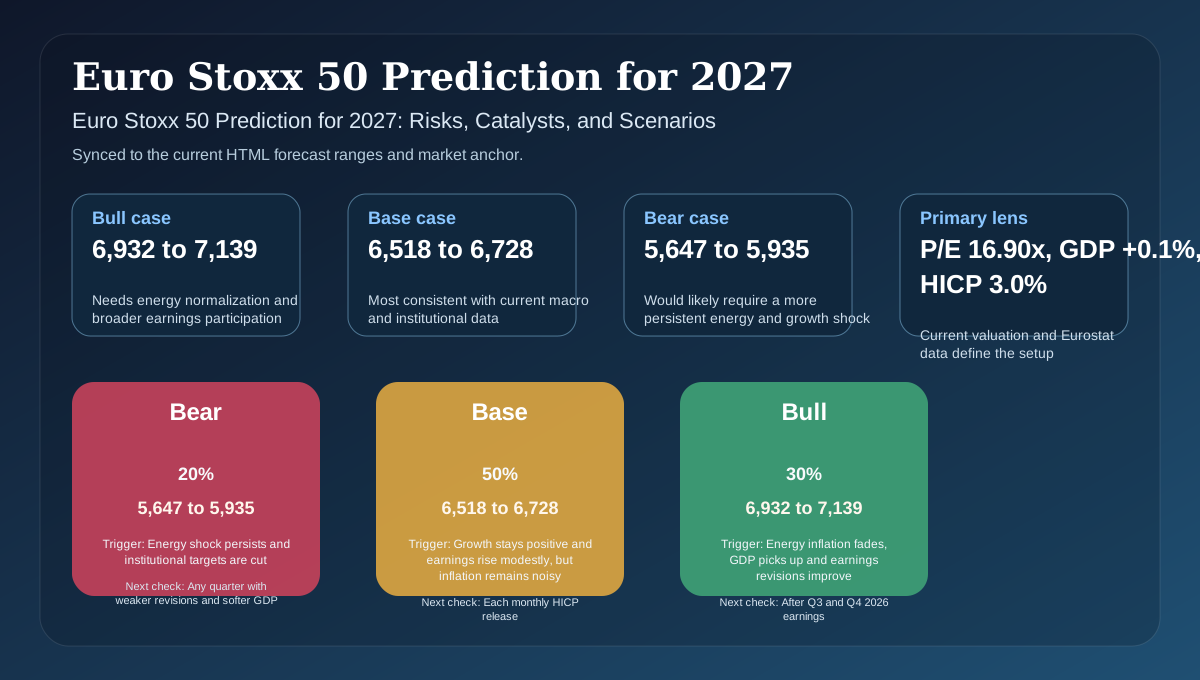
The base case assumes Europe continues recovering, but only gradually. The bull case assumes energy pressure fades and earnings broaden. The bear case assumes the April energy shock proves persistent.
| Scenario | Probability | Working range | Measured trigger | Review window |
|---|---|---|---|---|
| Bull | 30% | 6,932 to 7,139 | Energy inflation fades, GDP picks up and earnings revisions improve | After Q3 and Q4 2026 earnings |
| Base | 50% | 6,518 to 6,728 | Growth stays positive and earnings rise modestly, but inflation remains noisy | Each monthly HICP release |
| Bear | 20% | 5,647 to 5,935 | Energy shock persists and institutional targets are cut | Any quarter with weaker revisions and softer GDP |
The thesis should be reviewed after every Eurostat inflation release and after each major quarterly earnings season because those are the points where the probability mix is most likely to change.
For now, Euro Stoxx 50 is still investable into 2027, but the trade is cleaner when energy and inflation stop fighting the earnings story.
References
Sources
- BlackRock iShares Core EURO STOXX 50 UCITS ETF product page, portfolio characteristics and benchmark data (accessed May 2026)
- Eurostat, euro area annual inflation flash estimate for April 2026
- Eurostat, euro area GDP up 0.1% in the first quarter of 2026
- UBS House View, March 2026
- Reuters poll on European shares, via Investing.com, February 24, 2026
- Investing.com Euro Stoxx 50 historical data
- Goldman Sachs Asset Management, Market Monitor, week ending May 1, 2026