Home
» Today
»
From the 2026 Emmys to Your Community: Why Alan Cumming’s Voter Registration Message Matters Now
From the 2026 Emmys to Your Community: Why Alan Cumming’s Voter Registration Message Matters Now
You hear a celebrity say “register to vote,” you mean to check your status later, and then life moves on. That is the practical problem behind Alan Cumming’s voter-registration message at the 2026 Emmys: for many eligible voters, the barrier is not a lack of interest but a small administrative task that is easy to postpone until a deadline is close.
On September 14, 2026, after The Traitors won Outstanding Reality Competition Program at the 78th Emmy Awards, Cumming used part of the acceptance moment to urge Americans to make sure they were registered to vote. The timing was unusually direct. National Voter Registration Day falls on Tuesday, September 15, 2026, and the 2026 U.S. midterm elections are approaching in November. The Television Academy’s official record confirms The Traitors as the 2026 winner in the reality competition category, while the official National Voter Registration Day organization lists September 15 as this year’s date.
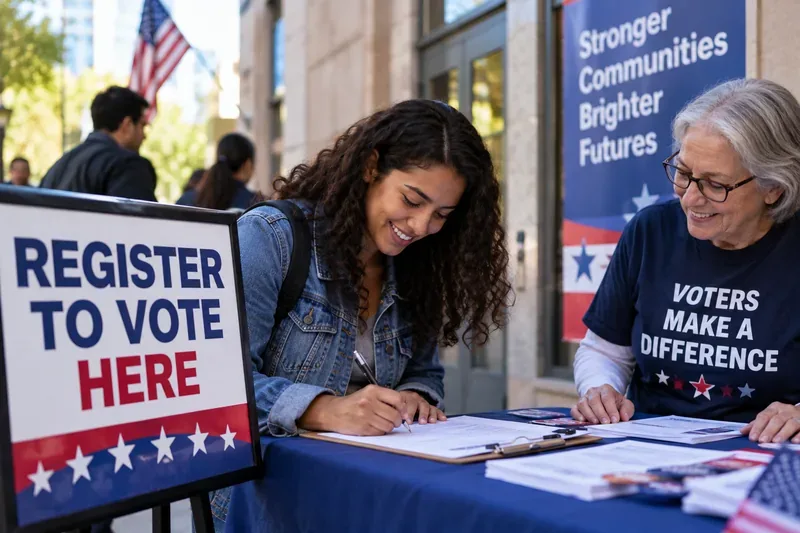
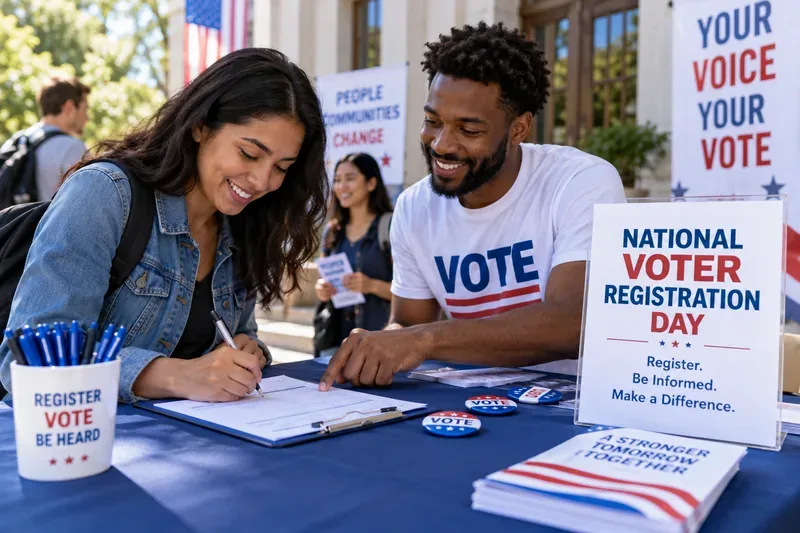
A community voter-registration table shows the local, practical side of a national reminder: checking eligibility, updating information, and meeting your state’s deadline are what turn a public message into an actionable civic step.
Why the message matters beyond an awards-show moment
A voter-registration reminder can sound almost too simple. But registration is the gateway step for participating in federal elections in nearly every state. The U.S. Election Assistance Commission explains that every state and territory except North Dakota uses voter registration as a prerequisite for federal voting. Each jurisdiction administers its own rules, deadlines, and registration system, which is why a generic “I think I’m registered” is not the same as confirming your record.
That difference matters in 2026 because the next midterm election will determine all 435 seats in the U.S. House of Representatives and roughly one-third of the U.S. Senate. USAGov describes midterms as congressional elections held halfway between presidential elections and confirms that the next cycle is in November 2026. State and local contests may also appear on ballots, depending on where you live.
Cumming’s message therefore matters less because it came from a television personality and more because it pointed viewers toward a time-sensitive administrative step. A national broadcast can create awareness, but election eligibility and registration are resolved locally.
Start with the easiest task: check whether you are already registered
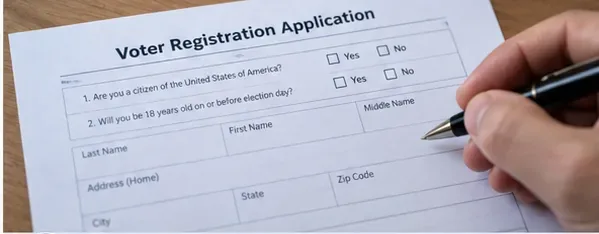
The simplest useful action is to verify your current registration rather than assume you need to register from scratch. Vote.gov, the federal voter-information portal, directs voters to their state or territory’s official election system for registration, updates, and status checks.
Look for three things: your legal name, your residential address, and whether the state shows your registration as active. Vote.gov notes that a registration can be marked inactive in some circumstances, including when a person has not voted in at least two federal elections and has not responded to election officials’ attempts to make contact.
If everything is correct, you may not need to submit anything new. Save or bookmark the official state confirmation page if your state provides one, and move on to checking your voting location and deadlines.
If you moved or changed your name, update the record now
Moving is one of the most common reasons a voter record needs attention. Vote.gov states that voters should update their registration after a change of address, whether the move was within the same state or to another state. If you moved to a new state, you generally register in the new state.
A legal name change can also require an update. The exact process varies by jurisdiction, and some states may ask for updated identification or driver’s-license information. Do not rely on an address change with another government agency automatically fixing your voter record unless your state explicitly says it does.
This is where Cumming’s broad message becomes concrete: “register” can also mean “make sure an old registration still matches your current life.”
Do not assume there is one national registration deadline
There is no single federal voter-registration deadline for every state. USAGov’s official deadline guidance says deadlines vary by state and may be as much as a month before an election. Some states offer Election Day registration; others require action earlier.
That variation is one reason National Voter Registration Day is useful as a reminder rather than a deadline. September 15 is not the legal cutoff for every voter. It is a nationwide civic event designed to prompt people to check their status while many still have time to correct problems.
Know what registration does—and what it does not do
Registering to vote is not the same as endorsing a candidate, a party, or a political position. National Voter Registration Day describes itself as nonpartisan, and its purpose is to help eligible people register or update their information.
Party affiliation rules can still matter in primary elections. Vote.gov explains that some states with closed primaries require voters to be affiliated with a party to participate in that party’s primary. General elections work differently: party registration does not restrict you to voting for that party’s candidates in the general election.
Another misconception is that a voter-registration card is always required at the polling place. Vote.gov says you do not generally need the registration card itself to vote, although your state may require an approved form of identification. Check your state’s voter-ID rules before Election Day rather than assuming the card is the required ID.
Make a plan for where and how you will vote
Once registration is confirmed, the next question is practical: where will you vote, and when? Polling locations can change. USAGov’s polling-place guidance recommends checking your assigned location through your state or local election office. Your polling place is typically tied to your residential address, and going to the wrong site can create delays or require a provisional ballot.
Depending on your state, you may also have early in-person voting or absentee/mail voting options. These rules are jurisdiction-specific. Do not assume that a procedure you used in another state, or in a previous election, still applies.
If you are a U.S. service member, eligible family member, or citizen living overseas, use the Federal Voting Assistance Program. FVAP provides state-specific deadlines and the Federal Post Card Application for registering and requesting an absentee ballot under the rules that apply to military and overseas voters.
If you want to help your community, keep the assistance nonpartisan and accurate
The jump from a televised reminder to community action does not require organizing a large campaign. A library, campus, neighborhood association, workplace, or civic group can simply point people to official registration resources and remind them to verify their status before their state deadline.
The safest approach is to avoid guessing about rules. If someone asks whether they are eligible, what identification they need, or whether a deadline has passed, direct them to the appropriate state or local election office. Election law can vary significantly by state, and local officials are the authoritative source for a person’s specific situation.
Community volunteers can also make registration more accessible by providing official links, helping people find their election office, or making printed forms available where permitted. The goal is not to tell people whom to support; it is to make accurate procedural information easier to reach.
Special situations deserve extra care
New U.S. citizens
Vote.gov states that noncitizens, including lawful permanent residents, cannot vote in federal elections and generally cannot vote in state elections. A newly naturalized U.S. citizen who is otherwise eligible can use the official state process to register. If citizenship status is uncertain, do not submit a registration based on assumptions; verify eligibility first.
Students and people with more than one address
Students, temporary residents, and people who divide time between locations may need to determine which address qualifies as their voting residence under state law. Because those rules differ, the state election office should be the source of record rather than social media advice or a generic checklist.
People who have not voted recently
Not voting in recent elections does not automatically mean you can never vote again, but your registration status may need attention. Vote.gov advises people whose status is inactive to contact their state or local election office for help restoring or confirming it.
Why a short Emmy speech can still have practical value
Major entertainment broadcasts reach people who may never visit an election-administration website on their own. That does not make a celebrity an election authority. It can, however, make a routine civic task salient at the right moment.
In this case, the sequence was unusually clear: The Traitors won at the Emmys on September 14, Cumming reminded viewers about voter registration, and National Voter Registration Day arrived September 15. The message was actionable almost immediately.
The responsible next step is not to treat a celebrity statement as voting guidance. It is to use the attention it creates to reach authoritative sources. That distinction keeps the message useful and nonpartisan.
Self-check: are you actually ready?
Before considering the task finished, run through this short check:
Did you confirm your voter-registration status on an official state or territory website?
Does the record show your current legal name and residential address?
Do you know your state’s registration deadline?
Have you checked whether your state requires voter identification?
Do you know your assigned polling place or your approved early/mail-voting option?
If you are military or overseas, have you checked FVAP’s state-specific instructions?
If you can answer yes to the items that apply to you, the registration reminder has done its job. If not, the easiest starting point is Vote.gov’s registration portal, which routes you to the correct official process for your state or territory.
The takeaway
Alan Cumming’s 2026 Emmys message matters because voter participation often begins with an unglamorous administrative detail: making sure the registration record is correct before the deadline. The celebrity moment created visibility; the meaningful work happens afterward, through official state systems, local election offices, and community organizations that help eligible voters navigate the process accurately.
For anyone who heard the message and thought, “I should check that,” the useful response is straightforward: verify your status today, correct anything that is outdated, note your deadline, and confirm how and where you plan to vote. That turns a few seconds of television into something concrete without requiring any particular political viewpoint.