01. Historical Context
By 2030, the index is a cash-flow machine before it is a multiple story
A 2030 view on FTSE 100 should begin with what the index already is: a globally exposed basket with heavy representation in energy, banks, pharma and defensive multinationals. That mix can outperform when nominal growth and commodity cash flows stay healthy, but it rarely deserves an unlimited valuation premium.
| Horizon | What matters most | Current assessment | What would weaken the thesis |
|---|---|---|---|
| 1-3 months | Inflation and rates | Still the main brake on rerating | Services inflation remains sticky |
| 6-18 months | EPS durability | Healthy if global cyclicals avoid a hard landing | Energy and financial profits roll over |
| To 2030 | Income compounding | Constructive, but not explosive | Dividend confidence or cash conversion weakens |
That is why the current starting point matters. BlackRock's FTSE 100 proxy showed 16.73x P/E and 2.31x P/B as of late April 2026, while UBS still described UK equities as Neutral in March. The market is no longer deeply neglected, so long-range upside must come from sustained earnings and distributions.
The strategic appeal to 2030 is therefore straightforward: if UK inflation and rates settle, the index can still compound well because dividends, buybacks and global cash generation remain strong. The strategic risk is equally straightforward: if inflation, currency volatility or commodity downside keep resetting the multiple, price progress can lag income growth.
02. Key Forces
What can still move FTSE 100 materially by 2030
First, the starting valuation is acceptable but not a gift. At 16.73x earnings on BlackRock's proxy, there is room for appreciation, but not much room for disappointment if long-term yields stay high.
Second, the macro corridor matters more than a single rate cut. ONS data show the UK economy still growing and inflation still elevated. A durable move toward lower inflation would support both domestic cyclicals and rate-sensitive sectors, while a stop-start disinflation path would keep the market trading as a yield and cash-flow story.
Third, sector concentration remains both a strength and a limit. FTSE can monetize energy shocks and global reflation better than many peers, but it can also lag when software-led growth dominates global returns.
Fourth, relative valuation versus other developed markets still helps. Goldman Sachs Asset Management's May 2026 chart put the UK on 13.2x next-12-month P/E against developed Europe at 15.4x and the U.S. at 22.0x. That does not guarantee outperformance, but it reduces the risk of starting from a valuation extreme.
| Factor | Current assessment | Bias | Bullish trigger | Bearish trigger |
|---|---|---|---|---|
| Starting valuation | Reasonable, not distressed | Neutral | P/E holds or expands modestly as inflation fades | Real rates stay high and compress the multiple |
| Income support | Structural strength | Bullish | Dividends and buybacks stay well covered | Capital returns weaken with cash flow |
| Domestic macro | Positive growth, sticky inflation | Neutral | Lower inflation without recession | Stagflationary mix persists |
| Global cyclicals | Important FTSE earnings engine | Neutral | Commodity demand and bank credit hold up | Global slowdown hits both at once |
| Relative valuation | Below U.S. multiples | Bullish | Capital rotates toward cheaper developed markets | Cheap stays cheap because growth lags |
Fifth, 2030 returns will likely depend on whether the index can upgrade its narrative from cheap-and-defensive to dependable-and-broadening. That change is possible, but it has to be earned through revisions and breadth, not just declared.
03. Countercase
The 2030 countercase is about stagnation, not collapse
The cleanest bear argument for 2030 is not a one-off crash. It is a market that keeps earning cash but never receives a sustained higher multiple because inflation and rates refuse to normalize cleanly.
That risk is visible in current data. CPI was 3.3% in March 2026 and services inflation 4.5%. If that kind of stickiness becomes recurring, FTSE could remain boxed into a high-yield, low-multiple regime.
A second risk is structural underexposure to the sectors global investors pay premium multiples for. If the next leg of global returns remains software, semis and asset-light growth, FTSE may continue to underparticipate relative to markets with heavier technology concentration.
| Risk | Latest data point | Why it matters | What to monitor next |
|---|---|---|---|
| Inflation persistence | CPI 3.3%, services inflation 4.5% | Caps terminal multiple expansion | BoE-sensitive inflation prints and wage data |
| Weak relative growth | GDP up 0.6% on the latest rolling three months, but not booming | FTSE needs at least moderate nominal growth to compound | Rolling GDP and investment data |
| Style lag | UK trades below U.S. multiples in GSAM work | Cheapness only helps if capital rotates | Relative earnings revisions vs U.S. and Europe |
| Sector concentration | Oil and gas about 20% of FTSE earnings in UBS work | Concentration increases path dependency | Breadth beyond energy, financials and pharma |
For a 2030 investor, the real mistake would be to confuse dependable cash generation with automatic index rerating.
04. Institutional Lens
Institutional views support a grind-higher thesis, not a glamour rerating
UBS's March 2026 House View is useful because it combines a cautious stance with explicit scenarios. A Neutral rating, a 10,500 December 2026 target and a 7,200 downside scenario all imply that FTSE can still work, but only if earnings continue to validate the move.
Goldman Sachs Asset Management's May 2026 valuation chart reinforces the relative-value argument. The UK still screens cheaper than developed Europe and far cheaper than the U.S., which is relevant for a 2030 horizon because long-run returns are often helped by not overpaying at the start.
| Institution / source | Updated | What it says | Why it matters here |
|---|---|---|---|
| UBS House View | March 2026 | Neutral on UK equities despite higher targets | Shows valuation upside is conditional, not automatic |
| UBS House View | March 2026 | Earnings growth around 5% in 2026 | Supports compounding through profits, not only through rerating |
| GS Asset Management | May 2, 2026 | UK on 13.2x forward P/E in its cross-market chart | Keeps FTSE in the relatively cheap bucket versus peers |
| ONS | April-May 2026 | Growth positive, inflation still above target | Explains why the market can rise, but not on a clean policy tailwind yet |
No public source used here argues that FTSE 100 deserves a dramatic structural multiple expansion. The better institutional reading is steadier: acceptable starting valuation, decent income support, and moderate upside if macro noise fades.
05. Scenarios
Scenario map to 2030
Long-range ranges should be wider because the uncertainty is wider. The inputs here are still current valuation, published institutional targets and official macro data; the ranges themselves are analytical outputs.
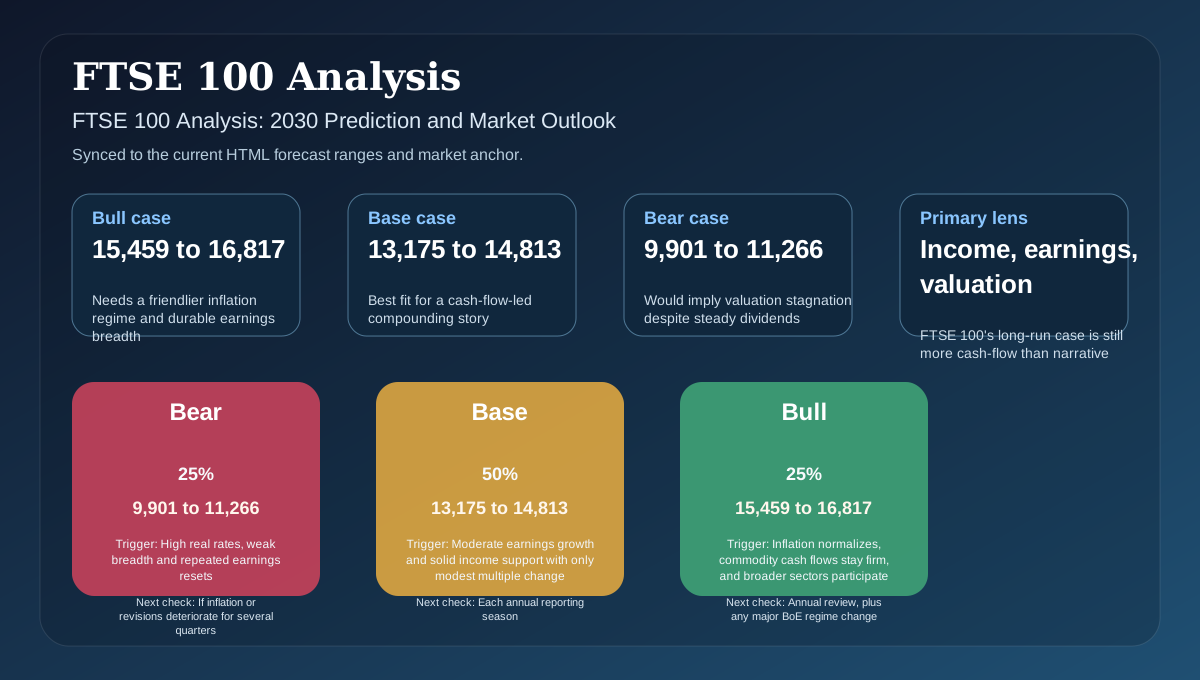
The base case assumes FTSE keeps compounding through earnings, dividends and modest rerating. The bull case assumes both lower inflation and a friendlier global commodity-credit cycle. The bear case assumes the market stays stuck in a low-growth, high-rate valuation regime.
| Scenario | Probability | Working range | Measured trigger | Review window |
|---|---|---|---|---|
| Bull | 25% | 15,459 to 16,817 | Inflation normalizes, commodity cash flows stay firm, and broader sectors participate | Annual review, plus any major BoE regime change |
| Base | 50% | 13,175 to 14,813 | Moderate earnings growth and solid income support with only modest multiple change | Each annual reporting season |
| Bear | 25% | 9,901 to 11,266 | High real rates, weak breadth and repeated earnings resets | If inflation or revisions deteriorate for several quarters |
A 2030 investor should revisit the thesis at least annually and after any major change in the UK inflation regime or energy complex. Those are the variables most likely to shift both earnings and terminal valuation.
The most attractive part of the long-range bull case is not a headline multiple jump. It is that FTSE does not need one to deliver acceptable total returns if cash generation remains intact.
References
Sources
- BlackRock iShares Core FTSE 100 UCITS ETF product page, portfolio characteristics and benchmark level (accessed May 2026)
- Office for National Statistics, Consumer price inflation, UK: March 2026
- Office for National Statistics, GDP monthly estimate, UK: March 2026
- UBS House View, March 2026
- Investing.com summary of UBS FTSE 100 outlook for 2026, published December 2025
- Financial Times historical prices for FTSE 100 Index
- Goldman Sachs Asset Management, Market Monitor, week ending May 1, 2026