01. Historical Context
A 2035 FTSE call is ultimately a thesis on cash generation surviving multiple cycles
Ten-year index forecasts fail when they assume a straight line. For FTSE 100, the better approach is to ask whether the index can keep converting global nominal growth into dividends and earnings even as macro regimes change. The answer is probably yes. The harder question is how much of that gets capitalized into a higher multiple.
| Horizon | What matters most | Current assessment | What would weaken the thesis |
|---|---|---|---|
| 1-3 months | Macro sentiment | Still rate-sensitive | Inflation surprises stay skewed higher |
| 6-18 months | Cycle durability | Supported by global earnings mix | Commodity and bank earnings fade together |
| To 2035 | Cash-flow resilience across cycles | Constructive but cyclical | Capital returns weaken and relative growth stays poor |
Today's starting point is not distressed. BlackRock's FTSE proxy showed 16.73x P/E and 2.31x P/B in late April 2026, while official UK data showed growth still positive and inflation still above target. That mix argues for positive long-run return potential, but not for a blind assumption that the next decade will be easy.
The main strategic attraction is that FTSE 100 does not need U.S.-style growth multiples to work over a long horizon. The main strategic risk is that it can spend long periods looking statistically cheap while other markets command the premium capital.
02. Key Forces
What matters for a ten-year FTSE outlook
The first force is valuation reset risk. Starting at a mid-teens earnings multiple is manageable, but not so cheap that it eliminates cycle risk.
The second force is inflation regime. ONS data still show inflation above target in 2026. A decade with repeated inflation spikes would keep UK discount rates elevated and make long-run compounding bumpier.
The third force is sector durability. If banks, healthcare, energy and industrial names continue to generate cash through different parts of the cycle, FTSE can still deliver respectable long-run returns even without fast top-line growth.
The fourth force is capital discipline. Over a ten-year period, payout policy, buybacks and reinvestment quality matter more than one year's macro noise.
| Factor | Current assessment | Bias | Bullish trigger | Bearish trigger |
|---|---|---|---|---|
| Valuation starting point | Fair, not washed out | Neutral | Mild rerating with better inflation credibility | Repeated de-ratings on macro shocks |
| Income profile | Structural support | Bullish | Capital returns stay durable | Distribution cuts emerge in downturns |
| Macro regime | Still uncertain | Neutral | Lower average inflation and stable real yields | Stop-start inflation keeps capital costs high |
| Sector structure | Cash-generative but cyclical | Neutral | Healthcare, industrials and banks broaden leadership | Index remains hostage to commodities only |
| Relative valuation | Cheaper than U.S. peers | Bullish | Global allocators re-rate UK exposure | Cheapness persists without reallocation |
The fifth force is relative opportunity cost. FTSE can rise in absolute terms and still disappoint if other developed markets keep absorbing the premium capital. That is why the long-run bull case needs both absolute growth and some narrowing of the valuation gap.
03. Countercase
The decade-long bear case is a low-multiple trap
A poor 2035 outcome does not require a deep structural collapse in UK corporates. It only requires the market to stay trapped in a low-excitement equilibrium where inflation periodically resurges, real yields stay demanding and capital keeps flowing elsewhere.
That risk is plausible because current inflation data are still uncomfortable and because FTSE's sector mix can look old-economy in growth-led markets. Even steady earnings may not rescue price performance if the market never believes in a higher terminal valuation.
Another risk is political and regulatory drift. Long-horizon investors cannot ignore tax, energy, financial and listing-rule changes when the index is dominated by sectors that are policy sensitive.
| Risk | Latest data point | Why it matters | What to monitor next |
|---|---|---|---|
| Low-multiple trap | FTSE valuation already rerated from prior troughs | Less starting margin of safety than in earlier years | Relative P/E vs Europe and U.S. |
| Inflation regime volatility | CPI 3.3% and services inflation 4.5% in March 2026 | Repeated inflation shocks damage duration and equity multiples | Medium-term inflation trend and bond yields |
| Commodity dependence | Energy still an outsized earnings driver | Makes decade returns path-dependent | Sector breadth and earnings mix |
| Policy drag | Rate-sensitive UK domestic backdrop remains fragile | Can limit both investment and rerating | Fiscal policy and UK investment trends |
So the real question for 2035 is not whether FTSE survives. It almost certainly does. The question is whether it compounds at a rate that beats the opportunity cost.
04. Institutional Lens
Institutional evidence still favors moderation over heroics
Public institutional research used here does not support a heroic FTSE story. UBS stayed Neutral in March 2026 even after a strong rally. Goldman Sachs Asset Management still showed the UK cheaper than developed peers, but not abandoned. That combination fits a decade thesis built on acceptable compounding rather than explosive rerating.
Official data matter even more over a decade because they tell you whether the macro base is improving or just surviving. For now, the UK is still in the second bucket: positive growth, elevated inflation, and no evidence of a clean, low-rate equilibrium yet.
| Institution / source | Updated | What it says | Why it matters here |
|---|---|---|---|
| UBS House View | March 2026 | Neutral stance despite higher FTSE targets | Long-run upside is not a consensus slam dunk |
| GS Asset Management | May 2, 2026 | UK still screens cheaper than developed Europe and much cheaper than the U.S. | Provides a valuation cushion, not a guarantee |
| ONS | March-April 2026 data | Growth positive, inflation sticky | Explains why the decade case depends on normalization, not just on time |
| FT historical prices | May 8, 2026 | Index around 10,233 after the first move above 10,000 | Sets the starting point for decade scenario ranges |
The most defensible 2035 stance is therefore constructive but unsentimental.
05. Scenarios
Scenario ranges into 2035
These ranges are intentionally wide because a decade includes multiple business cycles, elections and rate regimes. The goal is not false precision; it is to define what evidence would justify a meaningfully higher or lower long-run path.
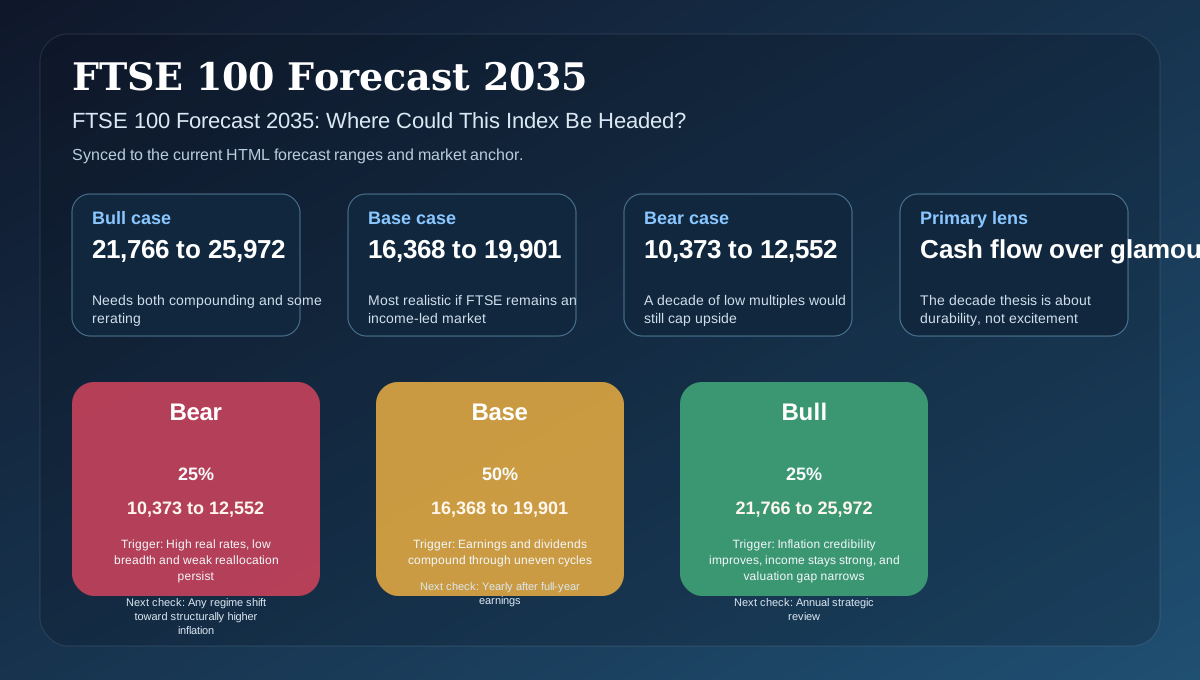
The bull case assumes inflation normalization, stable capital returns and a partial narrowing of the valuation gap to global peers. The base case assumes moderate earnings and dividend compounding with repeated drawdowns. The bear case assumes the market remains a low-multiple allocator's afterthought.
| Scenario | Probability | Working range | Measured trigger | Review window |
|---|---|---|---|---|
| Bull | 25% | 21,766 to 25,972 | Inflation credibility improves, income stays strong, and valuation gap narrows | Annual strategic review |
| Base | 50% | 16,368 to 19,901 | Earnings and dividends compound through uneven cycles | Yearly after full-year earnings |
| Bear | 25% | 10,373 to 12,552 | High real rates, low breadth and weak reallocation persist | Any regime shift toward structurally higher inflation |
For long-horizon investors, the most important review points are not monthly moves. They are shifts in the inflation regime, the sustainability of sector cash flows, and whether capital is re-entering the UK market structurally.
If those three improve together, FTSE can materially exceed the base case. If they do not, the market can spend a decade delivering income but disappointing on capital gains.
References
Sources
- BlackRock iShares Core FTSE 100 UCITS ETF product page, portfolio characteristics and benchmark level (accessed May 2026)
- Office for National Statistics, Consumer price inflation, UK: March 2026
- Office for National Statistics, GDP monthly estimate, UK: March 2026
- UBS House View, March 2026
- Investing.com summary of UBS FTSE 100 outlook for 2026, published December 2025
- Financial Times historical prices for FTSE 100 Index
- Goldman Sachs Asset Management, Market Monitor, week ending May 1, 2026