01. Historical Context
FTSE 100 enters the 2027 window with solid nominal support but less valuation slack
FTSE 100 went through a sharp regime shift between 2022 and early 2026: inflation shock, higher bond yields, a stronger energy complex, then the first leg of rate relief. The index crossed 10,000 for the first time in January 2026 and the Financial Times shows it at 10,233 on May 8, 2026, but that headline strength needs context. UBS still classed UK equities as Neutral in March 2026 and argued that much of the rerating had already happened.
| Horizon | What matters most | Current assessment | What would weaken the thesis |
|---|---|---|---|
| 1-3 months | Oil, banks, sterling and BoE repricing | Supportive earnings mix, but valuation is no longer deeply cheap | CPI stays above 3% and gilts reprice higher again |
| 6-18 months | EPS follow-through and margin resilience | UBS expects earnings growth around 5% in 2026 | Commodity weakness and slower global activity hit cash-flow sectors |
| To 2027 | Can earnings outrun multiple fatigue? | Base case favors range expansion, not a melt-up | Policy easing disappoints while revisions turn negative |
That matters because FTSE 100 is not a pure domestic UK growth benchmark. Earnings remain heavily exposed to global commodities, banks, pharma and multinationals, while sterling, oil and global credit conditions can matter more than a single UK data print. The practical question into 2027 is whether earnings can keep rising fast enough to defend a high-single-digit or low-double-digit index level without another major multiple expansion.
The cleaner way to analyze the next 18 months is to anchor on what is measurable today: valuation, inflation, growth, and the institutional targets already in the market. BlackRock's FTSE 100 proxy showed 16.73x P/E and 2.31x P/B on April 29, 2026. ONS reported CPI at 3.3% in March 2026 and monthly GDP up 0.3% in March, with real GDP up 0.6% on a three-month-on-three-month basis.
02. Key Forces
Five forces that matter most now
The first force is valuation discipline. BlackRock's FTSE 100 proxy stood on 16.73x earnings as of April 29, 2026, while UBS said broader UK equities were already at 14.2x forward P/E on February 25, roughly 15% above their 15-year average. That does not make the market expensive on a U.S. scale, but it does mean 2027 upside probably needs earnings and dividends to do the heavy lifting.
The second force is the UK macro mix. ONS showed CPI at 3.3% in March 2026, core CPI at 3.1%, and services inflation at 4.5%. At the same time, real GDP grew 0.6% over the three months to March. That combination is good enough to avoid a recession call, but not clean enough to guarantee a fast easing cycle or a broad domestic multiple re-rating.
The third force is sector mix. UBS noted that oil and gas contribute about 20% of FTSE 100 earnings, which means energy prices, dollar strength and global industrial demand still matter disproportionately. A firmer commodity tape can lift index earnings quickly, but it also ties the index to macro shocks outside the UK.
The fourth force is income support. Even when price appreciation moderates, FTSE 100's appeal relative to lower-yielding markets improves if cash generation stays intact and rates drift lower rather than higher. That is why the downside case is not simply about GDP; it is about whether inflation stays sticky enough to squeeze valuation and capital return confidence at the same time.
| Factor | Current assessment | Bias | Bullish trigger | Bearish trigger |
|---|---|---|---|---|
| Valuation | 16.73x P/E, 2.31x P/B on BlackRock proxy | Neutral | Earnings growth stays positive while P/E holds above 16x | P/E compresses below 15x as gilt yields rise |
| UK inflation | CPI 3.3%, core CPI 3.1%, services 4.5% in March 2026 | Bearish | CPI trends back toward 2%-2.5% | Services inflation stays above 4% |
| Growth | GDP up 0.6% over the three months to March | Neutral | Monthly GDP stays positive through H2 2026 | Rolling 3-month GDP turns flat to negative |
| Sector mix | Energy and financials still dominate earnings | Neutral | Breadth broadens into industrials and domestic cyclicals | Oil, metals and banks all soften together |
| Institutional stance | UBS is Neutral on UK equities | Neutral | House views turn Attractive and targets are revised higher | Targets get cut despite stable macro data |
The fifth force is breadth. A market that makes new highs while gains stay concentrated in miners, oil majors and a few banks is less robust than a market where industrials, consumer names and domestically exposed sectors also improve. For 2027, breadth is the cleanest confirmation signal that FTSE 100 has moved from rerating to durable earnings leadership.
03. Countercase
What would break the 2027 thesis
The first break point is inflation persistence. If CPI remains near the March 2026 pace of 3.3% and services inflation stays near 4.5%, the market may have to accept a slower path to easier financial conditions. That would matter because a market already above 16x earnings has less tolerance for higher real rates.
The second risk is that the earnings mix becomes a liability instead of a shield. UBS explicitly tied much of the FTSE 100 story to commodity-linked profit recovery. If oil and gas prices fall back sharply or global industrial demand weakens, index-level earnings can soften even if UK domestic data stay merely mediocre rather than recessionary.
Third, the market could simply have moved too far ahead of fundamentals. UBS's 10,500 year-end 2026 base target and 11,300 positive scenario were set with the index already at 10,847 on February 25. That tells you upside existed, but also that the easy rerating phase was not open-ended.
| Risk | Latest data point | Why it matters | What to monitor next |
|---|---|---|---|
| Sticky inflation | UK CPI 3.3%, services inflation 4.5% in March 2026 | Keeps the discount rate higher for longer | Monthly CPI and wage-sensitive services categories |
| Growth rollover | GDP up 0.6% on a 3m/3m basis to March 2026 | FTSE can digest slower growth, not a sharp earnings downdraft | Monthly GDP, retail and industrial production |
| Valuation compression | BlackRock proxy P/E 16.73x, UBS broader UK equities 14.2x forward P/E | Multiple support is thinner than in 2022-2023 | Gilt yields and FTSE relative performance vs Europe |
| Narrow leadership | Oil and gas about 20% of FTSE earnings in UBS work | Single-theme support is fragile | Breadth beyond energy, banks and miners |
A broken thesis would therefore look measurable, not dramatic: inflation fails to cool, GDP loses momentum, energy leadership narrows, and institutional targets stop ratcheting higher.
04. Institutional Lens
What serious institutions are actually saying
UBS's March 2026 House View is the cleanest public institutional anchor for FTSE 100. It kept UK equities at Neutral, used 10,847 as the current index level on February 25, set a December 2026 base target of 10,500, a positive scenario of 11,300 and a negative scenario of 7,200, and said it expected earnings to grow around 5% in 2026. That is constructive on profits but cautious on valuation.
Goldman Sachs Asset Management's Market Monitor, published for the week ending May 1, 2026, adds a useful relative-value lens. It showed FTSE 100 up 5.64% year to date and the UK trading on 13.2x next-12-month P/E in its global valuation chart, below developed Europe at 15.4x and well below the U.S. at 22.0x. That supports the view that FTSE is still cheaper than the U.S., but not automatically cheap in absolute UK terms after the rally.
| Institution / source | Updated | What it says | Why it matters here |
|---|---|---|---|
| UBS House View | March 2026 | Neutral on UK equities; FTSE 100 10,500 base, 11,300 upside, 7,200 downside for Dec. 2026 | Shows the market is no longer treated as a deep-value outlier |
| UBS House View | March 2026 | Expected UK equity earnings growth around 5% in 2026 | Puts profit growth, not rerating, at the center of the base case |
| GS Asset Management | May 2, 2026 | UK on 13.2x next-12-month P/E versus developed Europe at 15.4x | Supports relative-value appeal versus Europe and the U.S. |
| ONS | April-May 2026 releases | CPI 3.3% in March and GDP up 0.6% over the latest three months | Explains why FTSE can rally without a full domestic growth boom |
The institutional takeaway is that FTSE 100 is still investable into 2027, but the bull case now needs a second leg from earnings breadth and macro normalization rather than from simple rerating.
05. Scenarios
Probability-weighted scenarios through 2027
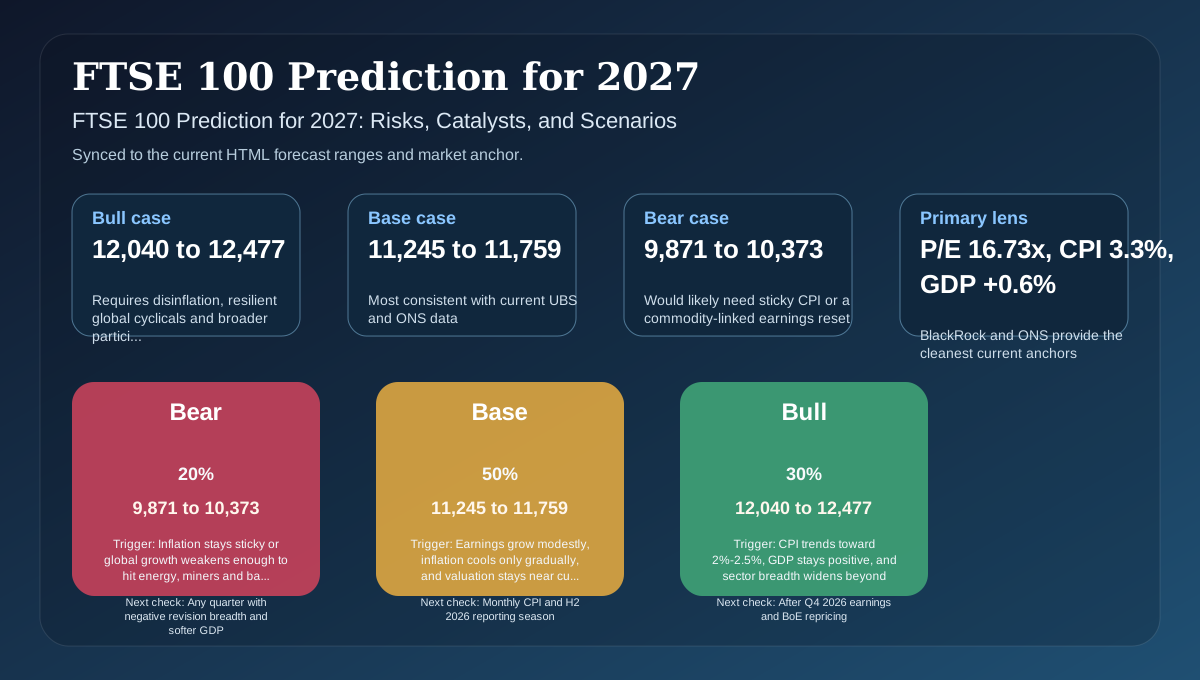
The most useful 2027 framework is not a single target but a probability-weighted map tied to inflation, earnings and breadth. The working ranges below are analytical ranges built from current valuation, institutional 2026 targets and the latest macro data, not claims that any single bank has published these exact 2027 numbers.
The base case assumes inflation cools enough for easier financial conditions but not enough to produce a major multiple expansion. The bull case assumes the energy and banking profit cycle stays firm while domestic breadth improves. The bear case assumes inflation or growth undermines both.
| Scenario | Probability | Working range | Measured trigger | Review window |
|---|---|---|---|---|
| Bull | 30% | 12,040 to 12,477 | CPI trends toward 2%-2.5%, GDP stays positive, and sector breadth widens beyond commodities | After Q4 2026 earnings and BoE repricing |
| Base | 50% | 11,245 to 11,759 | Earnings grow modestly, inflation cools only gradually, and valuation stays near current levels | Monthly CPI and H2 2026 reporting season |
| Bear | 20% | 9,871 to 10,373 | Inflation stays sticky or global growth weakens enough to hit energy, miners and banks together | Any quarter with negative revision breadth and softer GDP |
For investors already up, the key issue is whether FTSE is still compounding through earnings and dividends or simply levitating on positioning. For investors with no position, waiting for either disinflation confirmation or a post-pullback re-entry is still rational.
The thesis deserves a full review after each UK inflation release and again around the 2026 year-end reporting cycle, because that is where the market will decide whether 2027 is a carry story or a genuine earnings-upgrade story.
References
Sources
- BlackRock iShares Core FTSE 100 UCITS ETF product page, portfolio characteristics and benchmark level (accessed May 2026)
- Office for National Statistics, Consumer price inflation, UK: March 2026
- Office for National Statistics, GDP monthly estimate, UK: March 2026
- UBS House View, March 2026
- Investing.com summary of UBS FTSE 100 outlook for 2026, published December 2025
- Financial Times historical prices for FTSE 100 Index
- Goldman Sachs Asset Management, Market Monitor, week ending May 1, 2026