Who Is Brett Berard? Canadiens Call-Up, Scouting Report and Career | Nov. 19
Meet Brett Berard, the Canadiens winger recalled from Laval in November 2026. Explore his path from Providence and the Rangers, strengths and likely role.
Checked: November 18, 2026, 4:58 p.m. Eastern Standard Time (UTC−05:00; 21:58 UTC).
Giant viruses are viruses whose particles or genomes are unusually large by viral standards—large enough that some can be seen with a light microscope and carry DNA genomes spanning more than a million base pairs. The label is informal, however: virologists have not set one universal size cutoff, and some members of the same evolutionary group are much smaller than others. Their size makes them easier to spot and their genomes unusually complex, but it does not make them cells or organisms that can reproduce independently.
The field has changed rapidly since the Mimivirus was recognized in 2003. Recent work has mapped a much broader diversity of giant-virus genomes, while a 2026 study showed that Mimivirus encodes a functional translation-initiation complex that helps direct protein production on the host cell’s ribosomes. That discovery refines the textbook contrast between viruses and cells; it does not erase it. Giant viruses still depend on a host to make more virus particles.
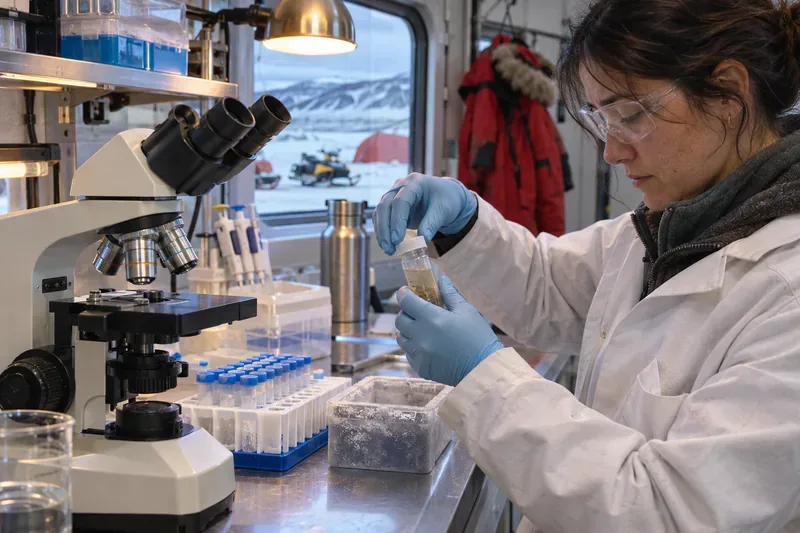
Most viruses are far smaller than bacteria and can only be resolved with an electron microscope. Giant viruses challenge that rule of thumb. Some are several hundred nanometres across, and a few have particles around one micrometre or longer. For comparison, a micrometre is one-thousandth of a millimetre. These particles can be comparable in scale to some small bacteria, although the virus remains a structurally different entity.
The term commonly refers to very large double-stranded DNA viruses in or near the phylum Nucleocytoviricota, especially lineages that infect protists such as amoebae and algae. Taxonomy is still evolving, and scientists use “giant” in more than one way: some apply it to the whole related phylum, while others reserve it for viruses with exceptionally large particles or megabase-scale genomes. That is why a headline calling a virus “giant” does not by itself identify its exact family, host or biological behaviour.
A giant virus still has the basic viral plan: genetic material enclosed in a protective protein shell called a capsid, sometimes with additional membranes or surface structures. The details vary. Mimivirus has an icosahedral capsid and a coat of fibres; Pithovirus has an elongated, barrel-like particle; Pandoravirus particles are also large and oval. Some particles carry internal membranes or complex features that help deliver the genome into a host cell.
The genome is usually double-stranded DNA. In some giant viruses, it spans more than 2.5 million base pairs and encodes hundreds or thousands of proteins. Their genes can include DNA replication and repair proteins, transcription factors, and enzymes or other proteins associated with metabolism. Some lineages also encode tRNAs and components linked to protein synthesis. The range of genes is striking, but the presence of cellular-looking genes does not mean a virus can carry out all the tasks of a living cell.
After a giant virus enters a susceptible host, it often builds a concentrated “viral factory” inside the cell. This compartment organizes genome copying and the assembly of new particles. The host’s resources are redirected toward viral reproduction. In some systems, smaller viruses called virophages can exploit the giant virus’s factory and interfere with its replication, adding another layer to the infection.
The story began with a mistaken identification. A large particle later named Mimivirus was isolated in 1992 from an amoeba found in a cooling tower in Bradford, England. It looked enough like a bacterium under the available tests that researchers called it “Bradford coccus.” A decade later, further analysis showed it was a virus. The 2003 description of Mimivirus—roughly 0.7 to 0.8 micrometres across, with a genome around 1.2 million base pairs—made it clear that the known boundaries of viral size and genetic content were incomplete.
Other discoveries followed, including Marseillevirus, Pandoravirus, Pithovirus and Mollivirus. Researchers have found related viruses in water, soil and hosts such as amoebae and algae. Each new genome has added unexpected genes and evolutionary relationships. A 2026 review in the Journal of Virology describes giant viruses as a broad, changing group rather than a tidy category with a single defining measurement.
“Regular virus” is not a formal scientific category; it usually means the smaller or more familiar viruses people encounter in health reporting, such as influenza virus. The main differences are scale and complexity. Many familiar viruses have genomes measured in thousands or tens of thousands of bases and rely on host enzymes for most copying and gene-expression steps. Giant viruses can have genomes millions of bases long and encode more of the tools needed to copy DNA, regulate genes and build particles.
Even so, giant viruses do not have cells, ribosomes or a self-sustaining metabolism. They cannot grow, make all their proteins, and reproduce without a susceptible host. A notable 2026 study found that Mimivirus carries a functional version of the eukaryotic IF4F translation-initiation complex. It can help select viral messenger RNA for translation, but it works with the host’s ribosomes; the finding does not show that Mimivirus has a complete, independent protein-making system. Giant viruses therefore complicate simple definitions without turning into free-living microbes.
Most well-studied giant viruses infect amoebae or other protists, not people. A peer-reviewed 2024 risk assessment in mSystems found no evidence of a causal link between giant viruses and human disease, and concluded that viruses from thawing permafrost do not currently present a higher or imminent outbreak risk than viruses in other environments. That is a measured assessment, not a claim that every environmental virus has been studied or that surveillance is unnecessary.
Permafrost research is scientifically important for a different reason: it can reveal how long some viruses and their hosts persist, and how microbial communities change as frozen ground thaws. In 2014 and 2015, researchers reported reviving Pithovirus and Mollivirus from roughly 30,000-year-old permafrost samples using amoebae as hosts. A later metagenomic study assembled a giant-virus-like genome from a 42,000-year-old sample, but an assembled genome sequence is not the same thing as reviving an infectious virus. Those distinctions matter when assessing risk. A virus shown to infect an amoeba in a laboratory is not evidence that it infects people.
For Canadian readers, the wider issue is the changing ecology of northern soils, lakes and coastal waters. Giant viruses can influence the abundance and metabolism of their protist hosts, which in turn affects food webs and nutrient cycling. Scientists are still working out how much these viruses shape those systems and how warming, altered water flow and changing host populations may affect them. The evidence supports careful environmental research, not claims that “ancient viruses” are about to trigger a human epidemic.
Some giant-virus particles are large enough to be visible with a light microscope, although electron microscopy is still used to examine their detailed structure.
They are not cells and cannot reproduce independently. They carry out replication only by using a host cell, even though some encode more of the machinery involved than smaller viruses do.
No. Some giant viruses have been revived in laboratory systems using amoebae, but current evidence does not establish that these viruses infect people or cause human disease.
Sources checked: Journal of Virology, “Primer: Giant viruses of protists” (2026); Cell, “Giant DNA viruses encode a hallmark translation initiation complex of eukaryotic life” (2026); npj Viruses, “20 years of research on giant viruses” (2025); Nature Communications, permafrost giant-virus metagenomics (2022); mSystems, “Cooling perspectives on the risk of pathogenic viruses from thawing permafrost” (2024).
Meet Brett Berard, the Canadiens winger recalled from Laval in November 2026. Explore his path from Providence and the Rangers, strengths and likely role.
The Nicolas Cage John Madden biopic is streaming on Prime Video in Canada. Here’s how to find it, what it costs to access, and what early critics and fans are saying.
Brett Berard made his Montreal Canadiens debut against New Jersey on Nov. 18, recording one shot in 5:08 as Montreal rallied for a 3–2 win.
A pregame breakdown of Colorado vs. Utah: records, head-to-head history, scoring rates, power-play edge, injuries and the keys that shaped the Nov. 18 matchup.
Now streaming on Prime Video in Canada, Madden follows John Madden from Raiders coach to broadcaster and video game icon. Here’s the real history behind the film.
Lainey Wilson’s third straight CMA hosting year adds a new chapter to her rise as country music’s awards-night anchor. Here’s how her run compares with CMA history.
Stephen Wilson Jr.’s acclaimed 2025 “Stand By Me” performance is drawing renewed attention after his 2026 CMA New Artist win and duet with Chris Stapleton.
A House of Commons petition seeking U.S. Ambassador Pete Hoekstra’s removal closed with 285,921 validated signatures. Here’s its parliamentary status and next step.
Colorado and Utah meet at Delta Center in their first 2026–27 regular-season matchup. Check the verified game status, key context and what Canadian fans should watch next.
Nicolas Cage’s John Madden biopic began streaming globally on Prime Video Nov. 18. See what Canadian viewers need to know and what the first AP review says.