01. History Setup
Gold 2020–2024: The base that made 2025 possible
The 2025 breakout did not come from nowhere. To understand why gold moved the way it did, you need to track where it had been — and what it endured without breaking down.
The 2020 peak of $2,075/oz (August 2020) was fueled by COVID-era monetary expansion and zero interest rates. When the Fed began hiking aggressively in 2022, many expected gold to collapse. Instead, it consolidated — holding above $1,620 at the 2022 trough and closing 2022 at $1,865. That resilience in the face of the fastest rate-hiking cycle since the 1980s was the first major signal that gold's demand structure had permanently changed.
| Year | Annual avg (USD/oz) | YoY change | Key macro driver |
|---|---|---|---|
| 2020 | $1,773 | +27% | COVID stimulus, zero rates, August ATH $2,075 |
| 2021 | $1,798 | +1% | Economy rebound, inflation rising; gold consolidates |
| 2022 | $1,800 | +0% | Fed +425bps; Russia-Ukraine spike to $2,070 then reversal |
| 2023 | $1,940 | +8% | Banking crisis (SVB), central bank buying record; December ATH $2,147 |
| 2024 | $2,386 | +23% | Fed pivot expectations, geopolitical risk premium, central banks 1,092t |
| 2025 | $3,431 | +44% | 53 new ATHs; demand record 5,002t; ETF inflows 801t |
What stands out in this table is the 2022–2023 period. While the S&P 500 fell 19% in 2022, gold ended approximately flat. While Bitcoin fell 65%, gold held. The Fed Funds rate rose from 0% to 4.25% — normally devastating for non-yielding assets — and gold largely shrugged it off. The reason was structural: central banks had become a permanent, price-insensitive buyer that didn't care about real yields.
| Asset | 2020 | 2021 | 2022 | 2023 | 2024 | 2025 |
|---|---|---|---|---|---|---|
| Gold (XAU/USD) | +27% | +1% | 0% | +13% | +27% | +44% |
| S&P 500 | +18% | +29% | −19% | +26% | +23% | ~+8% |
| USD Index (DXY) | −7% | +7% | +15% | −2% | +7% | ~−5% |
| Bitcoin | +302% | +60% | −65% | +157% | +121% | ~+30% |
Gold's 2022 resilience — flat while equity markets collapsed and crypto fell 65% — established its credibility as a genuine portfolio anchor rather than just a speculative safe-haven trade. That credibility is what attracted the institutional flows of 2024 and 2025.
02. 2025 Rally Drivers
The 2025 rally was powered by four simultaneous engines — a rare confluence
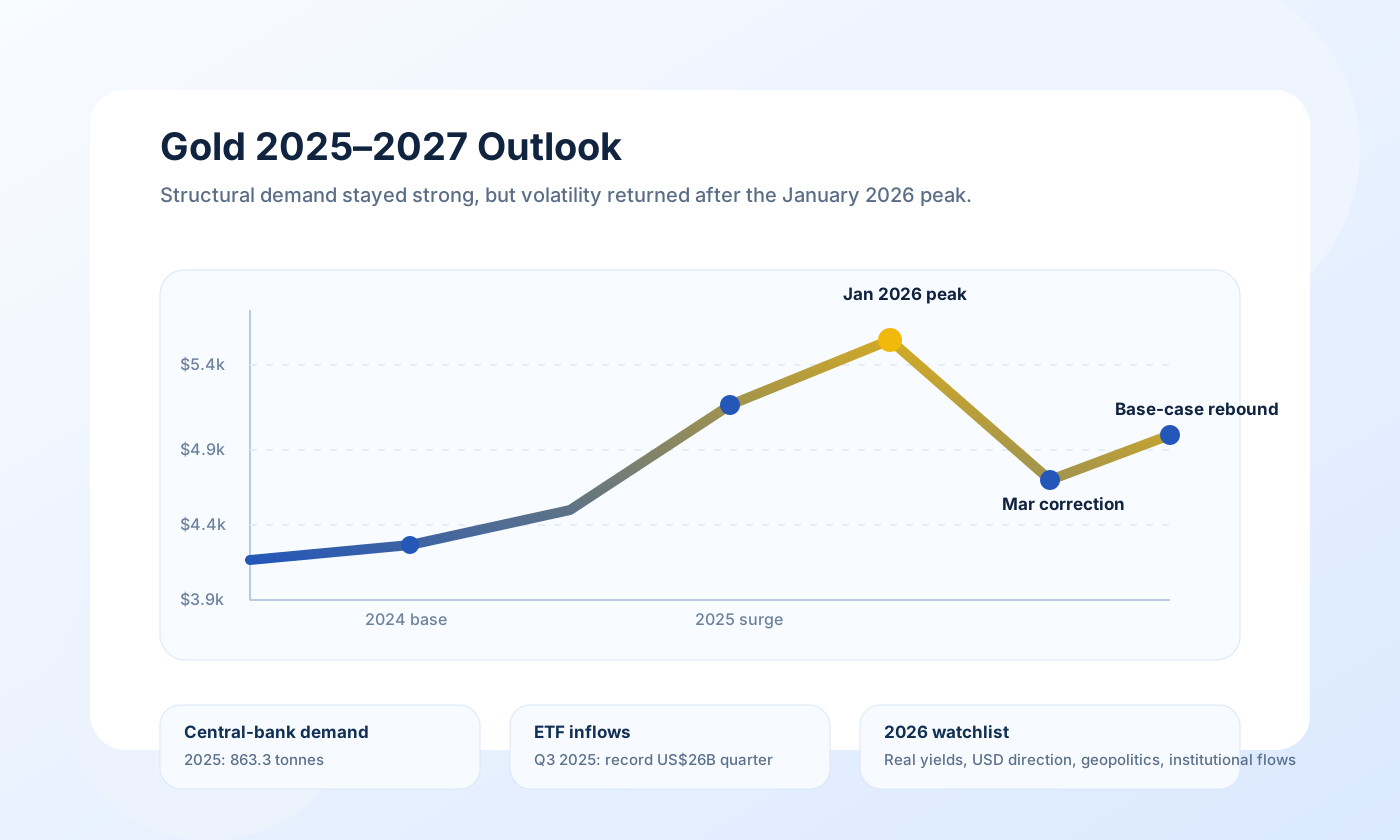
The World Gold Council's Gold Demand Trends: Full Year 2025 report documents record total demand of 5,002 tonnes — the first time in history demand exceeded 5,000 tonnes in a calendar year. What made 2025 different from previous bull runs was not one dominant driver, but the simultaneous activation of multiple buyer categories.
Engine 1: ETF inflows swung from outflow to record inflow
Gold ETFs had been a drag on demand in 2022 and 2023, as rising real yields made bond allocations more attractive. The pivot came in 2024, and by 2025 it had become a flood. Global gold ETF holdings grew by 801 tonnes in full-year 2025 — the second-strongest year in the history of ETF data. Q3 2025 alone saw a record US$24 billion in ETF inflows in a single quarter, with 222 tonnes added in three months. North America led with 346 tonnes year-to-date, followed by Europe at 148 tonnes and Asia at 118 tonnes.
This matters because ETF flows are the most liquid, transparent, and momentum-following segment of the market. When Western institutional capital re-entered gold after a two-year absence, it validated the central-bank buying trend that had been building for years.
Engine 2: Central banks — 16 consecutive years of net buying
Central banks purchased a net 863 tonnes in 2025, the upper end of their expected range. This came after 1,092 tonnes in 2024 and 833 tonnes in 2023. The consistent buyer base includes Poland, China, India, Turkey, and more than 20 other emerging-market central banks diversifying away from dollar-denominated assets. According to the World Gold Council's 2025 Central Bank Survey, 73% of central bank respondents expect the U.S. dollar's share of global reserves to be lower five years from now, and 76% expect gold's share to be higher.
Unlike ETF investors, central banks are not driven by short-term price momentum. They buy structurally, which means they provide a durable price floor that would not have existed in the 2008–2011 or 2018–2020 bull markets.
Engine 3: Political uncertainty and de-dollarization
The Trump administration's tariff policies, announced and partially implemented in early 2025, created sustained uncertainty across currency and equity markets. When the U.S. dollar weakens or when investors question the stability of dollar-denominated reserve assets, gold's bid strengthens internationally — particularly from Asian buyers in China and India whose purchasing power in gold terms increases as the dollar softens. The DXY fell approximately 5% during 2025, providing an additional tailwind to gold priced in non-dollar currencies.
Engine 4: The arithmetic of scarcity
Mine supply growth cannot keep pace with demand. Global gold mine production reached approximately 3,645 tonnes in 2024, a near-record level — but demand at 5,002 tonnes still required drawing down recycling and official sector inventories. No major gold deposit (defined as more than 2 million ounces) was discovered globally in 2023 or 2024. The average time from discovery to production is over 10 years. Mine supply is structurally constrained — and that constraint is becoming more acute as the world's richest deposits are progressively exhausted.
| Demand segment | 2025 volume (tonnes) | Change vs 2024 |
|---|---|---|
| Total investment (incl. OTC) | 2,175 | +84% |
| Gold ETF inflows | 801 | +134% (Q3 alone) |
| Central bank net purchases | 863 | Upper end of expected range |
| Jewellery consumption | ~1,850 | Slightly lower on price sensitivity |
| Technology | ~330 | Stable; AI electronics supporting |
| Total demand | 5,002 | Record annual total |
The 84% jump in investment demand — from bar-and-coin buyers in Asia and ETF buyers in the West — was the most telling single statistic of 2025. It confirms that gold's repricing was not a temporary geopolitical fear trade but a structural re-rating by informed, long-duration capital.
03. Q1 2026: The ATH and the Correction
$5,405 peak, then a 16% correction — what the numbers actually tell us
Gold opened 2026 in a continuation of its 2025 momentum. The World Gold Council recorded an intraperiod high of US$5,405/oz in Q1 2026, with some sources citing intraday prints closer to $5,595. The Q1 return was approximately +6%.
The correction that followed was sharp. By late March 2026, Reuters cited spot prices in the $4,600s. By early February, the price had pulled back briefly to $4,098 before recovering. As of early May 2026, gold was trading around $4,564/oz — approximately 16% below the Q1 peak.
The immediate catalyst for the March correction was the Iran conflict escalation, which initially drove gold lower as oil spiked, the dollar rebounded, and leveraged long positions were forcibly unwound. This is a pattern seen before in gold markets: when geopolitical events shift from "fear premium" to "oil inflation risk," gold can fall even though the same event might have driven it higher at an earlier stage.
| Bull market period | Peak | Worst intra-cycle correction | Outcome |
|---|---|---|---|
| 2008–2011 bull run | $1,920 (Sep 2011) | −34% (late 2008) | Resumed rally; net +166% from 2008 to 2011 peak |
| 2018–2020 bull run | $2,075 (Aug 2020) | −12% (Mar 2020 COVID sell-off) | Recovered within months; new ATH within 5 months |
| 2023–2026 cycle | $5,405 (Q1 2026) | −16% (through May 2026) | Ongoing — watching $4,300 as the key structural level |
Historically, corrections of 12–20% within a structural gold bull market have represented entry points rather than reversals. The critical question is whether the structural demand drivers — central bank buying, ETF flows, de-dollarization — remain intact. Through Q1 2026, the World Gold Council reported that official sector buying and bar-and-coin demand stayed firm, suggesting the price floor is more durable than in a purely speculative-driven market.
04. 2026–2027 Institutional Forecasts
Where the major banks stand — and the conditions that separate the scenarios
When major institutions set gold price targets, they are not just extrapolating trend lines. They are expressing views on Fed policy, the dollar, central bank behavior, and geopolitical risk premium. That is why the current spread of institutional forecasts is so wide — the uncertainty around these variables is unusually high.
| Institution | 2026 year-end target | Key assumption |
|---|---|---|
| J.P. Morgan Global Research | $6,300 | Sustained central bank and investor demand; dollar weakness persists |
| Wells Fargo Investment Institute | $6,100–$6,300 | Structural demand, geopolitical risk premium, ETF continuation |
| UBS | $6,200 (average) | De-dollarization trend; Fed easing probability |
| Goldman Sachs | $5,400 | De-dollarization and private sector diversification; more conservative Fed view |
| Morgan Stanley | $4,800 (average) | Moderate growth, Fed holds rates longer, dollar remains supported |
| Deutsche Bank | $4,500 (average) | Dollar resilience; demand slows after speculative flush |
| HSBC | $4,800 | Most conservative: real yields elevated, risk appetite returns |
The range — from $4,500 to $6,300 — is unusually wide for institutional gold forecasts. This reflects genuine disagreement about whether the current environment is a prolonged structural shift or a cyclical overshoot. J.P. Morgan's $6,300 implies gold adds roughly 38% from current levels by year-end. HSBC's $4,800 implies gold merely recovers its recent loss with limited additional upside.
2027 targets: the longer horizon
For 2027, J.P. Morgan Global Research projects gold averaging $5,200–$5,400/oz. Goldman Sachs sees $5,000. These forecasts imply that even the optimistic banks do not believe gold maintains its 2025-style momentum in 2027 — they see a more gradual upward path, driven by structural demand rather than speculative acceleration.
| Scenario | Indicative range | Conditions required | Probability weight (author estimate) |
|---|---|---|---|
| Bull | $5,400–$6,300+ | Dollar weakens further, Fed cuts 2–3x in H2 2026, ETF inflows resume, geopolitical stress persists, central banks maintain 800t+ pace | 30% |
| Base | $4,700–$5,300 | Central bank buying stays firm (600–700t), investment demand cools but positive, Fed holds or cuts once, dollar neutral | 45% |
| Bear | $4,000–$4,600 | Fed signals rate hike restart, DXY strengthens above 110, risk-on environment reduces safe-haven premium, ETF outflows return | 25% |
The base case reflects the view that gold's structural demand — which did not disappear during the correction — continues to provide a floor well above pre-2025 levels, even if the speculative and fear-premium layers get partially unwound. The bear case requires not just a weaker gold price but an active reversal of the central-bank buying trend, which would be historically unprecedented. The bull case requires macro conditions to realign in gold's favor after the current consolidation phase.
05. Key Variables to Watch Through 2027
Six indicators that will determine which scenario unfolds
Rather than guessing which scenario plays out, the more useful exercise is identifying which data points you should track. Each of the following variables has a direct and well-documented impact on gold prices.
1. U.S. real yields (TIPS market). The 10-year TIPS yield above 1.5% would significantly increase the opportunity cost of holding gold. The current environment shows real yields near post-2015 highs — this is the primary pressure point for gold's short-term price. Watch the TIPS market for any Fed signal shift.
2. DXY direction. Gold and the dollar maintain roughly a −0.5 to −0.7 rolling correlation over 12-month periods. A sustained DXY move above 108–110 would reduce gold's purchasing power for Asian buyers and typically triggers selling. Conversely, a return to DXY below 100 would be strongly supportive.
3. Central bank buying pace. The World Gold Council's Central Bank Survey 2025 projected 585 tonnes per quarter as the 2026 average — roughly 2,340 tonnes per year if maintained. Any signal of reduced official purchases would remove the most durable structural support under the market. IMF COFER data releases quarterly.
4. ETF net flows (monthly). World Gold Council ETF data is published monthly. Sustained net positive flows — even modest ones — signal that the broader institutional community remains constructive. A return to outflows comparable to 2022–2023 would be the clearest tactical warning sign.
5. Geopolitical escalation vs. de-escalation. The current Iran conflict and its impact on energy markets added a "war premium" that cuts both ways: initial fear can drive gold higher, but prolonged conflict with an oil-inflation shock can trigger risk-off selling that hits gold alongside equities. Watch Middle East and Russia-Ukraine developments closely.
6. Gold's $4,300 structural level. This level corresponds approximately to the 200-week moving average and to the 2025 price base before the final Q4 acceleration. If gold sustains a close below $4,300 for multiple weeks, that would represent a material structural break that warrants reassessing the base and bull cases.
| Indicator | Bull signal | Bear signal | May 2026 status |
|---|---|---|---|
| 10Y TIPS yield | <0.5% | >2.0% | Neutral (~1.2%) |
| DXY | <98 | >110 | Neutral (~103) |
| CB quarterly buying | >600t/qtr | <200t/qtr | Watching Q1 2026 data |
| ETF monthly flows | Net +50t/month | Net −50t/month | Neutral/slight positive |
| Price vs $4,300 level | Holding above $4,500 | Close below $4,300 | Watching (~$4,564) |
06. Conclusion
Structural case intact; tactical picture mixed — conditional conviction is the right framework
The 2025 gold rally was not a one-headline trade or a temporary fear spike. It was built on a rare alignment of record ETF inflows, the highest central bank buying in history, geopolitical risk premiums, and a structurally weaker dollar — all occurring simultaneously. That demand architecture has not collapsed in the March–May 2026 correction.
At the same time, the correction is real. Gold has given back 16% from its Q1 2026 peak. Real yields remain elevated. The Fed has signaled limited rate cuts for 2026. These are legitimate headwinds that mean gold needs continued macro validation rather than automatic extrapolation of its 2025 trend.
The institutional consensus — led by J.P. Morgan at $6,300 and Goldman Sachs at $5,400 for year-end 2026 — suggests that the majority of large-capital analysts still see higher gold prices by year-end. But with HSBC at $4,800 and Morgan Stanley at $4,800, there is a credible "range-bound" scenario where gold simply consolidates for most of 2026 before any next move higher.
For any investor evaluating gold exposure, the most important question is not "what is the target price?" It is: "which of the six watchlist variables is moving in which direction?" The answer to that question will be far more predictive than any single price forecast.
References
Primary and high-value sources
- World Gold Council, Gold Demand Trends: Full Year 2025 — primary source for 2025 demand volume, ETF flows, central bank data
- World Gold Council, Gold Outlook 2026 — institutional demand projections and structural drivers
- World Gold Council, Gold Demand Trends: Q1 2026 — Q1 high price, correction data, structural demand update
- World Gold Council, Gold Demand Trends: Q3 2025 — Q3 ETF record $24bn, 222t inflows data
- J.P. Morgan Global Research, Gold price outlook — $6,300 year-end 2026 target and rationale
- GoldSilver.com, Gold Price Forecast 2026–2027: Key Predictions from Top Analysts — institutional target compilation
- World Gold Council, Central Bank Gold Reserves Survey 2025 — 73% expect USD share to fall, 76% expect gold share to rise
- IMF COFER data brief Q2 2025 — USD share at 56.32%, gold share trend data
- World Gold Council, Gold Focus Blog Jan 2026 — mine supply analysis and "peak gold" context
- Fortune, May 4 2026 — current gold spot price reference ($4,564)