01. Historical Context
Gold's five-year bull cycles: does the current one follow the pattern?
Before constructing a 2030 forecast, it is worth examining how gold has moved in previous five-year cycles. The metal does not trend smoothly — it cycles between multi-year consolidations and explosive breakouts. Understanding those patterns helps calibrate how realistic specific 2030 price targets actually are.
| Period | Start price (approx.) | End price (approx.) | 5-year return | Key driver |
|---|---|---|---|---|
| 1999 → 2004 | $252 | $435 | +73% | Dollar weakness, post-dot-com era diversification |
| 2004 → 2009 | $435 | $1,090 | +151% | GFC, liquidity crisis, zero rates, early central bank buying |
| 2009 → 2014 | $1,090 | $1,200 | +10% | Post-GFC recovery, equity bull market; gold consolidates after 2011 peak |
| 2014 → 2019 | $1,200 | $1,480 | +23% | Range-bound; Fed tightening, dollar strength; quiet accumulation |
| 2019 → 2024 | $1,480 | $2,640 | +78% | COVID, zero rates, inflation, Ukraine war, banking crisis, CB buying |
| 2024 → 2029E | $2,640 | $5,000–$10,000? | +89%–+279%? | De-dollarization, fiscal deficits, supply constraints, ETF re-entry |
The 2004–2009 cycle (+151%) and the 2009–2014 period together illustrate an important pattern: gold can produce explosive multi-year returns in response to systemic macro shocks, followed by years of digestion. The 2019–2024 cycle returned 78% on the back of COVID-era stimulus and geopolitical premium. The question for 2024–2030 is whether the structural drivers are more powerful than in any previous cycle — or whether they will fade, triggering a prolonged consolidation.
02. The 5 Structural Forces
Five forces define the credible long-run upside path to 2030
Force 1: Reserve de-dollarization — gradual but persistent
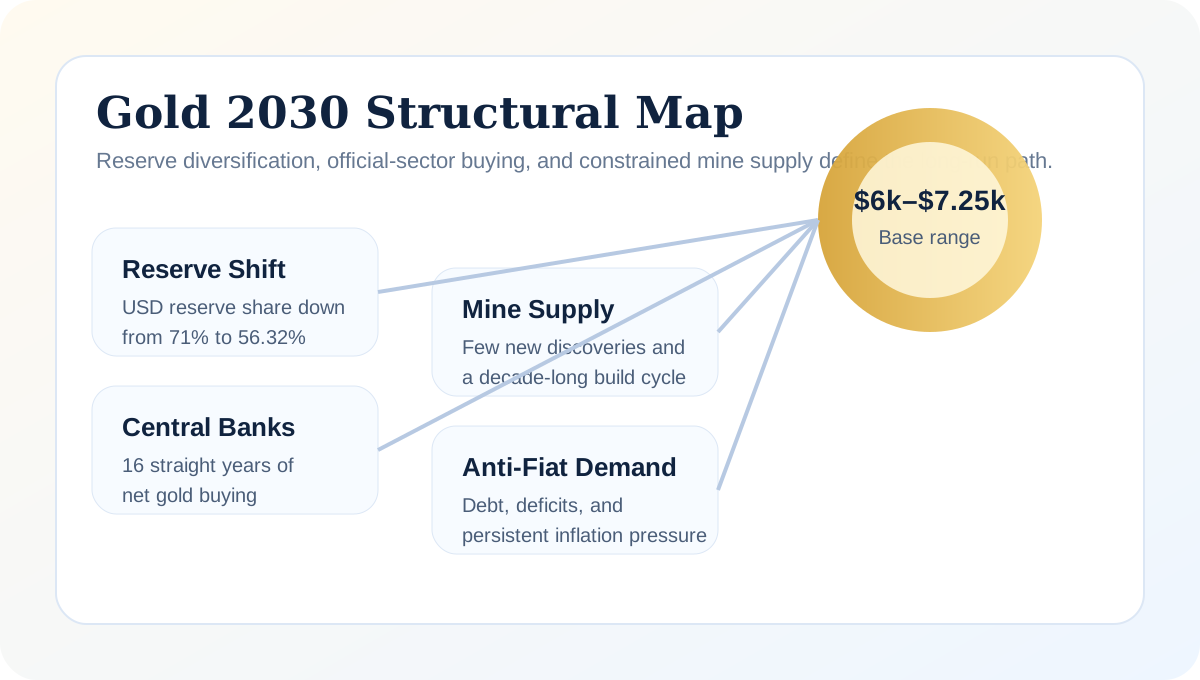
The U.S. dollar's share of global allocated foreign exchange reserves has declined from 71% in 1999 to 56.32% in Q2 2025, according to IMF COFER data. That 15-percentage-point decline over 26 years is not dramatic in annual terms — but it represents a steady structural shift that has been accelerating since 2022, when the U.S. froze Russian sovereign assets, demonstrating that dollar reserves carry a non-trivial geopolitical risk.
The IMF blog on reserve composition notes that even after adjusting for exchange rate valuation effects, the dollar's "fundamental" share is declining. The World Gold Council's Central Bank Gold Reserves Survey 2025 found that 73% of central bank respondents expect the USD's share of global reserves to be lower in five years, and 76% expect gold's share to be higher. These are the actual decision-makers who set reserve policy — their stated intentions carry direct market implications.
If the USD share declines to approximately 50% by 2030 (consistent with its current trajectory), and if even half of the displaced allocation goes to gold rather than euros, yuan, or other currencies, the resulting demand would be structurally bullish for gold for the entire period.
Force 2: Central bank buying — 16+ consecutive years, above historical norms
Central banks have been net buyers of gold every year since 2010 — a 16-year streak with no parallel in modern monetary history. The recent pace has been extraordinary:
| Year | Net central bank purchases (tonnes) | Context |
|---|---|---|
| 2021 | ~450t | Post-COVID reserve rebuilding |
| 2022 | ~1,136t | Record year; Ukraine war; dollar-reserve concerns |
| 2023 | 833t | Second highest on record; broad EM participation |
| 2024 | 1,092t | Second-highest year ever; China, India, Poland leading |
| 2025 | 863t | Upper end of expected range; 43% of CBs plan to increase reserves |
The World Gold Council's 2025 survey found that 43% of central bank respondents planned to increase their own institution's gold reserves in the next 12 months — up from 29% in the prior year. At current pace, central banks alone represent a structural bid of 800–1,100 tonnes per year through 2030. This is a fundamentally different demand floor than anything that existed before 2022.
Force 3: Mine supply constraints — no fast solution
Global gold mine production reached 3,645 tonnes in 2024 — near a record — but at a price level of $2,386 per ounce. The 2025 average price was $3,431, a 44% increase. Standard supply theory would predict a production response. But gold mining does not work that way.
No major gold deposit (more than 2 million ounces) was discovered globally in 2023 or 2024. The average time from major discovery to first production is over 10 years. All-in sustaining costs (AISC) hit a record $1,438/oz in Q4 2024 — up 8% year over year — meaning margins are healthy but not generating transformative new investment. World Gold Council analysis published in January 2026 suggests global mined gold production is likely to gradually plateau rather than surge in response to price increases, constrained by declining ore grades, regulatory hurdles, water access restrictions, and the absence of new tier-1 discoveries.
If demand stays at 4,500–5,000 tonnes per year and supply plateaus at 3,600–3,700 tonnes, the structural gap widens — and that gap must be filled by recycling, official sector selling, or inventory drawdowns. None of these is inexhaustible.
Force 4: Fiscal pressure and the anti-fiat case
U.S. federal debt has surpassed $36 trillion as of 2025, with the Congressional Budget Office projecting continued trillion-dollar-plus deficits. The U.S. debt-to-GDP ratio exceeds 120%. The fiscal trajectory across most developed economies (Japan, UK, France, Italy) is similarly stressed. M2 money supply has grown by approximately 40% since 2019 globally.
Gold has historically been used as a hedge against monetary debasement. The relationship is not mechanical — gold can underperform during periods of high real yields even when nominal deficits are high. But if the combination of rising debt, continued stimulus, and structurally higher inflation expectations persists through 2030, the anti-fiat bid for gold becomes a durable rather than a temporary argument.
Ed Yardeni of Yardeni Research — who correctly called gold's 2025 move — explicitly cites this as the "debasement trade" that could push gold to $10,000 by 2029-2030. His argument is not momentum extrapolation; it is a thesis about the inherent instability of fiscal trajectories in major economies.
Force 5: Broadening buyer base — new categories of institutional gold demand
The traditional Western institutional gold buyer — macro hedge funds, ETF investors, inflation-focused asset allocators — returned aggressively in 2024–2025. But new buyer categories are emerging that were not structural forces in prior cycles:
- China has permitted insurance companies to allocate up to 1% of assets under management to gold — a market that represents trillions in potential flows even at modest allocation rates.
- Sovereign wealth funds in the Gulf and Southeast Asia have increased gold as a share of diversified allocations.
- Retail gold bar and coin demand in Asia — particularly from younger buyers in China, India, and Vietnam — has been structurally rising as a generational savings behavior.
- AI-related infrastructure investment indirectly supports gold via electronics demand; gold's irreplaceable role in high-reliability connectors and circuit boards creates a low but stable technology demand floor.
These buyer categories are not replacing traditional demand — they are adding to it. And unlike speculative ETF flows, many of these new buyers are accumulating without a clear price target to sell at, which means they do not provide the same selling pressure that speculative holders do in corrections.
03. Bear Case
Four conditions that would break the long-run thesis
A credible gold bear case for 2030 is not "gold is overvalued." It is a specific scenario in which multiple structural forces reverse simultaneously. Here are the four most serious risks:
1. A durable productivity boom driven by AI. If artificial intelligence produces genuine, measurable total factor productivity growth of 1.5–2.0% per year (far above historical norms), real economic growth could rise sharply. This would raise real interest rates, strengthen the dollar, and reduce the attractiveness of gold as an anti-fiat hedge. HSBC's bear case of $3,950 is built partly on this scenario — where the "technology deflation" argument overwhelms the monetary debasement argument. This is a real risk, though current evidence suggests AI productivity gains are concentrated in specific sectors rather than broadly realized across the economy.
2. A U.S. fiscal consolidation that restores confidence in the dollar. If a U.S. administration undertook a credible multi-year deficit reduction plan — significantly cutting spending and/or raising taxes — the market's confidence in the long-run value of dollar-denominated assets would strengthen. This would reduce the de-dollarization rationale and reduce gold's anti-fiat premium. Historically this has happened (the 1990s Clinton surplus era saw gold languish at $260–$400). It requires significant political will — which currently appears absent — but is not impossible.
3. A geopolitical de-escalation that eliminates the risk premium. If the Ukraine conflict resolved and Middle East tensions subsided dramatically, the geopolitical risk premium embedded in gold's current price — estimated at $200–$400/oz — could be removed relatively quickly. This alone would not push gold below $4,000, but combined with Fed tightening or dollar strength, it could produce a material bear case.
4. Central banks become net sellers. This is the most extreme bear scenario. It has happened before — the Washington Agreement on Gold (1999–2009) involved European central banks systematically selling hundreds of tonnes per year and contributed to gold's suppression below $400 for years. If EM central banks that have been aggressive buyers (China, Russia, Turkey, India) were to reverse course — perhaps in response to a domestic financial crisis requiring dollar liquidity — the structural demand floor would erode rapidly. Currently there is no evidence this is occurring, but it is a risk that investors must monitor through IMF official reserve data.
| Condition | Current status | Probability of occurring (author estimate) |
|---|---|---|
| AI productivity boom → real GDP growth 3%+/year | Not yet evident in macro data | 15% |
| U.S. achieves sustained fiscal surplus / credible consolidation | No current policy path | 10% |
| Major geopolitical de-escalation (Russia-Ukraine + Middle East) | Active conflicts; low near-term probability | 20% |
| Central banks become net sellers | No current evidence; 43% plan to increase | 5% |
| All four conditions simultaneously | Very low | <5% |
04. Institutional 2030 Forecasts
What the major institutions and analysts are projecting — and why the range is so wide
The wide dispersion in 2030 gold forecasts is not random noise — it reflects deeply different assumptions about Fed policy, dollar trajectory, AI-driven productivity, and geopolitical trajectories. No institution can claim special knowledge about these variables four years out. The forecasts are best interpreted as probability-weighted scenarios, not precise targets.
| Source | 2030 target / range | Underlying thesis | Bias |
|---|---|---|---|
| Ed Yardeni Research | $10,000 by end-2029 | "Debasement trade" — fiscal deficits + de-dollarization accelerate; gold is "physical Bitcoin" | Aggressive bull |
| Bank of America | $8,000+ (extreme demand scenario) | CB demand + ETF re-entry + supply constraints compound through decade | Bull |
| J.P. Morgan Global Research | $6,000 by 2028 (implied ~$6,500+ by 2030) | De-dollarization + CB buying structural; easing cycle continues | Moderately bull |
| Goldman Sachs | $5,000–$5,400 (medium-term) | Demand structural but moderate rate environment; no dramatic acceleration | Constructive |
| LiteFinance / statistical models | $8,000–$9,600 | Technical trend extrapolation + structural factors | Bull (model-based) |
| HSBC | $3,950 (bear scenario) | Dollar strength + real yield normalization + productivity boom | Bear outlier |
The most noteworthy element of this table is the absence of a major institution projecting a price significantly below current levels ($4,500–$5,000) as a base case for 2030. Even HSBC's explicit bear case of $3,950 is below current prices but not a catastrophic collapse — it implies gold holds most of its 2020–2025 gains. This institutional consensus that gold has re-rated upward on a structural basis is itself a significant data point.
05. 2030 Scenarios
Three conditional price ranges — with explicit criteria for each
Rather than a single price target, the more useful framework is a set of conditional scenarios with clearly defined criteria. If you track the criteria, you can update your view as the data evolves.
| Scenario | 2030 price range | Required conditions | Supporting institutions |
|---|---|---|---|
| Bull | $8,000–$10,000 | De-dollarization accelerates (USD below 50% of reserves), CB buying maintains 800t+/year through 2028, Fed cumulative easing 200bps+ by 2028, geopolitical fragmentation continues, no productivity boom. U.S. debt exceeds 130% GDP with no credible consolidation plan. | Ed Yardeni Research, Bank of America (extreme case), LiteFinance models |
| Base | $6,000–$7,250 | Current structural trends persist at moderate pace: CB buying 500–700t/year, ETF flows mildly positive, real yields stay below 1.5%, dollar range-bound, no dramatic macro regime break. Gold compounds at 7–10% per year from current ~$4,500 levels. | J.P. Morgan implied trajectory, Goldman Sachs (extended), Wells Fargo |
| Bear | $3,500–$4,500 | USD strengthens significantly (DXY 115+), real yields rise to 2%+, AI productivity boom reduces deficit pressure, geopolitical de-escalation removes war premium, CB buying slows to pre-2022 pace of 400–500t/year. | HSBC bear scenario (most explicit); Deutsche Bank downside |
The base case — gold at $6,000–$7,250 by 2030 — implies an annualized return of approximately 5–8% per year from current prices near $4,500. That would represent gold continuing to outperform its long-run historical average of roughly 3% real return, but doing so less dramatically than in 2024–2025. It requires no specific catalyst — just the continuation of the trends already in place.
The bull case requires active acceleration of structural forces, particularly de-dollarization and CB buying. The bear case requires a genuine regime shift — not just a correction, but a fundamental change in why central banks and institutions hold gold. Given current policy trajectories, the base case appears more likely than either extreme, but the distribution of outcomes is genuinely wide.
Author's assessment
Based on current data — the IMF's own documentation of declining dollar reserve share, the 16-year central bank buying streak, the structural supply constraints, and the broadening buyer base — the base case appears better supported than either the aggressive bull or the HSBC bear. The primary risk is not that the structural thesis is wrong, but that financial repression (deliberately suppressed real yields) creates periods of significant volatility that test investors' holding discipline before the long-term trend reasserts itself.
Gold at $8,000–$10,000 by 2030 is possible but requires explicit, measurable conditions to materialize. Investors should watch the IMF COFER data quarterly, WGC central bank survey annually, and TIPS yields as the three most leading indicators for the 2030 scenario path.
References
Sources
- IMF COFER data brief Q2 2025 — USD share 56.32%, reserve composition data
- IMF blog on reserve composition — adjusted for FX valuation effects
- World Gold Council, Full Year 2025 — demand data, central bank purchases 863t
- World Gold Council, Central Bank Gold Reserves Survey 2025 — 73% expect USD share to fall; 43% plan to increase gold holdings
- World Gold Council, Gold Focus Jan 2026 — mine supply plateau analysis, ore grade decline, no new major discoveries
- J.P. Morgan Global Research gold outlook — targets and structural demand thesis
- Benzinga, Ed Yardeni $5,000 (2026) and $10,000 (by 2030) forecast — debasement trade thesis
- Fortune, Oct 2025 — "at this rate gold could soar to $10,000" — debasement and de-dollarization analysis
- Spargold — Goldman Sachs & Yardeni 2030 forecast comparison
- U.S. Joint Economic Committee — federal debt and deficit trajectory data